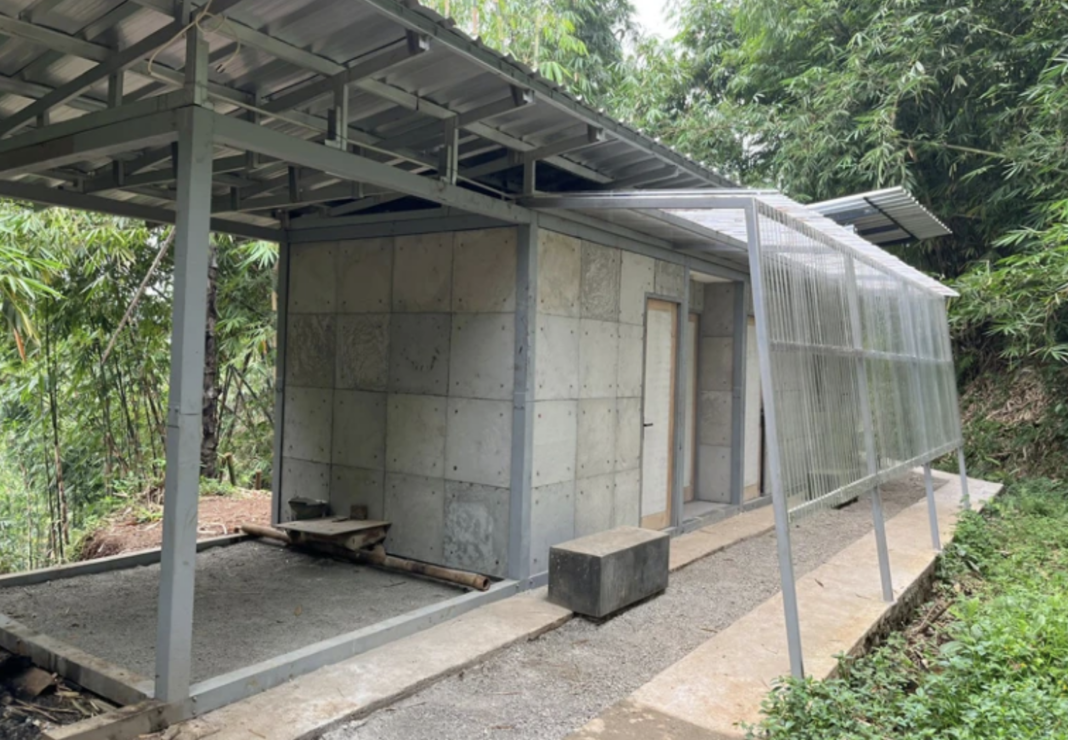


A tiny house was built using recycled baby diapers and concrete showing this novel recycled material mix can replace up to 40% of the sand used in concrete without reducing its strength, according to a new study by researchers at the University of Kitakyushu in Japan.
The team published a study in Scientific Reports about their findings and say that it could be used to create low-cost housing for low-income countries.
A small, tiny house was built in Indonesia to demonstrate how the material works, using a concrete mix which diverts 1.7 cubic metres of diaper waste from going to landfill. Plastic bottles, tires, essentially Earthships (how to build one here) made from waste –– are all ways to divert garbage from going to landfill. This latest idea integrates a common household nuisance – diapers.
The downside to the new building material is that diapers decrease compressive strength in the building, so columns and beams would require a smaller proportion of the diaper waste than do architectural elements, such as walls.


As for being a practical solution, unfortunately, “there’s no supporting system in the municipal waste management to separate diapers”, notes civil engineer Siswanti Zuraida, who led the project in Indonesia.

Municipalities in countries like Canada have the ability to separate diaper waste from compost and other household waste so trying further pilots in Canada might be worthwhile.


The Japanese researchers in this study were trying to solve two environmental problems together: disposable diapers used both for babies and an increasing elderly population in countries like Japan are a growing source of non-recyclable waste, and cement production is responsible for almost 7% of global greenhouse-gas emissions, while consuming 50 billion tonnes of sand each year.
The diaper-concrete house in Indonesia demonstrates how this type of waste could be used for building housing in lower and middle-income communities. But better ideas using vernacular building techniques are out there: trailblazers like Bill and Athena Steen in Arizona have shown in an endless number of projects in Mexico that local, vernacular architecture can replace concrete altogether, and provide passive air conditioning and heating. Their solution uses natural strawbale building, adobe and earthen plaster that breathes.
The late and alternative builder Nader Khalili from Iran used superadobe methods (basically sand in bags, skipping concrete altogether), to build homes that nurture the human psyche, with caverns made to be soft and organic (like people), without modern sharp, square edges.
And Egypt’s Hassan Fathy nurtured the vernacular with his development of New Gourna for Egypt’s poor. As we see in Saudi Arabia it wasn’t that long ago when kings lived in mud houses – see the House of Saud’s ancestral mud house.
But modern architects love concrete; they are addicted to it, despite its toll on the planet. Indonesia, home to creative bamboo architects that gave birth to the Bali Green School, can surely come up with a better idea than more concrete.

Siswanti Zuraida, a civil engineer at the University of Kitakyushu, began putting the project together while lecturing at the Bandung Science Technology Institute near Jakarta. Populations in Indonesia’s low- and middle-income brackets are growing, along with more babies, more diapers and more demands for low-cost housing.
“It’s all about the resource availability,” says Zuraida. “With the growth of the population, the diaper waste will also grow. It’s challenging, so we thought that this would be a part of our contribution to recycling this waste.”
Single-use diapers are made from wood pulp, cotton and super-absorbent polymers, small amounts of which have been shown to improve the mechanical properties of concrete. With funding from a Jakarta-based waste-management company called Awina, Zuraida set out to determine how much sand could be swapped for shredded nappies to create useful concrete and mortar.