
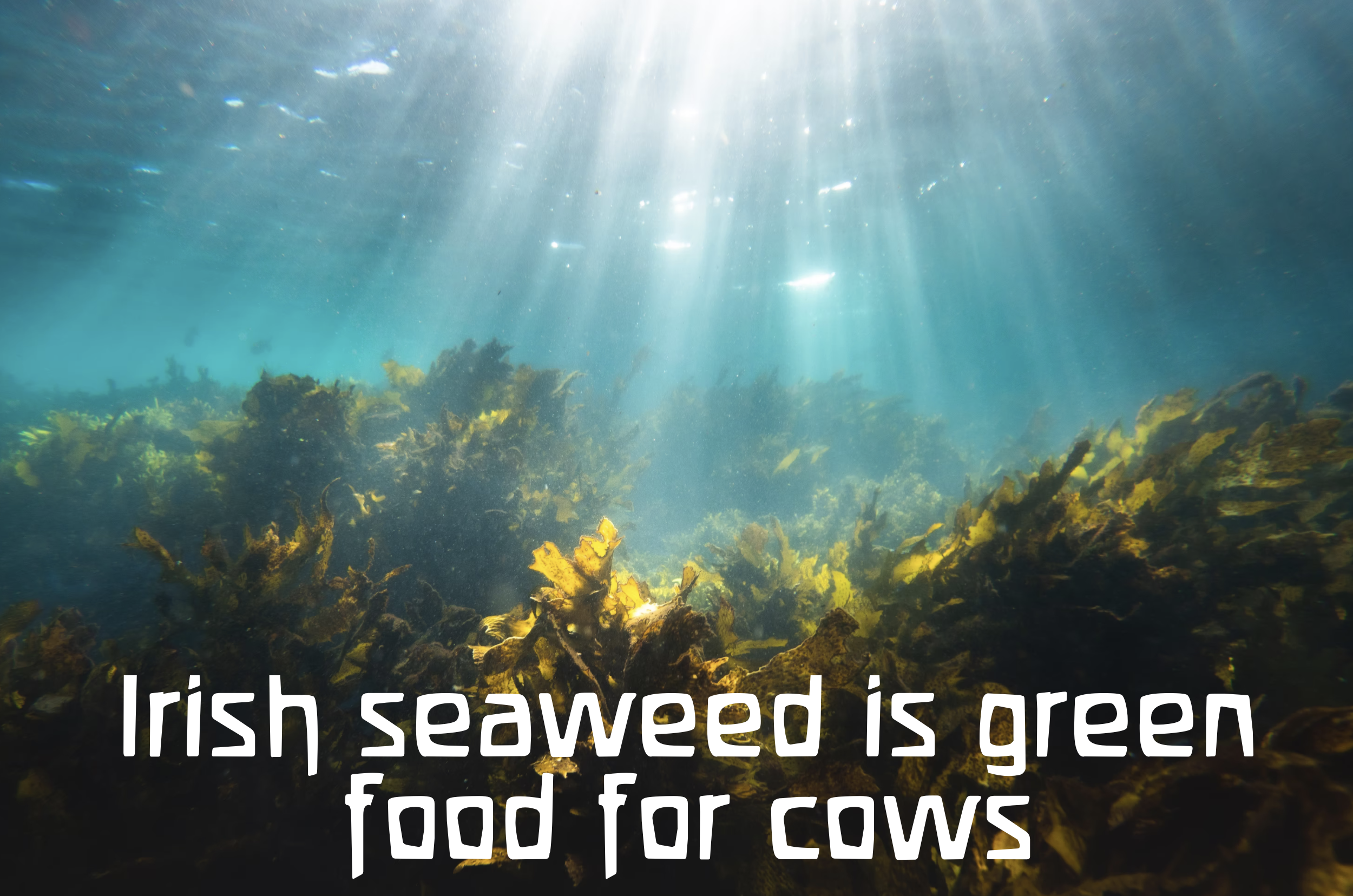
The Irish will feed their cows seaweed, for the earth

As COP26 politicians continue to debate methane – with the US And EU having pledged to reduce agricultural methane outputs from ruminant livestock by upwards of 30% by 2030 – scientists at Queen’s University Belfast are to feed seaweed to farm animals in a bid to slash methane by at least 30%.

Seaweed has long been hailed a ‘superfood’ for humans but adding it to animal feed to reduce methane gas released into the atmosphere by ruminants’ burping and flatulence is a relatively new idea. Early laboratory research at Queens has shown promising results using native Irish and UK seaweeds.

Previous research in Australia and the USA generated headline results – up to 80% reductions in methane emissions from cattle given supplements from a red seaweed variety. These red seaweeds grow abundantly in warmer climates; however, they also contain high levels of bromoform – known to be damaging to the ozone layer. Seaweed indigenous to the UK and Ireland tends to be brown or green and does not contain bromoform.

UK and Irish seaweeds are also rich in active compounds called phlorotannins, found in red wine and berries, which are anti-bacterial and improve immunity so could have additional health benefits for animals.

Now the science is moving into the field, with trials on UK farms about to begin, using seaweed sourced from the Irish and North Seas as a feed supplement for cattle.

One 3-year project is in partnership with the UK supermarket Morrisons and its network of British beef farmers who will facilitate farm trials. The project also includes the Agrifood and Biosciences Institute (AFBI), in Northern Ireland, as a partner.

A second project sees to monitor the effects of seaweed in the diet of pasture-based livestock. Seaweed will be added to grass-based silage on farm trials involving dairy cows from early 2022.

As well as assessing methane emissions of the beef and dairy cattle, these projects will assess the nutritional value of a variety of homegrown seaweeds, their effects on animal productivity and meat quality.

Scientist Sharon Huws, Professor of Animal Science and Microbiology within the School of Biological Sciences, said she expected the combined research to evidence a reduction in GHG emissions of at least 30%.

She said: “The science is there. It’s simply a matter of providing the necessary data and then implementing it. Using seaweed is a natural, sustainable way of reducing emissions and has great potential to be scaled up. There is no reason why we can’t be farming seaweed – this would also protect the biodiversity of our shorelines.

Agriculture accounts for around 10% of all UK GHG emissions. Within this, beef farming is the most carbon-intensive, with methane, which cows produce as they digest, a major component. Methane accounts for almost a quarter of GHG emissions, with 80% of that from agriculture.

Morrisons supermarket plans to be completely supplied by net-zero-carbon British farms by 2030. Sophie Throup, Head of Agriculture at Morrisons said: “As British farming’s biggest customer, we’re very mindful of our role in supporting and inspiring the farmers we work with to help them achieve goals in sustainable farming.

“By supporting this research at Queen’s and AFBI, we are trialling this natural approach to reducing environmental emissions and improving the quality of beef products.


Karin Kloosterman
Karin Kloostermanhttp://www.greenprophet.com
Karin Kloosterman is an award-winning journalist, innovation strategist, and founder of Green Prophet, one of the Middle East’s pioneering sustainability platforms. She has ranked in the Top 10 of Verizon innovation competitions, participated in NASA-linked challenges, and spoken worldwide on climate, food security, and future resilience. With an IoT technology patent, features in Canada’s National Post, and leadership inside teams building next-generation agricultural and planetary systems — including Mars-farming concepts — Karin operates at the intersection of storytelling, science, and systems change. She doesn’t report on the future – she helps design it. Reach out directly to [email protected]

Read More

TRENDING

Hydrophilis rebreather, an interview with Oliver Isler

A retired Swiss biology teacher has built one of...

A Quantum Kaddish? What fungal networks teach us about grief, God and death

Can Zar speak with her recently departed mother into...

Econcrete makes built coastlines richer in marine life with new investment

    A decade ago, we met Shimrit Perkol-Finkel in a...

Desalination experts debunk Aqua Solaire, the floating desalination barge

AI makes it easy to dream, develop, and create images of what could be world-changing ideas, until the reality sets in. A new project making the rounds is Aqua Solaire, an allged French concept for a solar-powered desalination vessel designed to bring drinking water to coastal communities facing drought, storms, and infrastructure failures.

Exploring Bangkok by electric bike with teenagers

With two teenagers in tow and four nights to spare, we decided to give Thailand’s capital the attention it deserved. My son had one request: he wanted to rent electric bikes. A friend of his had explored Japan this way, and he was convinced Bangkok would be just as exciting.

How to quiet noise from construction in your office

Streets need to be resurfaced in New York but the humming and grinding noise is unsettling. Noise is environmental pollution. 

EarthX and a blueprint for sustainable investing

Trammell S. Crow, a Dallas-based businessman and father of four, is focusing his efforts on impact investing, and media that focuses on saving the planet through EarthX.

Mining Afghanistan’s Mineral Discoveries Similar to Avatar

Now that American forces in Afghanistan are commemorating the longest period of any war that America has been involved in, including the 1965-73 Vietnam War, the recent discoveries of large and extremely valuable mineral and metal deposits may finally bring to light a reason to continue the presence of US fighting forces in this war torn and backward country.

From Pilot Plant to Global Stage: How Aduro Clean Technologies’ 2026 Expansion Signals a Turning Point for Chemical Recycling Investors Like Yazan Al Homsi

The company's Next Generation Process (NGP) Pilot Plant in London, Ontario, has officially moved into initial operating campaigns, generating the kind of structured, repeatable data that separates laboratory promise from commercial viability.

Nobul’s Regan McGee on Shareholder Value: “Complacency Is the Silent Killer” 

Why the governance framework designed to protect shareholders so...

Should You Invest in the Private Market?

startustartup Unlike public stock exchanges, which offer daily trading, strict...

How to build a 100-year-company

Kongō Gumi is a Japanese construction company, purportedly founded in 578 A.D., making it the world's oldest documented company. What can we learn about building sustainable businesses from them?

How AI Helps SaaS Companies Reduce Repetitive Customer Support Work

SaaS products are designed for large numbers of users with different levels of experience, and also in renewable energy.

Popular Categories