
Saudi Arabia to grow world’s largest crescent-shaped Garden of Eden

 King-Abdullah-International-GardensSaudi Arabia is building the world’s largest botanical gardens on nearly 2.5 million square meters of desert land near Riyadh. A stellar environmental initiative to educate the public on climate change, or a tourism-boosting novelty? However you dice it, it’s amazing. 

The enormous facility – five times larger than the UK’s Eden Project – focuses on the history of local plants in the Arabian Peninsula, then peers forward to a more sustainable future (it will use renewable energy for power and plant irrigation).

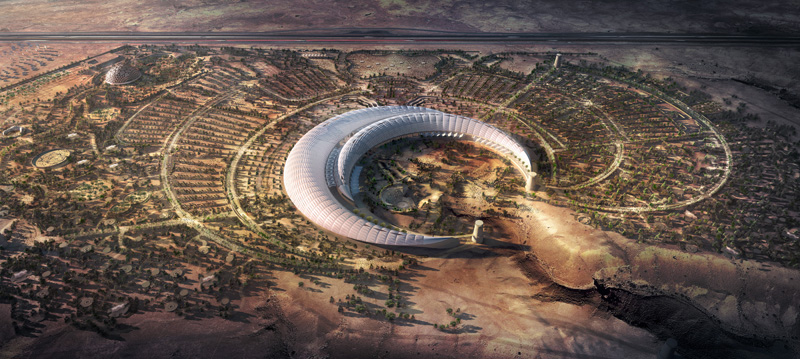
King Abdullah International Gardens (KAIG) is an enormous desert park; 150 hectares of the 160 hectare site will be planted with indigenous species, mostly contained within two giant domes – crescent-shaped structures that resemble a swirling galaxy.

Appropriate imagery for gardens that look back to the origins of life on earth – KAIG will contain a detailed time line that portrays the great paleobotanical ages that have swept across the region.
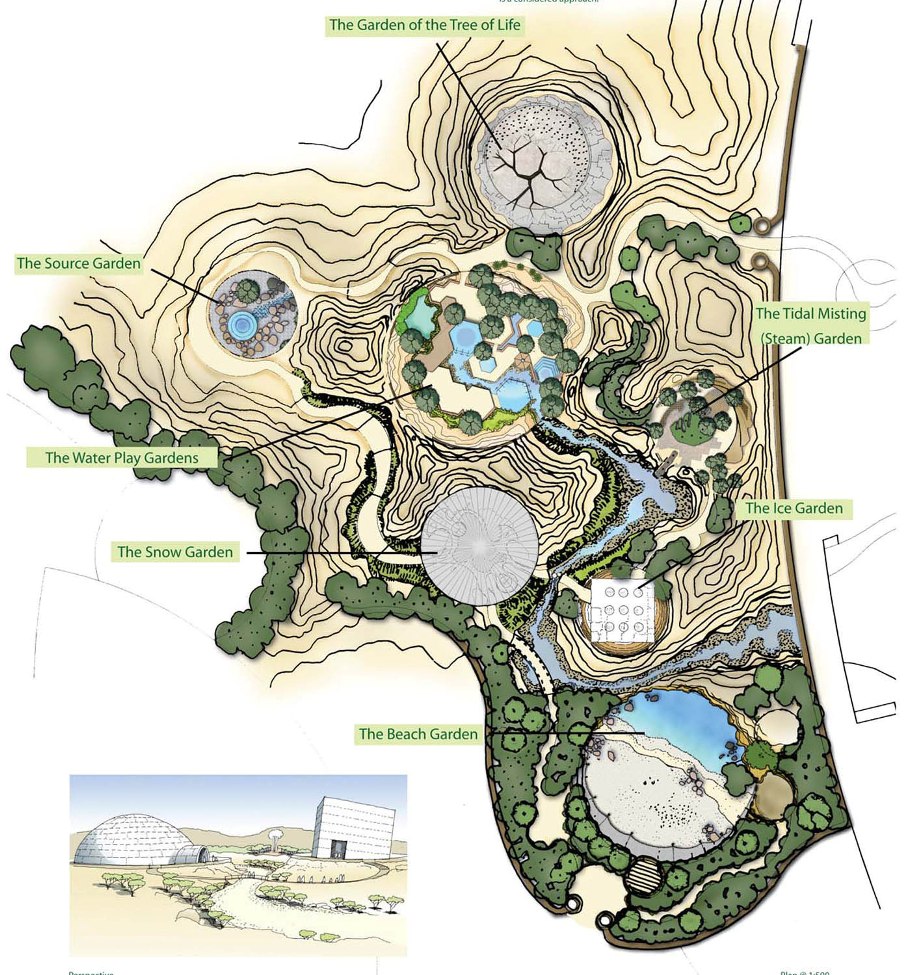
King Abdullah International GardensSiteworks began in 2008. The final project includes several botanical gardens, split in two sections. One will display historical plant evolution in the Arabian Peninsula, including a museum of animals contemporary with those times. This section will be fully contained under the domes.

An open-air section will contain indigenous plants current to today, a desert park, rock gardens, and a garden featuring different styles of landscaping from across the world.

The project also includes a flower garden, a physics garden, geological park, and separate sections for birds, fish, butterflies and reptiles.

Irrigation will use 100% recycled greywater obtained by treated sewage effluent generated on site.  Renewable energy will fully power the place, 93% of the landscaping materials will be sourced from the original site (soil, rock, stone, gravel, soil), and waste will be recycled.

Visitor and worker transport will be restricted to electric vehicles charged from the on-site solar array.
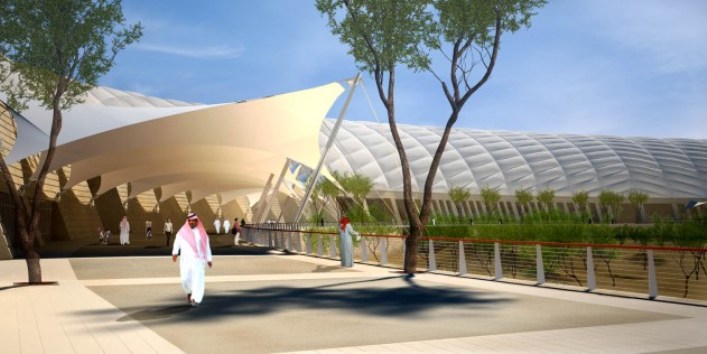
Barton-Willmore-King-Abdullah-GardensDesigned by UK-based planning and design consultants Barton Willmore, KAIG aims to become a world-leader in the study of climate change. Emphasis has been placed on special parks for children where they can interact with different environmental ecosystems.

While the project will include research institutes,  it also houses a water park, theater, restaurants, mosques, camping areas, gift shops, and…a snow park?

A stellar environmental initiative or a tourism-boosting novelty? Like I said, however you dice it, it’s amazing.

Images of KAIG from Barton Willmore

Read More

2 COMMENTS

LEAVE A REPLY

Please enter your comment!
Please enter your name here

TRENDING

Desalination experts debunk Aqua Solaire, the floating desalination barge

AI makes it easy to dream, develop, and create images of what could be world-changing ideas, until the reality sets in. A new project making the rounds is Aqua Solaire, an allged French concept for a solar-powered desalination vessel designed to bring drinking water to coastal communities facing drought, storms, and infrastructure failures.

Baby teeth read like tree rings paint a picture of toxins in early life

A new study from the Icahn School of Medicine at Mount Sinai in New York offers a striking insight into how the environments we are born into can quietly shape our brains years later. By analyzing naturally shed baby teeth, the ones tucked under pillows for the tooth fairy, researchers have reconstructed a detailed timeline of exposure to environmental metals during pregnancy and early infancy.

Shebara hotel Saudi Arabia – is it eco-luxury dream or desert illusion?

A new breed of luxury has landed on the Red Sea, mirrored pods floating above coral reefs, reflecting sky and sea like something not entirely of this Earth. Energy powered by solar powers, drinking water pulled from the sea using desalination. 

When peace returns, will we rediscover Saudi Arabia’s mud-brick soul?

When the region settles after the American war with Iran, and it will, American and European travelers will come back. Not just for spectacle or headline projects, but for places that feel real. Places that haven’t been engineered to impress and which get into your soul. We predict that visitors to Saudi Arabia will want to see places like Rijal Alma.When the region settles after the American war with Iran, and it will, American and European travelers will come back. Not just for spectacle or headline projects, but for places that feel real. Places that haven’t been engineered to impress and which get into your soul. We predict that visitors to Saudi Arabia will want to see places like Rijal Alma.

Nearly the half the world’s migratory species are declining, in new UN report for COP15

With larger, land-bound animals human encroachment and Middle East warns make it more troubling for the survival of migratory animals on land, air and at sea. A new United Nations report released this week warns that the situation is getting worse, not better.

How to quiet noise from construction in your office

Streets need to be resurfaced in New York but the humming and grinding noise is unsettling. Noise is environmental pollution. 

EarthX and a blueprint for sustainable investing

Trammell S. Crow, a Dallas-based businessman and father of four, is focusing his efforts on impact investing, and media that focuses on saving the planet through EarthX.

Mining Afghanistan’s Mineral Discoveries Similar to Avatar

Now that American forces in Afghanistan are commemorating the longest period of any war that America has been involved in, including the 1965-73 Vietnam War, the recent discoveries of large and extremely valuable mineral and metal deposits may finally bring to light a reason to continue the presence of US fighting forces in this war torn and backward country.

From Pilot Plant to Global Stage: How Aduro Clean Technologies’ 2026 Expansion Signals a Turning Point for Chemical Recycling Investors Like Yazan Al Homsi

The company's Next Generation Process (NGP) Pilot Plant in London, Ontario, has officially moved into initial operating campaigns, generating the kind of structured, repeatable data that separates laboratory promise from commercial viability.

Nobul’s Regan McGee on Shareholder Value: “Complacency Is the Silent Killer” 

Why the governance framework designed to protect shareholders so...

Should You Invest in the Private Market?

startustartup Unlike public stock exchanges, which offer daily trading, strict...

How to build a 100-year-company

Kongō Gumi is a Japanese construction company, purportedly founded in 578 A.D., making it the world's oldest documented company. What can we learn about building sustainable businesses from them?

How AI Helps SaaS Companies Reduce Repetitive Customer Support Work

SaaS products are designed for large numbers of users with different levels of experience, and also in renewable energy.

Popular Categories