
Bees Trained to Detect Cancer and TB on Human Breath

Susana Soares, Bee Sniffers, bees trained to detect cancer, glass cancer-detecting device, bees detect cancer on human breath, Pavlov's reflex for bees, sniffer bees, bees trained to detect disease, Dutch Design WeekIt turns out that bees are not only essential to global food production, they also make amazing sniffer “dogs.” Which is how Portuguese designer Susana Soares is able to train Apis mellifera to detect cancer and tuberculosis on human breath.

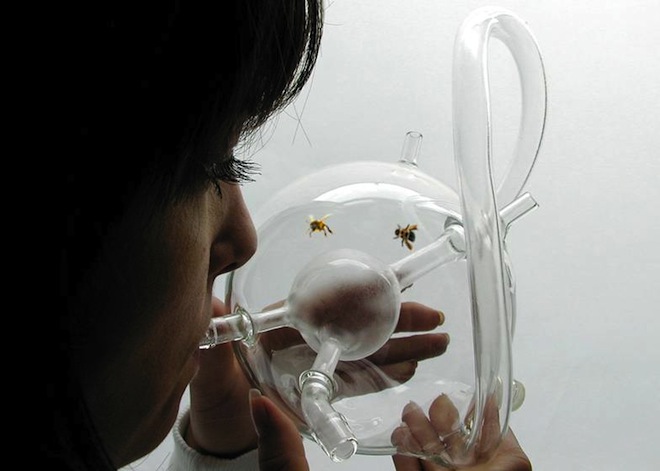
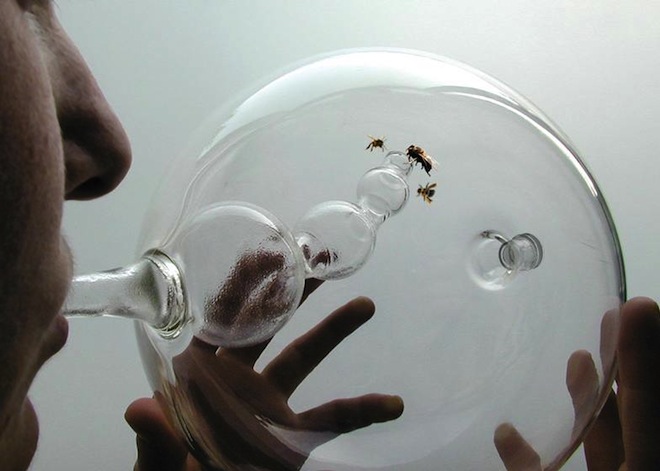
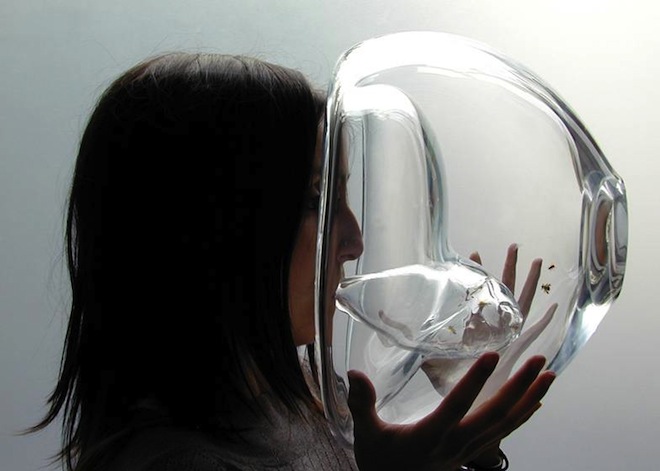
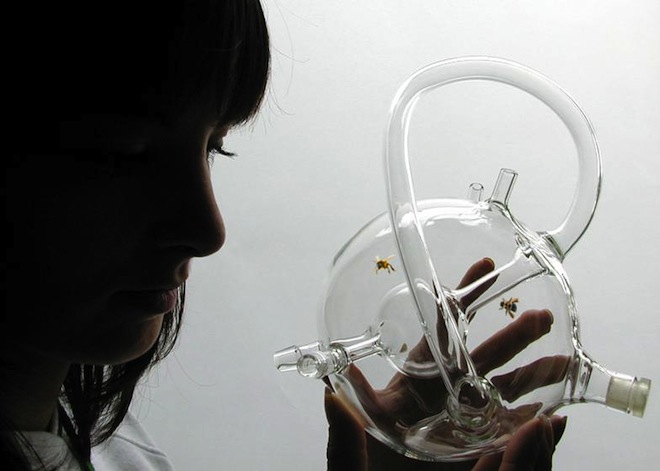
Soares recently presented a glass bowl or horn-like device with a mouth piece and two chambers at Dutch Design Week in Eindhoven.

Men and women exhale into the glass horn and bees, which have been trained to detect odors associated with certain diseases such as various kinds of cancer and tuberculosis, quickly dart from the primary chamber into the secondary chamber if the odor appears.
Susana Soares, Bee Sniffers, bees trained to detect cancer, glass cancer-detecting device, bees detect cancer on human breath, Pavlov's reflex for bees, sniffer bees, bees trained to detect disease, Dutch Design Week

These bees have been trained with Pavlov’s reflex within a mere 10 seconds. Presented with the biomarkers associated with lung, skin or pancreatic cancer, along with a serving of sugar, they “remember” this odor for as long as they live – up to six weeks or so.

During the cancer test, they are rewarded with sugar every time the odor shows up, ensuring a reliable, early disease diagnosis.

“These insects are very accurate in early medical diagnosis through detection on a person’s breath,” according to the designer. “Bees are a sustainable and valuable resource. After performing the diagnose [sic] in the clinic they are released, returning to their beehive.”
Susana Soares, Bee Sniffers, bees trained to detect cancer, glass cancer-detecting device, bees detect cancer on human breath, Pavlov's reflex for bees, sniffer bees, bees trained to detect disease, Dutch Design Week

With an extraordinary sense of smell in the parts per million range, bees have been used in other applications as well – including those formerly reserved for hound dogs.

“Bees have also been trained to detect explosives,” according to Dezeen, “and a company called Insectinel is training “sniffer bees” to work in counter-terrorist operations.”
Susana Soares, Bee Sniffers, bees trained to detect cancer, glass cancer-detecting device, bees detect cancer on human breath, Pavlov's reflex for bees, sniffer bees, bees trained to detect disease, Dutch Design Week

This is a fascinating and groundbreaking design, which could have enormous consequences for the medical community, particularly in areas where health care services are scarce.

“There’s plenty of interest in the project especially from charities and further applications as a cost effective early detection of illness, specifically in developing countries,” Soares said.

:: Dezeen
Tafline Laylin
Tafline Laylinhttp://www.greenprophet.com
As a tour leader who led “eco-friendly” camping trips throughout North America, Tafline soon realized that she was instead leaving behind a trail of gas fumes, plastic bottles and Pringles. In fact, wherever she traveled – whether it was Viet Nam or South Africa or England – it became clear how inefficiently the mandate to re-think our consumer culture is reaching the general public. Born in Iran, raised in South Africa and the United States, she currently splits her time between Africa and the Middle East. Tafline can be reached at tafline (at) greenprophet (dot) com.

Read More

4 COMMENTS

Comments are closed.

TRENDING

Sustainability That Sells: How Profit and Purpose Come Together in the Hive

Whether you are a commercial grower, hobbyist beekeeper or retail equipment supplier, this system opens a new income stream with minimal environmental impact.

Honey gummies from the Land of Milk and Honey

A new gummy made with honey.

Bees for Peace in Israel uses biodynamic beekeeping to sweeten hearts

Israel is a global hotspot for plant and animal diversity. Bees as pollinators are crucial, biodynamic beekeeping, which sees the hive as one organism, growing in practice.

The bees of Azerbaijan go hightech

A feature on who is leading beekeeping and honey production in Azerbaijan.

Is eating honeycomb good for you?

This review of existing studies on eating beeswax or honeycomb showed an antimicrobic effect of beeswax against Staphylococcus aureus, Salmonella enterica, Candida albicans and Aspergillus niger: "these inhibitory effects are enhanced synergistically with other natural products such as honey or olive oil."

How to quiet noise from construction in your office

Streets need to be resurfaced in New York but the humming and grinding noise is unsettling. Noise is environmental pollution. 

EarthX and a blueprint for sustainable investing

Trammell S. Crow, a Dallas-based businessman and father of four, is focusing his efforts on impact investing, and media that focuses on saving the planet through EarthX.

Mining Afghanistan’s Mineral Discoveries Similar to Avatar

Now that American forces in Afghanistan are commemorating the longest period of any war that America has been involved in, including the 1965-73 Vietnam War, the recent discoveries of large and extremely valuable mineral and metal deposits may finally bring to light a reason to continue the presence of US fighting forces in this war torn and backward country.

From Pilot Plant to Global Stage: How Aduro Clean Technologies’ 2026 Expansion Signals a Turning Point for Chemical Recycling Investors Like Yazan Al Homsi

The company's Next Generation Process (NGP) Pilot Plant in London, Ontario, has officially moved into initial operating campaigns, generating the kind of structured, repeatable data that separates laboratory promise from commercial viability.

Nobul’s Regan McGee on Shareholder Value: “Complacency Is the Silent Killer” 

Why the governance framework designed to protect shareholders so...

Should You Invest in the Private Market?

startustartup Unlike public stock exchanges, which offer daily trading, strict...

How to build a 100-year-company

Kongō Gumi is a Japanese construction company, purportedly founded in 578 A.D., making it the world's oldest documented company. What can we learn about building sustainable businesses from them?

How AI Helps SaaS Companies Reduce Repetitive Customer Support Work

SaaS products are designed for large numbers of users with different levels of experience, and also in renewable energy.

Popular Categories