

Hurricane Sandy bulldozed my home coastline with a ferocity rarely seen outside the big screen. It ploughed through lives of friends and family, shredding homes, floating cars, and drowning pets. We can debate the causes of climate change, but the increasingly damaging effect of extreme weather upon basic civil services is indisputable.
In a crisis, communication is paramount. Instant info exchange minimizes fallout and saves lives. So how long does an unjuiced laptop or cell phone last? Are you prepared to power them up if you lose access to the grid? Hurricane Sandy stranded my son for three days in his Hoboken apartment without water or electricity. His lifeline through the world storming outside was only as strong as his remaining phone charge. That’s a lot to hang on a simple battery.
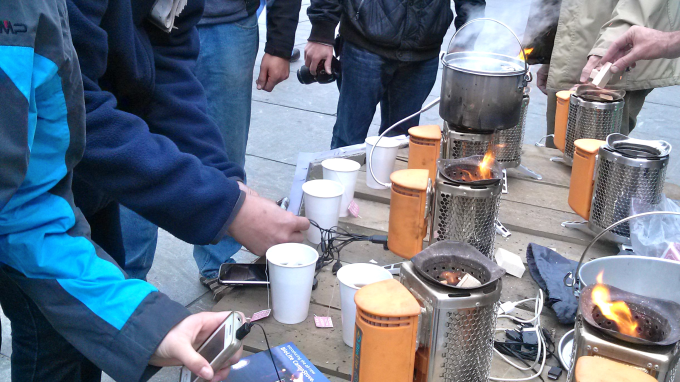
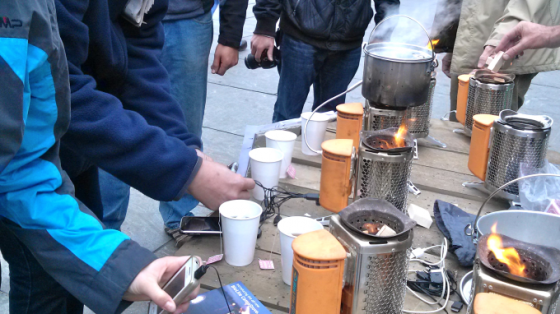
Here in Jordan, I’d been looking for ways to get involved with Syrian refugee camps: so it was surreal to see news footage of a product I’d identified for refugee aid put into action in New York City. In Sandy’s wake, with Manhattan de-powered and personal communication gadgets running out of steam, engineers from the BioLite company took to the streets to set up impromptu charging stations fueled by their tiny cookstoves. They loaded the units onto portable tables and offered people a chance to recharge their cell phones, served up with free cups of tea. It restored lifelines for a handful of lucky Manhattanites in a simple, accessible and environmentally positive way.
Green Prophet’s reported that nearly half the world’s population cooks on open fires, which kill nearly two million people every year, with disastrous impact to local environments. That shocking statistic got me looking into portable cookstoves.
Most cater primarily to outdoor recreation, but the traits that make them attractive to campers also make them perfect for emergency relief: lightweight, portable, and affordable. Among many on the market, the best are multifunctional. The BioLite HomeStove will brew your coffee and charge your smartphone when there’s no access to a power grid.
Designed by Jonathan Cedar and Alec Drummond, the small wood-burning stoves are as clean and safe as gas or electrical units. Use hardwood fuel like maple, oak, or hickory for a longer burn; softer woods like fir or pine require more feeding. During full burn, it can boil a liter of water in as little as 4.5 minutes.
The design reduces over 95% of the smoke typically generated by wood fires and produces sufficient electricity to charge any device that uses a USB port (e.g., mobile phones, LED flashlights, rechargeable battery packs). Charging times will vary by device, by the fire’s strength and other variables like outside temperature. For an Apple iPhone 4S (2G), 20 minutes of charging with a strong fire can provide you with 60 minutes of talk time.
A small internal fan creates airflow, which, combined with a unique fuel chamber, creates a high efficiency fire. A power module converts the fire’s heat into electricity and automatically recharges the lithium ion battery powering the fan. Surplus electricity powers a USB outlet which, in turn, can charge small electronics.
After field trials on four continents, BioLite is currently working with Columbia University’s Mailman School of Public Health on a study to determine how advanced cookstoves can improve the health of pregnant women and children in developing nations. Pilot programs are planned for Ghana, India and Kenya.
Stoves ship internationally and start at $129: check with your local customs office for details on import fees. Knock wood you’ll never need it, but burn wood if you do. This could be the smartest addition to your emergency bag of tricks.
:: BioLite




The story’s about a wood burning stove – and it’s application to folks who are affected by downed systems. It’s not about weather patterns.
I do believe Climate Change is real – and own up to the story title reflecting my P.O.V – but the story’s about a stove.
Apologies for a title that confused. No need to argue about content that doesn’t exist.
hehe, yep, you’ll hold your ground even though the title is incredibly misleading. Don’t let the facts get in the way of the story.
Climate change has nothing to do with the devastation, and building in an area that can be hit by the ravages of nature does.
If you wanted to be truthful and actually report with the facts in mind you would not have mentioned climate change and made the story title reflect the fact that the civil services are not up to the task when a hurricane hits a place like New York.
And given that we are in a period of very low hurricane activity, imagine how it will be when they DO actually begin to increase, as they are sure to eventually.
Actually it’s you that have a “climate change”bias as there was no need to refer to that at all. Just state the facts and leave it at that. There was no need for that snide remark on Peter either,as I said state the facts and leave the personal remarks out of it. You must know the current controversy on this issue,so I question why that point was mentioned in the story at all.
Sorry, Peter, but will hold my ground on this.
The article makes mo claims regarding climate change or the trending of severe weather – it’s about a stove that can be used to power small electrical devices. No “scare story” in sight.
That opening line points out how our built environment (basic civil services like transport, power and built infratructures) is proving incompatible with extreme weather. Extreme weather here refers to hurricanes, heavy precip., etc.
I pin it on aging infrastructure and rapid urbanization. Reference Hurricane Sandy’s destruction to old coastal roads and bridges, mass transit systems such as PATH, and the power distribution grid in the NYC/NJ metropolitan area. Look to rapid urbanization with resultant loss of permeable surfaces: in the greater Dublin region last year, not-atypical rainfall caused record-busting flooding, washing out roads, floodign shopping centers, closing portions of the city for a week. Just two weather events I have personal experience in.
So long as we continue to build in places we ought not be building in, and defer weather-defensive-improvements to things already built, we’ll continue to see large scale weather-related losses.
Clearly you have a climate change bias: you read things into this article that just don’t exist.
“but the increasingly damaging effect of extreme weather upon basic civil services is indisputable.”
Actually its very disputable indeed. The fact of the matter is that no long term record of extreme weather events shows any upward trend at all during the period of human industrialization, making rather a nonsense of this claim. The world, and in particular the USA, is in the midst of the LEAST active period for hurricanes in recorded history -7 years and counting since a real hurricane made landfall in the US. Similar trends are evident with tornadoes (last year notwithstanding), droughts and floods.
The only thing that is increasing is insurance claims, but that has nothing to do with increasing extreme weather (because its not happening) and everything to do with our increased wealth, and predilection for building in risky situations.
Not that I expect you to let the facts get in the way of a good scare story.