
Apple Admits Dropping EPEAT Eco Standard Was a Mistake

muslim women hijab apple computer

Apple product releases are  delayed in the Mideast shortening the supported product life in this part of the world. Apple also practices planned obsolescence.

In an open letter to customers, Apple’s senior VP of hardware engineering admitted that it was a mistake to remove Apple products from the EPEAT environmental rating system. He writes:”We’ve recently heard from many loyal Apple customers who were disappointed to learn that we had removed our products from the EPEAT rating system. I recognize that this was a mistake. Starting today, all eligible Apple products are back on EPEAT.”

The Electronic Product and Environmental Assessment Tool (EPEAT) is a voluntary environmental rating system for electronic products.  It was developed in 2003 as a collaborative effort between business, government and academic interests and helps define and measure such parameters as energy consumption, use of toxic materials, greenhouse gas emission, recycling efficiency and serviceability.

When Apple suddenly removed all of its iPhones, iPads and Macbooks from the EPEAT registry, it was the equivalent of an architectural firm suddenly saying it would would no longer look at LEED, BREEAM, Estidama or GSAS green building standards.  It went beyond mystifying, it was just plain stupid.  This isn’t just a green opinion, it was an immediate threat to Apple’s bottom line. When Apple dropped EPEAT, certain government agencies including the city of San Francisco and large companies such as Ford would stop buying Apple products.

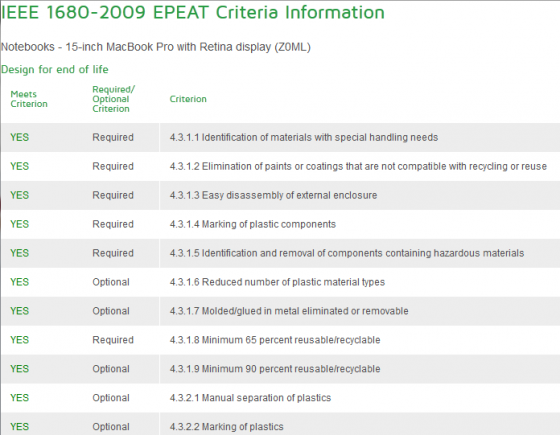
Now that Apple has reversed its decision, anyone can search the EPEAT website and see some of the criteria which helped the 15 inch MacBook Pro earn a ‘Gold’ rating:
lego man fixing apple battery

Retina Display MacBooks “Designed for End of Life”

Apple gets 5 out of 5 points here but they were right about one thing, EPEAT doesn’t tell the whole green story.  Notice particularly criteria 4-3.1.3 Easy disassembly of external enclosure and 4.3.1.7 Molded/glued in metal eliminated or removable.

According to the experienced technicians at iFixit, the 2012 Macbook’s Pro’s display and battery are glued into the aluminum case rendering it virtually unfixable.  You can forget about replacing or upgrading the RAM or hard drive too.

The RAM is soldered to the motherboard and the hard drive does not use an industry standard SATA connector.  Notice also that iPods, iPads and  iPhones do not appear on the EPEAT website.  The current generation are even less serviceable than the MacBooks.
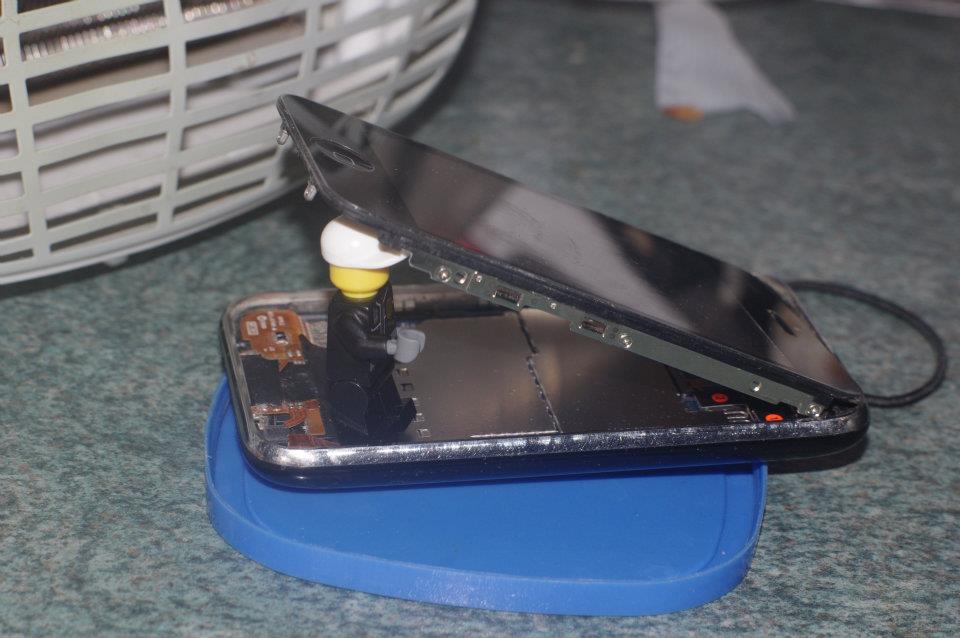
lego man fixing apple batteryRemember when batteries were replaceable?

Apple knows how to design serviceable products.  Last night I repaired the loose antenna inside my wife’s iPhone 3G using only a screwdriver, a suction cup and a bit of sticky tape.  My thirteen-year-old Apple Powerbook’s DVD drive, hard drive, RAM, battery, keyboard and individual keys can be replaced without any special tools.

Some lithium batteries only last about 300 charge cycles, less than a year of daily use.  So it is conceivable that my 1999 Powerbook will outlive these 2012 MacBooks.  Except that Apple recently obsoleted it with their iCloud service.  Software upgrades and cloud services should extend a device’s life, but Apple found a way for them to do the opposite.  Apple product releases are often delayed in the Mideast further shortening the supported product life in this part of the world.

Can a greenwashable standard keep my iDevice out of the iLandfill?

Apple topped Fortune magazine’s most respected company list for the past four years.  It has beautiful products and enviable market-share.  Sometimes it seems that Apple can do no wrong and yet they were not able to ignore even this weak environmental standard.  Perhaps there is a lesson here for all of us?

Consumers do care deeply about the environment and yet even the best available standard for green electronics overlooks the fact that the current generation of iPhones, iPads and MacBooks are designed to be disposable in as little as one year.

Apple may use green materials and contract with good product recyclers but think of the energy required to ship your device to Apple when a dead battery renders it useless.  Apple’s short-cycle planned-obsolescence violates the spirit of EPEAT standard, but they aren’t being evil.

Planned obsolescence is simply how Apple survives in our fast-paced economy where environmental standards are greenwashable and consumers are focused on “I” and “Now!”   Whether your next iDevice goes into a landfill or is recycled into a toilet seat, it is unlikely to have a long iLife unless consumers demand it.

Photo of Lego man fixing an iPhone by Brian Nitz
Photo of women with laptop via Shutterstock

Brian Nitz
Brian Nitzhttp://www.greenprophet.com
Brian remembers when a single tear dredged up a nation's guilt. The tear belonged to an Italian-American actor known as Iron-Eyes Cody, the guilt was displaced from centuries of Native American mistreatment and redirected into a new environmental awareness. A 10-year-old Brian wondered, 'What are they... No, what are we doing to this country?' From a family of engineers, farmers and tinkerers Brian's father was a physics teacher. He remembers the day his father drove up to watch a coal power plant's new scrubbers turn smoke from dirty grey-back to steamy white. Surely technology would solve every problem. But then he noticed that breathing was difficult when the wind blew a certain way. While sailing, he often saw a yellow-brown line on the horizon. The stars were beginning to disappear. Gas mileage peaked when Reagan was still president. Solar panels installed in the 1970s were torn from roofs as they were no longer cost-effective to maintain. Racism, public policy and low oil prices transformed suburban life and cities began to sprawl out and absorb farmland. Brian only began to understand the root causes of "doughnut cities" when he moved to Ireland in 2001 and watched history repeat itself. Brian doesn't think environmentalism is 'rocket science', but understanding how to apply it within a society requires wisdom and education. In his travels through Europe, North America, Asia and the Middle East, Brian has learned that great ideas come from everywhere and that sharing mistakes is just as important as sharing ideas.

Read More

TRENDING

Waste Reform from the Ground Up: How Trash Balers Are Helping Cities Rethink Sustainability

If you’ve ever watched a recycling truck weaving through city streets, you’ve seen the problem firsthand. Most of what we call “recycling” still depends on long-distance transportation and centralized sorting facilities. Those systems are energy-intensive and prone to contamination — the dreaded mix of wet food, plastic wrap, and paper that renders recyclables useless.

A Mac User’s Guide to Becoming Eco-Friendlier

Apple is embracing the green technology and encourages Mac users to become eco-friendly. Learn the efficient ways of embracing eco-friendly Mac usage in this article.

Refugees code their way to assylum

A new project by the City of Tel Aviv is offering a coding course to selected refugees, giving them a jumpstart to a new career path. And in my eyes a chance to influence the machine. 

Electronic waste getting worse, up 20% in 5 years

Last year’s e-waste weighed substantially more than all the adults in Europe, or as much as 350 cruise ships the size of the Queen Mary 2. Another metric: 15 pounds for ever person on earth, every year.

An international day for electronic waste

More than one hundred organisations from over forty countries worldwide will organise activities as part of the second International E-Waste Day taking place on 14th October.

Yerukim Forms a New Green Economy Where the Money is Really Green

The Yerukim members who pick up the recyclables get to keep the monetary reward, the public earns "green" bills that can be used in shops, and business owners get to be associated with environmentalism.

Choosing Riyadh over Dubai? What Investors Should Know

Saudi Arabia is deploying capital at unmatched scale to catalyze tourism and advanced industry while rewiring its power-and-water backbone. The investable frontier is widening—especially in renewables, grid storage, water efficiency/desal retrofits, and hospitality operating platforms. Prudent investors will insist on phased delivery, enforceable KPIs (energy, water, biodiversity), and RHQ/zone compliance—while pricing political-economy and reputational risks alongside growth upside.

Sell your cooking oil for biodiesel money

Want to make money on old french fry oil? Sell it.

Qatar Alternative Energy Summit Pairs Investors And Innovators

Alternative energy investors and innovators can meet n' greet in Doha, Qatar March 16 and 17.

Here’s How To Implement The Four Pillars Of Employee Engagement

If you throw a party for your work team and they are vegans, don't make it a barbecue. Know the sustainability values of your team to boost moral and retain good people.

Locals From Rishon Fight IKEA

Big Box stores are a pretty new concept in Israel, and thank God that not every Israeli city wants them in their backyard. A word from someone who has see the beautiful farmland around her hometown Newmarket, Ontario stripped and converted into vulgar strip malls of big box shops: they have no place in a healthy and sustainable town or city.

The Jewish National Fund Meets An Inconvenient Truth

According to the JNF, it has transformed thousands of acres of barren land into green forests in Israel. They state that each person emits about 23 tons of carbon per year, estimating that each tree planted can absorb one ton of carbon in its lifetime. That's a whole lot of trees you'd need to be planting. Could so many fit in Israel?

How to quiet noise from construction in your office

Streets need to be resurfaced in New York but the humming and grinding noise is unsettling. Noise is environmental pollution. 

Popular Categories