Iraqis Pour Their Art Out at Venice Biennale

art and environment, water, water pollution, water conservation, iraq, venice biennale, wounded waterAzad Nanakeli returned to his Kurdish home Erbil to find all of the wells contaminated with waste and chemicals. AU is one among many art pieces on display at Iraq’s first pavilion at the Venice Biennale.

Fewer canvases are overflowing with pristine landscape scenes as unsustainable building programs throughout the Middle East encroach upon this once-abundant source of inspiration. Of course, land in the region has been set aside to protect historical monuments and indigenous fauna and flora, but artists such as Camille Zakharia in Bahrain increasingly find themselves documenting a depleted, shattered earth.

So it is for six Iraqi artists whose work is currently on display at the 2011 Venice Biennale. After years of war, Iraq’s environmental woes are numerous, though the depletion and pollution of water takes the prize. Called “Wounded Water,” the Iraqi pavilion in Venice doesn’t only creatively depict the ongoing water crisis that has arisen as a result of neglect, but also the sometimes extraordinary ways in which life is able to adapt.

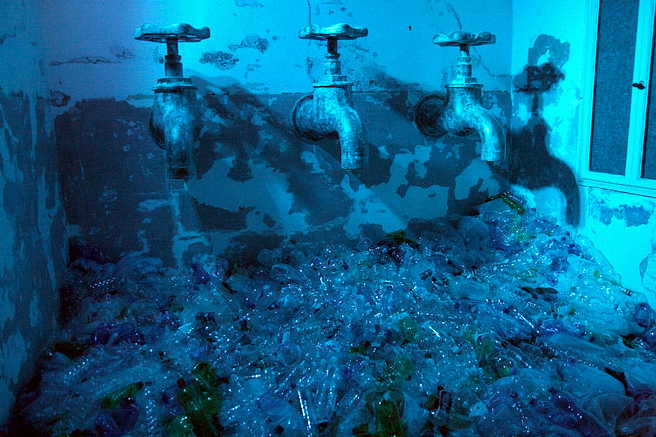
water conservation, water, art and environment, Venice Biennale, Iraq, wounded waterNation’s Laundry by Halim al Karim

The six artists represent two different generations of Iraqis. Ali Assaf, Azad Nanakeli, and Walid Siti were born in the 1950s. They experienced Iraq’s cultural golden age before several decades of war and eventually sanctions plunged the country into its current state.

Adel Abidin, Ahmed Alsoudani and Halim Al Karim on the other hand have always been surrounded by war starting with the Iran/Iran war during the 1980s, the Gulf war, following Iraq’s invasion of Kuwait, and then Operation Iraqi Freedom waged by George Bush in 2003.

In addition to leaving untold environmental scars, these oppressive latter years weren’t conducive to producing great art, so each of the artists sought solace in either Europe or the United States. But no amount of physical distance could overshadow the reality they left behind.
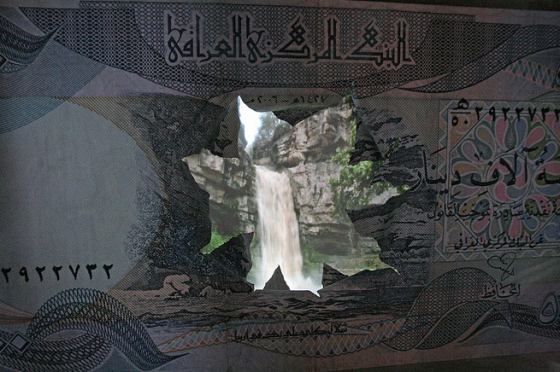
water conservation, water, art and environment, Venice Biennale, Iraq, wounded waterBeauty Spot by Walid Siti

Rijin Sahakian wrote in the exhibition’s catalogue:

Water was chosen as the central theme of the Pavilion of Iraq 2011. A resource that enabled Iraq’s initial and ongoing growth, it is now in crisis due to diversion, contamination, and neglect. Its past and present life is reflective of its manipulation by various domestic and international actors, and its scarcity has caused the endangerment, and in some cases the extinction, of various peoples, animal and plant species.

Despite this rather bleak outlook, there remains hope. The description continues:

But it is in the fluidity of movement as well as the ability to reconstitute realities and find solutions where both artists and scientists have found new means of adaptation to new environmental circumstances.

Art and culture evolve alongside economic, environmental, and socio-political changes, so it is telling that artists, documentarians, photographers, and writers in the Middle East are becoming more aware of our degraded natural resources. And we hope that eventually their vision will seep into the general consciousness.

Readers in or on their way to Venice have until 27 November, 2011 to experience this groundbreaking work.

:: Universes in Universe

More on Environmental Art in the Middle East:

Art and Spirituality: The Antidote to Bigger, Better, More
Camile Zakharia Coastal Promenade Photo Exhibition

1000 Naked Israelis Strip to Save the Dead Sea

Tafline Laylin
Tafline Laylinhttp://www.greenprophet.com
As a tour leader who led “eco-friendly” camping trips throughout North America, Tafline soon realized that she was instead leaving behind a trail of gas fumes, plastic bottles and Pringles. In fact, wherever she traveled – whether it was Viet Nam or South Africa or England – it became clear how inefficiently the mandate to re-think our consumer culture is reaching the general public. Born in Iran, raised in South Africa and the United States, she currently splits her time between Africa and the Middle East. Tafline can be reached at tafline (at) greenprophet (dot) com.

Read More

TRENDING

Can Scientists Predict Coral Bleaching Before It Happens?

Now researchers at the Woods Hole Oceanographic Institution (WHOI) in the US say they have developed a way to predict coral bleaching five to six months before it occurs, potentially giving reef managers enough time to intervene and save vulnerable corals.

AC Water Uses: How to Reuse Air Conditioner Condensate Water for Plants, Cleaning and Water Conservation

That means the water dripping from your air conditioner may already be usable for gardening, cleaning, flushing toilets, topping up humidifiers, or cooling systems — instead of disappearing into the sewer. A new study. Is it safe?

Collecting kinetic energy from roads; REPS turns traffic into a power plant

REPS announced a $23.6M equity financing round to scale...

Hormuz 2026 Conflict Poses an Energy and Food Security Dilemma in a Warming World

As tensions rise in one of the world’s most critical maritime chokepoints, the ripple effects go far beyond oil—touching food systems, climate pressures, and regional stability

Baby teeth read like tree rings paint a picture of toxins in early life

A new study from the Icahn School of Medicine at Mount Sinai in New York offers a striking insight into how the environments we are born into can quietly shape our brains years later. By analyzing naturally shed baby teeth, the ones tucked under pillows for the tooth fairy, researchers have reconstructed a detailed timeline of exposure to environmental metals during pregnancy and early infancy.

Locals From Rishon Fight IKEA

Big Box stores are a pretty new concept in Israel, and thank God that not every Israeli city wants them in their backyard. A word from someone who has see the beautiful farmland around her hometown Newmarket, Ontario stripped and converted into vulgar strip malls of big box shops: they have no place in a healthy and sustainable town or city.

The Jewish National Fund Meets An Inconvenient Truth

According to the JNF, it has transformed thousands of acres of barren land into green forests in Israel. They state that each person emits about 23 tons of carbon per year, estimating that each tree planted can absorb one ton of carbon in its lifetime. That's a whole lot of trees you'd need to be planting. Could so many fit in Israel?

How to quiet noise from construction in your office

Streets need to be resurfaced in New York but the humming and grinding noise is unsettling. Noise is environmental pollution. 

EarthX and a blueprint for sustainable investing

Trammell S. Crow, a Dallas-based businessman and father of four, is focusing his efforts on impact investing, and media that focuses on saving the planet through EarthX.

Mining Afghanistan’s Mineral Discoveries Similar to Avatar

Now that American forces in Afghanistan are commemorating the longest period of any war that America has been involved in, including the 1965-73 Vietnam War, the recent discoveries of large and extremely valuable mineral and metal deposits may finally bring to light a reason to continue the presence of US fighting forces in this war torn and backward country.

From Pilot Plant to Global Stage: How Aduro Clean Technologies’ 2026 Expansion Signals a Turning Point for Chemical Recycling Investors Like Yazan Al Homsi

The company's Next Generation Process (NGP) Pilot Plant in London, Ontario, has officially moved into initial operating campaigns, generating the kind of structured, repeatable data that separates laboratory promise from commercial viability.

Nobul’s Regan McGee on Shareholder Value: “Complacency Is the Silent Killer” 

Why the governance framework designed to protect shareholders so...

Should You Invest in the Private Market?

startustartup Unlike public stock exchanges, which offer daily trading, strict...

Popular Categories