
Earth. Energy. Everything next.

Jordanian Villagers Trained to Bring Solar Energy to Rural Areas

  Solar Energy Coming to Jordanian Villages

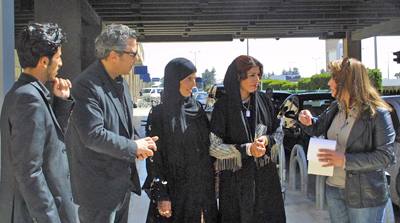
Three Jordanian villagers returned this week from training at the Barefoot College in India (Petra photo). 

Here’s a heartwarming story published in the Jordan Times yesterday that can distract us for a few moments from the human and environmental catastrophe in Japan: A new grassroots program in Jordan aims to bring solar power to rural areas.

While the Israeli-Palestinian Comet-ME partnership is similarly installing solar and wind technology in impoverished Palestinian villages in the Hebron hills, Jordan’s program is unique in that it will be led by three local residents who received six months of training in solar power technology at the Barefoot College in India, a college that only accepts people from remote areas across the world.

Sixty-one-year-old Seiha Al Raja, her son Bader Awad Fahed Hamed, and Rafia Enad Fahed Hamed from the Mansheyet Al Ghayath village returned home this week and are now awaiting  funds to initiate a JD50,000 project to install solar panels for about 200 families in the village, according to Jordan’s Ministry of Environment, which has contacted several donor bodies and private sector entities that have expressed interest in financing the venture.

“The training in India was excellent. I will train other people in my village and other villages in the area on how to use solar cells to generate power. Some people in the village are not provided with electricity. Many others do not have money to pay for it,” Bader told the Jordan Times yesterday.

“I never would have believed that the sun can be used to generate electricity,” his mother Seiha said. “At the end of the course, I was surprised and very happy that I could assemble and conduct maintenance for solar cells to generate electricity. I am illiterate, but am proud of myself now,” she added.

Solar grandmothers

Barefoot College has trained 140 grandmothers in 23 countries. As a result, some 600 villages in India, Asia, Africa and South America are now running on solar power.

Jordan’s Minister of Environment Taher Shakhshir noted that the project is the first of its kind in the region, and said the ministry has coordinated with the Ministry of Education to provide a classroom for the three Jordanians to spread the know-how they acquired in India.

Environment Ministry officials emphasized the importance of such projects, noting that supplying electricity to remote villages costs about JD250,000.  Jordan has set a goal of meeting 10% of its energy needs with solar power by 2020.

:: Jordan Times

Read related stories on Green Prophet:

Comet-ME Continues to Bring Power to Villagers in the South Hebron Hills
SolarPower for Small Portable Solar Grids Virtually Anywhere
Jordan Signs Up for Epic ‘Sahara Forest Project’

Ira Moskowitz
Ira Moskowitzhttps://www.greenprophet.com/
When his kids were small, Ira would point to litter on the ground and tell them: “That makes me angry!” He still gets angry about pollution, waste and abusive treatment of our world, but is encouraged by the growing awareness of environmental issues and has been following the latest developments in cleantech with great interest. Ira grew up in the green hills of western Massachusetts and moved to Israel in the early 1980s after completing an MA in Middle Eastern Studies. He has worked as a software developer and journalist, and translates works of Hebrew fiction and non-fiction to English. Ira is trying to age gracefully, but refuses to surrender his youthful belief in the potential for change, including a collaborative future for the peoples of the Middle East. To contact Ira, email ira (at) greenprophet (dot) com.

Read More

TRENDING

Cities promise net zero. A new UN-aligned checklist asks them to prove it

At COP31 in Türkiye, a new climate checklist challenges cities to prove their net-zero promises with measurable action, transparent reporting and real emissions cuts.

Petra by Night returns as Jordan tries brings tourists back to Wadi Rum

The Nabataeans understood that prosperity in the desert depended on respecting environmental limits. Two thousand years later, Petra's greatest attraction may still be the wisdom of the people who learned to live within them.

The pulsing planet and the earthquakes that shape our world

One of the most persistent questions in seismology concerns whether scientists will eventually be able to predict major earthquakes before they happen.

Amman’s traffic crisis is about more than cars. It’s about how we think

I believe Jordan needs a cultural transformation alongside its infrastructure investments. We must begin by redefining social prestige. Why should ownership of an expensive car be considered a greater achievement than making an environmentally responsible transportation choice? Why should travelling by bus carry a social stigma?

Why water-starved Amman keeps flooding and how underground rain tanks could help

Jordan's capital faces a troubling paradox: chronic water shortages and destructive winter floods. Hydrogeological expert Dr. Osama MN Gazal explains how underground rainwater tanks and green infrastructure could help Amman capture precious rainfall, reduce flooding and build a more water-secure future.

Why Bronwyn Finnegan Chose the Nonprofit Sector Over Politics or Corporate Life

Bronwyn Finnegan could have pursued a career in politics or corporate leadership. Instead, she chose the nonprofit sector, where she focuses on financial sustainability, governance and helping mission-driven organizations build the capacity to survive and grow.

Scientists make lead-free perovskite solar cells that can weather the elements

Scientists have developed a “raincoat” for lead-free tin perovskite solar cells, helping them withstand air, moisture and heat while maintaining high efficiency.

The Essential Guide To Sustainability in Project Management

Sustainability is an approach where businesses and individuals balance the environmental, social, and economic aspects of a project such that current and future stakeholders are not overburdened with the impacts of the project in future.

Yerukim Forms a New Green Economy Where the Money is Really Green

The Yerukim members who pick up the recyclables get to keep the monetary reward, the public earns "green" bills that can be used in shops, and business owners get to be associated with environmentalism.

Choosing Riyadh over Dubai? What Investors Should Know

Saudi Arabia is deploying capital at unmatched scale to catalyze tourism and advanced industry while rewiring its power-and-water backbone. The investable frontier is widening—especially in renewables, grid storage, water efficiency/desal retrofits, and hospitality operating platforms. Prudent investors will insist on phased delivery, enforceable KPIs (energy, water, biodiversity), and RHQ/zone compliance—while pricing political-economy and reputational risks alongside growth upside.

Sell your cooking oil for biodiesel money

Want to make money on old french fry oil? Sell it.

Qatar Alternative Energy Summit Pairs Investors And Innovators

Alternative energy investors and innovators can meet n' greet in Doha, Qatar March 16 and 17.

Here’s How To Implement The Four Pillars Of Employee Engagement

If you throw a party for your work team and they are vegans, don't make it a barbecue. Know the sustainability values of your team to boost moral and retain good people.

Popular Categories