British Jews get dirty down at the allotment

More Jews in Britain are finding spiritual and culinary inspiration by growing their own food.

Jews are known for their love of food, but less so for their love of farms. Most Jews in Britain live in big cities where, like many urban-dwellers, they are detached from the people and places producing their nosh. But the sterile fruit and veg in supermarkets and the economic pressure of the recession are inspiring more Brits to grow their own.

uk allotment green jewishIn Israel, allotments are few and far between (probably owing to the fact that land is scare, water is scarcer and quality local produce is abundant).

But in Britain, there are around 330,000 allotments – with some cities having a waiting list of several years.

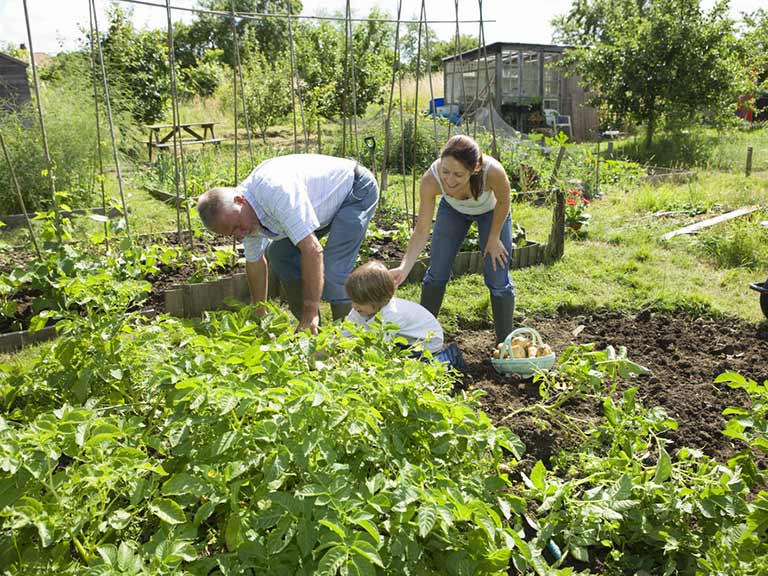
The Big Green Jewish website has an allotment blog following the sowing, composting and pruning habits of north Londoner, Alexei Charkham, and his green-fingered family.

Last week, the Jewish Chronicle reported on the “grow-your-own revolution” which is inspiring everyone from suburban families to rabbis to work the land. With the help of local volunteers, Rabbi Natan Levy recently converted the backyard of the London School of Jewish Studies into a mini-farm as part of a “living Judaism” course:

“I have found it very therapeutic. First of all I like that gardening requires emunah – you have to have a lot of faith. You put these seeds in the ground, water them and pray like crazy,” says Rabbi Levy. “We live in a world that is very disconnected from what we eat and how it is produced. It helps me on many different levels to see where a carrot comes from. It just takes a little bit of that initiative, which gives a lot of empowerment.

In the west of the city, the post-denominational Jewish community, Moishe House, has launched a box scheme, delivering fresh produce from local green grocers, as well as piloting raised bed horticulture in its back yard.

This spring, I decided to try growing my own veg for the first time. With a few pots filled with compost, my small patio has been transformed into a thriving horticultural plot. I’m not giving up my day job yet, but the satisfaction of seeing a seed I planted with my own hands spiral into 10-foot runner bean is priceless.

::Allotment blog

More farming articles:
Farmigo Software to Manage the Organic Farm
Keep Food Safe from Farm to Fork
A Halal’s Day Work for Organic Muslims

Michael Green
Michael Greenhttps://www.greenprophet.com/
Born into a family of auto mechanics and engineers in east London’s urban sprawl, Michael bucked the trend and chose a bicycle instead of a car. A relative newcomer to Jerusalem, he works as a freelance journalist writing for the Jerusalem Post and other publications. Before moving to Israel, he worked for an environmental NGO in England where he developed a healthy obsession with organic vegetables and an aversion to pesticides and GMOs. Michael’s surname is pure coincidence. Michael can be reached at michael (at) greenprophet (dot) com.

Read More

1 COMMENT

TRENDING

Make Guarapo De Piña (it’s fermented pineapple juice)

In Cuba, guarapo is simply freshly-pressed sugar cane juice, and is drunk on the spot, without waiting for it to ferment. But in Colombia, Venezuela, Peru and Mexico, they homebrew guarapo from pineapples or oranges, and the fragrant fluid sits on the kitchen counter top to ferment until it's bubbly.

Baby teeth read like tree rings paint a picture of toxins in early life

A new study from the Icahn School of Medicine at Mount Sinai in New York offers a striking insight into how the environments we are born into can quietly shape our brains years later. By analyzing naturally shed baby teeth, the ones tucked under pillows for the tooth fairy, researchers have reconstructed a detailed timeline of exposure to environmental metals during pregnancy and early infancy.

Poop in the East River shows the city’s rat problem and what people like to eat

New York ecology and health can be monitored by a jug of water a week.

Monitoring farmers’ tillage patterns from space

Tillage is one of the clearest signals of how a farm treats its soil. Intensive plowing can degrade structure, release carbon, and increase erosion. Conservation practices—no-till, cover cropping, minimal disturbance—do the opposite. They build soil, retain water, and support biodiversity. But until now, measuring these practices at scale has been slow, expensive, and often self-reported.

Saving Gourmet Wild Plants For The Future

Think of truffles, a gourmet wild food. The European...

Locals From Rishon Fight IKEA

Big Box stores are a pretty new concept in Israel, and thank God that not every Israeli city wants them in their backyard. A word from someone who has see the beautiful farmland around her hometown Newmarket, Ontario stripped and converted into vulgar strip malls of big box shops: they have no place in a healthy and sustainable town or city.

The Jewish National Fund Meets An Inconvenient Truth

According to the JNF, it has transformed thousands of acres of barren land into green forests in Israel. They state that each person emits about 23 tons of carbon per year, estimating that each tree planted can absorb one ton of carbon in its lifetime. That's a whole lot of trees you'd need to be planting. Could so many fit in Israel?

How to quiet noise from construction in your office

Streets need to be resurfaced in New York but the humming and grinding noise is unsettling. Noise is environmental pollution. 

EarthX and a blueprint for sustainable investing

Trammell S. Crow, a Dallas-based businessman and father of four, is focusing his efforts on impact investing, and media that focuses on saving the planet through EarthX.

Mining Afghanistan’s Mineral Discoveries Similar to Avatar

Now that American forces in Afghanistan are commemorating the longest period of any war that America has been involved in, including the 1965-73 Vietnam War, the recent discoveries of large and extremely valuable mineral and metal deposits may finally bring to light a reason to continue the presence of US fighting forces in this war torn and backward country.

From Pilot Plant to Global Stage: How Aduro Clean Technologies’ 2026 Expansion Signals a Turning Point for Chemical Recycling Investors Like Yazan Al Homsi

The company's Next Generation Process (NGP) Pilot Plant in London, Ontario, has officially moved into initial operating campaigns, generating the kind of structured, repeatable data that separates laboratory promise from commercial viability.

Nobul’s Regan McGee on Shareholder Value: “Complacency Is the Silent Killer” 

Why the governance framework designed to protect shareholders so...

Should You Invest in the Private Market?

startustartup Unlike public stock exchanges, which offer daily trading, strict...

Popular Categories