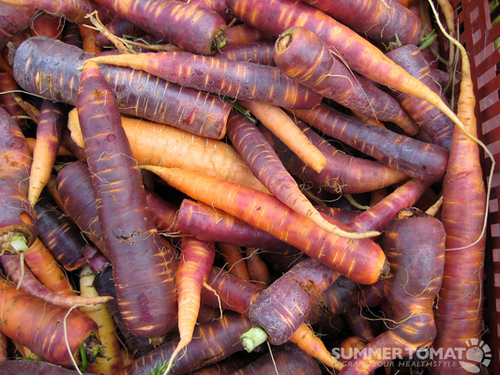
This history of carrots and how they went from purple to orange

Originating in ancient Egypt, carrots didn’t start out so orange. Can you imagine how Bugs Bunny would look chomping down on one of these?

When you think of carrots what is the first thing that comes to mind? One thing is for sure, you don’t think “Gee, you mean that long purple vegetable.”  Well here’s news for you, the original color of the carrot was not orange! Carrots originated in Middle Asia with some historians believing that they were known as far back as Ancient Egypt over 5,000 years ago. It is not clear if they were actually cultivated at this time, however by the 10th century in Afghanistan, they were being grown in the colors purple or yellow.

These weren’t the only colors around, however. In addition to purple and white, carrots were grown in red, yellow and even black. In fact to begin with carrots were not favored as a favorite vegetable, but rather in the times of the Ancient Romans, as a medicinal herb and even as an aphrodisiac. A “green” aphrodisiac at that.
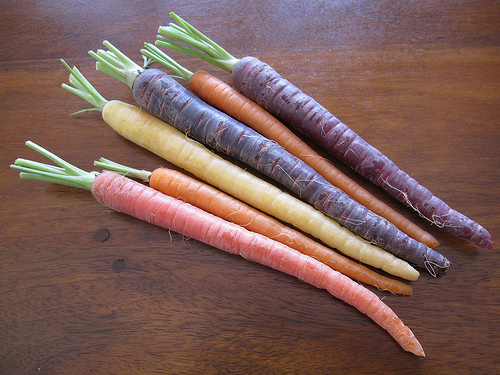
carrots colorful purple
Here’s a simple way to add colour onto your table 

Today we know that carrots have great nutritional value being low in calories. Not only that but carrots are an excellent source of carotene, which the body converts into Vitamin A. It is this particular vitamin that really helps with vision, which is why carrots are a great vegetable to add to your diet. If you ask us, your natural advisor? Search no more! Carrots are the thing!

Blame it on the “orange” Dutchmen

When you are preparing your carrots for eating, whether you plan on cooking them or eating them raw, there is something important to keep in mind: don’t peel the skin! In carrots, like many vegetables, most of the nutritional value is just below the skin, so instead of peeling, just scrub the skin clean. And choose organic varieties when you can.

So our popular orange carrot of today, isn’t even one of the original, natural color. Actually it is the product of cross breeding the red and yellow carrots. In the 16th century some Dutch farmers succeeded in growing the first orange carrots in honour of the House of Orange. It is this color carrot, which is most widespread today.

So when you are next making a delicious carrot salad, think just how much more colorful purple would look on your table. Try a local farmer’s market, or health food store near you and taste the difference. Or look for a way near you to order seeds of heirloom varieties of ancient carrots.

Read more on vegetables and health:
How green is your garlic
RECIPE – Flavors of Peasant Cooking: Majadra Means Lentils and Rice
Conserve What You Eat


Naomi Ben-David
Naomi Ben-David
Naomi interned at Green Prophet during the summer of 2010. She grew up in Australia with a chiropractor mom who introduced her to various forms of alternative medicine. Her mother was forever pointing out the healthy food choices in the supermarket, or attempted to make it from scratch at home in order to avoid the preservatives and additives in the food. Naomi’s mother’s influence has stayed with her, impacting the food and medical choices she makes to this day. She is currently pursuing a career in writing.

Read More

7 COMMENTS
  1. Yes there are a lot of versions of the origin of orange carrots and the apocryphal Dutch tale. We can only go on verified documentary evidence and that is what the Carrot Museum explains and examines. There is no record of the “invention” of orange carrots to honour the Royal Orange Family.

    The fact remains that there were orange carrots as early as 512ad and nowhere near Holland or the 16thC!

  2. Orange carrots are NOT a result of cross breeding between red and yellow, it does not work like that in nature.
    Orange was probably developed from a found mutant in the wild.

    The Dutch developed orange carrots to make a stable and consistent vegetable, not to honour the House of Orange, that is simply a romantic tale with no historical evidence to back it up.

    The World Carrot Museum has the full history of carrots.

TRENDING

5 Reasons Why You Should Save Seeds (and plant them)

Saving seeds from tomatoes, peppers, herbs and flowers helps preserve biodiversity, strengthen food security, and keep heirloom varieties alive. Even a small balcony garden can make a difference.

HelloFresh’s pride prepping ad raises a bigger question: we are we still outsourcing dinner?

The backlash against HelloFresh's Pride Month marketing campaign has sparked a wider conversation about food, labor, sustainability, and whether consumers should reconnect with local farmers, butchers, and home gardens instead of relying on subscription meal kits.

A visit to Amirim, Israel’s first all-vegetarian village in the Galilee

Just 15 kilometers from Tzfat there is a moshav that was founded in the late 50s that was ideologically influenced by organic, vegetarian and vegan principles. My hostess at Ohn-Bar, the tzimmer where I stayed, explained that the people of Amirim were among the pioneers of Israel’s strong vegetarian movement.

Park Slope food coop boycotts “Gay Tahini” already boycotted by Muslims in Israel

The tragedy is that this kind of activism rarely builds peace. It builds tribes instead of humanity. It rewards outrage over dialogue. Once an enlightenment group starts deciding which nationalities are acceptable to boycott publicly, history suggests the line rarely stops where activists think it will.

Make Guarapo De Piña (it’s fermented pineapple juice)

In Cuba, guarapo is simply freshly-pressed sugar cane juice, and is drunk on the spot, without waiting for it to ferment. But in Colombia, Venezuela, Peru and Mexico, they homebrew guarapo from pineapples or oranges, and the fragrant fluid sits on the kitchen counter top to ferment until it's bubbly.

Yerukim Forms a New Green Economy Where the Money is Really Green

The Yerukim members who pick up the recyclables get to keep the monetary reward, the public earns "green" bills that can be used in shops, and business owners get to be associated with environmentalism.

Choosing Riyadh over Dubai? What Investors Should Know

Saudi Arabia is deploying capital at unmatched scale to catalyze tourism and advanced industry while rewiring its power-and-water backbone. The investable frontier is widening—especially in renewables, grid storage, water efficiency/desal retrofits, and hospitality operating platforms. Prudent investors will insist on phased delivery, enforceable KPIs (energy, water, biodiversity), and RHQ/zone compliance—while pricing political-economy and reputational risks alongside growth upside.

Sell your cooking oil for biodiesel money

Want to make money on old french fry oil? Sell it.

Qatar Alternative Energy Summit Pairs Investors And Innovators

Alternative energy investors and innovators can meet n' greet in Doha, Qatar March 16 and 17.

Here’s How To Implement The Four Pillars Of Employee Engagement

If you throw a party for your work team and they are vegans, don't make it a barbecue. Know the sustainability values of your team to boost moral and retain good people.

Locals From Rishon Fight IKEA

Big Box stores are a pretty new concept in Israel, and thank God that not every Israeli city wants them in their backyard. A word from someone who has see the beautiful farmland around her hometown Newmarket, Ontario stripped and converted into vulgar strip malls of big box shops: they have no place in a healthy and sustainable town or city.

The Jewish National Fund Meets An Inconvenient Truth

According to the JNF, it has transformed thousands of acres of barren land into green forests in Israel. They state that each person emits about 23 tons of carbon per year, estimating that each tree planted can absorb one ton of carbon in its lifetime. That's a whole lot of trees you'd need to be planting. Could so many fit in Israel?

How to quiet noise from construction in your office

Streets need to be resurfaced in New York but the humming and grinding noise is unsettling. Noise is environmental pollution. 

Popular Categories