


Karin tries urban foraging and eating weeds from her garden. What are the chances she will live after this experiment?
Taking cues from the Arab women foraging for mallows in the kindergarten in front of my house, and Miriam’s latest winter salad recipe, I decided to do a little urban foraging myself.
(That’s me above sampling what tastes like dandelion leaves, but it could be roquet.)
This time of the year is perfect for leafy greens – ones we can find growing just about anywhere in the Levant region getting rain. Find them in a neglected city park, out in a forest, or in your background, here I present some of the greens I found in my backyard. Next week I am going to tell you (with the help of an expert), which ones you are allowed to eat and how.
Meanwhile, look through the pictures and let us know in the comments section which ones you’d eat (if you dare), and how they’d taste yummy.
A. I don’t think these are fit for human consumption, but my pooch Tasha loves eating winter grass. She is munching on some here in this picture.

B. Would you eat generic looking weeds?

C. These ones have potential. Heard they taste good stuffed.

D. These ones look kind of poisonous. Do you think they’d work in salad?

E. These are the weeds in my mouth above. I am growing crops of these things without even trying. I think they are dandelion.
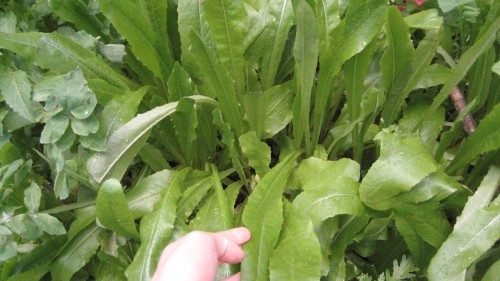
F. These weeds look poisonous and not something I feel like biting into. But maybe they have some medicinal purpose.

G. Another weed better left in the garden? Or can we forage it?
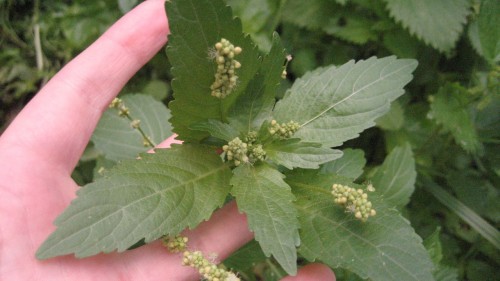
H. These ones look like carrot tops. But they don’t smell like carrots.

So what weeds would you eat? Leave your ideas in the comments section, please!




I have #H in my driveway and it smells minty when I crush the leaves.. is it eatable? and what is it called?
It’s Jan 2013 and I found this post while trying to identify a weed. Your last photo is an exact match. From looking at images elsewhere I don’t think it’s Queen Anne’s Lace nor Poison Hemlock but it might be an immature specimen of the latter.
Would you please send me the link to the follow post that has the results because I can’t seem to find it?
Thank you!
thank you so much for this article. i was able to identify some khubaiza growing in a friend’s yard and i plan to pick it next week.
F is stinging nettles. Despite the fact that the little hairs on it’s stem irritate the skin, the plant is edible. Like mallow, it’s supposed to be best before it flowers. It can be cooked and eaten like spinach, but it tends to cook down very small, so you’d need a large amount for it to look like a normal serving. The cooking water can be used to wash your hair, and you can even buy dried nettles in health food stores for making herbal infusions.
I love that you are writing about wild weeds. Chicory (picture E) is one of my staple foods this season, along with chickweed. I love collecting weeds that grow around my vege garden, it's a good feeling. And all done inside Tel Aviv 🙂 I've read some stuff on this site about composting (which we manage very successfully at our place) and wild foods & would love to see more of it. Thanks for your efforts
Thank you Abbie! I will post an update shortly. – Karin
Rachel,If someone from Green Prophet doesn't go, it would be great if you could send us a recap of how it went.
Karin – Now that you've opened your eyes to the eating potential of all the wild greens around you, you'll never look at the landscape in the same way again. In your backyard alone you have three plants that are good for eating. C is hubeisa (mallow in English, halamit in Hebrew) – gets its name from the Arabic word for bread (hubs) and it is indeed one of the most basic of all foraging foods. E is ellet (olesh in Hebrew, chicory in English)- also a seasonal delicacy. And F is stinging nettle which, if you pick carefully, can be used in soup – I've also heard of it being used as a medicinal tea. If you go into your local Arab vegetable stand, you will probably find the ellet, and maybe hubeisa. Ellet has now been cultivated – hubeisa is so abundant that it is still gathered…
B'vadi, K, b'vadi….absolutely. I have only done this once, a few years back when I was living in the Scottish Borders and the dandelions were growing everywhere, but the ground up and roasted root tasted just like coffee. Try it and let me know…….
This Euell Gibbons?http://en.wikipedia.org/wiki/Euell_GibbonsSounds like a neat guy.
so you better come to our workshop and see
Nice idea, but I've seen goats eat cars. And lamp-posts and just about anything they can wrap their mouths around…
My friend Wajee says – anything the goat eats you can. Now it's easy, all you have to do is get yourself a goat….We are offering a workshop to answer exactly these questions: on traditional uses for local vegetation by Palestinians, on Friday 15.1.2010, in Sawiyah (near Tapuahc, shomron). Host and instructor: Shawkat Abu-Rass. I hope to see you there.you can call me for registration and more details: 054-4948914Best,Rachel
I will try that James. But before the work: does the end result actually resemble coffee?
Two whole weeks? Maybe that's a skill us city folks will need to learn fast if climate predictions become true. Meanwhile I am fertilizing my weeds… 🙂
Natural foods advocate Yul Givens once said that he could live two weeks on weeds usually found in a normal vacant lot. The question is though -which weeds?
top tip K – dig up the dandelion roots (they are white & thick tubers), clean them thoroughly, then roast in the oven for about an hour. let them cool, then grind up – makes great coffee!
It's hard to tell from the photo, but G looks like it might be in the mint family, from the shape of the leaves. If the stem is square rather than round, it's in that family, and therefore edible.