
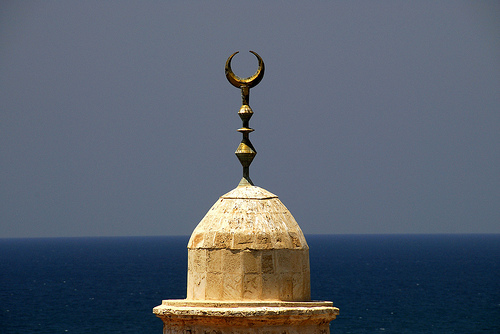

 Islam’s holy city Medina is about to become green model for Muslim world.
On November 4, 2009, UK-based the Alliance of Religions and Conservation (ARC), in working with the U.N., hosted 200 representatives from nine major world religions spanning over 60 different religious organizations. For a background, read Green Prophet’s post Interfaith Initiative plans to mobilize billions.
Baha’i, Buddhists, Christians, Hindus, Jews, Muslims, Shintoists, Taoists and Sikhs all gathered at London’s Windsor Castle with a united environmental agenda. In an era of increasing religious divide, a once little thought of topic known as “the environment” was able to bring together ancient faith groups to discuss a modern solution.
And with Islam at the forefront of today’s news, Muslim leaders proved Islam’s ability to adapt and meet new needs.
Under the newfound coalition toward eco-commitment and a Muslim Seven Year Plan, Medina, Islam’s second most important city after Mecca, is to serve as a model green city. This move is critical since Saudi Arabia is essentially, for better or worse, presently the pillar of the Arab nations.
Medina, “The City of the Prophet”, is a strategic start pointing that has the capacity to really launch a green campaign in neighboring territories.
The Seven Year Plan was presented by the Sheikh Ali Goma’a, Egypt’s Grand Mufti, who has already introduced the plan into his own city of Dar Al Iftaa. Some key initiatives of the Seven Year Plan include:
- Develop and implement a “Green Hajj”. With 2-3 million people visiting Mecca during Hajj alone, transforming the experience into an environmentally-friendly pilgrimage will reap immediate benefits.
- Construct a “green mosque” and introduce this model for other Islamic buildings worldwide.
- In the first phase, develop 2-3 green model cities; in the second phase, adapt ten other Muslim cities to implement the model.
- Integrate eco-awareness into Islamic education.
- Publish “green Qurans”, printed on paper procured from sustainable wood.
- Create a specialized TV channel focused on Islam and the environment.
- Create award and prize systems for excellence in this field.
The ultimate goal here, as with other faith groups, is to radically redefine faith-based relationships with the environment. While the “greenie” movement is still seen as a secular front by a number of conservative groups, the world’s oldest religions with a following in the billions will be able to bring much needed attention and authority to an issue that has predated our recognition of it.
Faith groups also realize the inherent relationship they have with the environment. Islam’s Sufi Muslims have long been known to have a deep reverence for nature.
However, despite regional shifts toward eco-awareness, ARC Secretary General Martin Palmer accurately points out the difficultly in Islamic groups face in changing what are essentially government policies.
As Palmer states, essentially Muslims groups will be “saying to Islamic governments that this is how you should act Islamically.” Palmer also astutely notes that implementing green changes are possible if they can be proven to be Islamic in nature. In anticipation of this obstacle, plans are in effect to functionally launce the Muslim Association for Climate Change Action (MACCA).
With 1.5 billion Muslims worldwide, the Seven Year Plan not only paves the way for increased interfaith cooperation, increased dialogue, but will also have a considerable environmental impact. With faith as the new foundation of a green movement, critical eco-issues have a new audience and a new life force that has the potential to quickly propel the issue forward – providing not only increased awareness but effective and long lasting solutions to a growing number of environmental concerns.


[…] hasn’t quite reached the wider Muslim community. Ground-breaking policies such as the Muslim Seven Year Action Plan on Climate Change were impressive but as Nasir points out, but they failed to “develop the necessary research or […]
[…] a number on environmental projects into the Kingdom, including being involved in a world-wide Muslim “Seven Year Plan” for greening the environment that is to include building a “Green Mosque” to emphasize […]
News:: Muslims Adopt A 7-Year Plan As Part of Islam's Green Agenda http://bit.ly/4GoUW5