
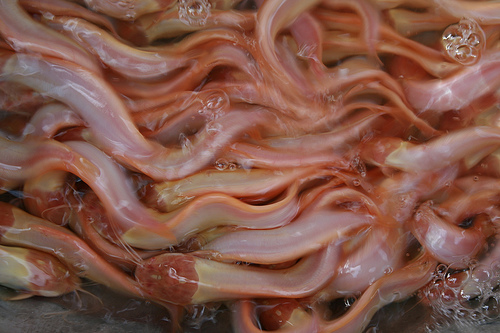
(Water snakes in Thailand. This new technology developed by Prof. Katzir can see through water, just like a snake.)
Although most people take the safety of their drinking water for granted, that ordinary tap water could become deadly within minutes, says Prof. Abraham Katzir of Tel Aviv University’s School of Physics and Astronomy.
To combat the threat of contamination due to industrial spillage, natural disaster or sabotage, the physicist has developed a new system to monitor the safety of a building or community’s water supply in real time.
Modifying special fibers developed in his lab, Prof. Katzir can detect “colors” in the infrared spectrum which distinguish between pure and contaminated water.
Not visible to the naked eye, this spectrum is normally only seen by certain animals, like snakes or vampire bats, to track down prey. Connected to a commercial infrared spectrometer, the fibers serve as sensors that can detect and notify authorities immediately if a contaminant has entered a water reservoir, system, building or pipeline.
In the lab, the fiberoptic system detected poisons such as pesticides in amounts well below the World Health Organization safety threshold. Preliminary field experiments have already been done at several European sites, and the results were reported recently in the Journal of Applied Spectroscopy.
The Colors of Danger
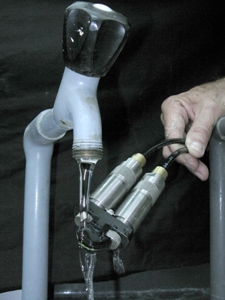 Placed in a stream of flowing water, a sensor head provides real-time quality analysis.
Once in use, the sensor system would be one of the first real-time water monitors in the United States to provide protection from chemoterrorism attacks — a threat to which U.S. water supplies are particularly susceptible. “It’s unlikely that someone will poison the water supply in Afghanistan,” says Prof. Katzir, “but America is in grave danger and needs to arm itself against chemical threats to its drinking water.
“With our naked eyes we can’t distinguish between pure water and water that contains a small amount of alcohol or acetone. They’re all clear. We can’t do it even with a spectrophotometer, which measures visible colors,” explains Prof. Katzir.
“But we can clearly distinguish between liquids using an infrared spectrometer which can distinguish between ‘colors’ in the invisible infrared spectrum.”
Such an instrument can be used to detect hazardous chemicals, pollutants and threats in the water, “seeing” water in the same way as a snake does. The special fiber sensors make it possible to monitor the quality of water in a remote location, such as a lake, a river, or a pipeline, and detect trace amounts of contaminants in real time, adds Prof. Katzir. Water management executives in Florida’s Everglades and officials in Germany are among those who have expressed an interest in using the technology.
Skyscrapers in New York City a Likely Point of Attack
“Toxic materials are readily available as pesticides or herbicides in the agriculture industry, and can be harmful if consumed even in concentrations as low as few parts per million,” says Prof. Katzir.
Cities like New York are especially susceptible to a chemoterrorist threat. With many skyscrapers holding water reserves on the top of the building, a terrorist only needs to introduce poison into a tank to wreak havoc. “A terrorist wouldn’t have to kill tens of thousands of people. Only 50 deaths — as horrible as that would be — would cause nationwide panic.”
Currently, water authorities in America test water reservoirs usually once every day or two, with no system in place to detect chemical threats instantaneously.
“This new system can cut millions of dollars from the cost of testing water manually.” The fiber sensors developed by Prof. Katzir are made of insoluble, non-toxic, and biocompatible materials. “You can eat them and nothing will happen to you,” he notes.
Prof. Katzir’s determination to fight terrorism through science has a personal side as well. His father, world-renowned scientist Prof. Aharon Katzir, was assassinated by the Japanese Red Army in a terror attack in 1972.
“I am trying to walk in his footsteps by doing applied research that can be a practical tool in an important battle. This system can be ready for use in less than a year.”
::AFTAU
[image via @N07]