People whose drinking water came from newer groundwater had a higher risk of developing Parkinson’s disease than those whose drinking water came from older groundwater, according to a preliminary study released March 2, 2026, that will be presented at the American Academy of Neurology’s 78th Annual Meeting taking place April 18–22, 2026, in Chicago and online.
The Avocado-Mango group also saw increases in fiber, vitamin C, and heart-healthy monounsaturated fat – nutrients tied to cardiovascular wellness – without changes in calorie intake or body weight. Select kidney function markers, such as estimated glomerular filtration rate (eGFR), also improved.
Banerjee’s research team is among the first to examine the interactions between foodborne pathogens and plastic particles, thereby advancing this emerging field from a food safety perspective.
Short-term surges in air pollution in New Jersey from the 2023 Canadian wildfires were associated with a higher stroke rate and more serious strokes, according to a preliminary study
Alien signals might be getting scrambled near their own stars before they reach Earth, so scientists searching for perfectly clear signals could be missing them.
People whose drinking water came from newer groundwater had a higher risk of developing Parkinson’s disease than those whose drinking water came from older groundwater, according to a preliminary study released March 2, 2026, that will be presented at the American Academy of Neurology’s 78th Annual Meeting taking place April 18–22, 2026, in Chicago and online.
The Avocado-Mango group also saw increases in fiber, vitamin C, and heart-healthy monounsaturated fat – nutrients tied to cardiovascular wellness – without changes in calorie intake or body weight. Select kidney function markers, such as estimated glomerular filtration rate (eGFR), also improved.
Banerjee’s research team is among the first to examine the interactions between foodborne pathogens and plastic particles, thereby advancing this emerging field from a food safety perspective.
Short-term surges in air pollution in New Jersey from the 2023 Canadian wildfires were associated with a higher stroke rate and more serious strokes, according to a preliminary study
Alien signals might be getting scrambled near their own stars before they reach Earth, so scientists searching for perfectly clear signals could be missing them.
People whose drinking water came from newer groundwater had a higher risk of developing Parkinson’s disease than those whose drinking water came from older groundwater, according to a preliminary study released March 2, 2026, that will be presented at the American Academy of Neurology’s 78th Annual Meeting taking place April 18–22, 2026, in Chicago and online.
The Avocado-Mango group also saw increases in fiber, vitamin C, and heart-healthy monounsaturated fat – nutrients tied to cardiovascular wellness – without changes in calorie intake or body weight. Select kidney function markers, such as estimated glomerular filtration rate (eGFR), also improved.
Banerjee’s research team is among the first to examine the interactions between foodborne pathogens and plastic particles, thereby advancing this emerging field from a food safety perspective.
Short-term surges in air pollution in New Jersey from the 2023 Canadian wildfires were associated with a higher stroke rate and more serious strokes, according to a preliminary study
Alien signals might be getting scrambled near their own stars before they reach Earth, so scientists searching for perfectly clear signals could be missing them.
People whose drinking water came from newer groundwater had a higher risk of developing Parkinson’s disease than those whose drinking water came from older groundwater, according to a preliminary study released March 2, 2026, that will be presented at the American Academy of Neurology’s 78th Annual Meeting taking place April 18–22, 2026, in Chicago and online.
The Avocado-Mango group also saw increases in fiber, vitamin C, and heart-healthy monounsaturated fat – nutrients tied to cardiovascular wellness – without changes in calorie intake or body weight. Select kidney function markers, such as estimated glomerular filtration rate (eGFR), also improved.
Banerjee’s research team is among the first to examine the interactions between foodborne pathogens and plastic particles, thereby advancing this emerging field from a food safety perspective.
Short-term surges in air pollution in New Jersey from the 2023 Canadian wildfires were associated with a higher stroke rate and more serious strokes, according to a preliminary study
Alien signals might be getting scrambled near their own stars before they reach Earth, so scientists searching for perfectly clear signals could be missing them.
People whose drinking water came from newer groundwater had a higher risk of developing Parkinson’s disease than those whose drinking water came from older groundwater, according to a preliminary study released March 2, 2026, that will be presented at the American Academy of Neurology’s 78th Annual Meeting taking place April 18–22, 2026, in Chicago and online.
The Avocado-Mango group also saw increases in fiber, vitamin C, and heart-healthy monounsaturated fat – nutrients tied to cardiovascular wellness – without changes in calorie intake or body weight. Select kidney function markers, such as estimated glomerular filtration rate (eGFR), also improved.
Banerjee’s research team is among the first to examine the interactions between foodborne pathogens and plastic particles, thereby advancing this emerging field from a food safety perspective.
Short-term surges in air pollution in New Jersey from the 2023 Canadian wildfires were associated with a higher stroke rate and more serious strokes, according to a preliminary study
Alien signals might be getting scrambled near their own stars before they reach Earth, so scientists searching for perfectly clear signals could be missing them.
People whose drinking water came from newer groundwater had a higher risk of developing Parkinson’s disease than those whose drinking water came from older groundwater, according to a preliminary study released March 2, 2026, that will be presented at the American Academy of Neurology’s 78th Annual Meeting taking place April 18–22, 2026, in Chicago and online.
The Avocado-Mango group also saw increases in fiber, vitamin C, and heart-healthy monounsaturated fat – nutrients tied to cardiovascular wellness – without changes in calorie intake or body weight. Select kidney function markers, such as estimated glomerular filtration rate (eGFR), also improved.
Banerjee’s research team is among the first to examine the interactions between foodborne pathogens and plastic particles, thereby advancing this emerging field from a food safety perspective.
Short-term surges in air pollution in New Jersey from the 2023 Canadian wildfires were associated with a higher stroke rate and more serious strokes, according to a preliminary study
Alien signals might be getting scrambled near their own stars before they reach Earth, so scientists searching for perfectly clear signals could be missing them.
People whose drinking water came from newer groundwater had a higher risk of developing Parkinson’s disease than those whose drinking water came from older groundwater, according to a preliminary study released March 2, 2026, that will be presented at the American Academy of Neurology’s 78th Annual Meeting taking place April 18–22, 2026, in Chicago and online.
The Avocado-Mango group also saw increases in fiber, vitamin C, and heart-healthy monounsaturated fat – nutrients tied to cardiovascular wellness – without changes in calorie intake or body weight. Select kidney function markers, such as estimated glomerular filtration rate (eGFR), also improved.
Banerjee’s research team is among the first to examine the interactions between foodborne pathogens and plastic particles, thereby advancing this emerging field from a food safety perspective.
Short-term surges in air pollution in New Jersey from the 2023 Canadian wildfires were associated with a higher stroke rate and more serious strokes, according to a preliminary study
Alien signals might be getting scrambled near their own stars before they reach Earth, so scientists searching for perfectly clear signals could be missing them.
People whose drinking water came from newer groundwater had a higher risk of developing Parkinson’s disease than those whose drinking water came from older groundwater, according to a preliminary study released March 2, 2026, that will be presented at the American Academy of Neurology’s 78th Annual Meeting taking place April 18–22, 2026, in Chicago and online.
The Avocado-Mango group also saw increases in fiber, vitamin C, and heart-healthy monounsaturated fat – nutrients tied to cardiovascular wellness – without changes in calorie intake or body weight. Select kidney function markers, such as estimated glomerular filtration rate (eGFR), also improved.
Banerjee’s research team is among the first to examine the interactions between foodborne pathogens and plastic particles, thereby advancing this emerging field from a food safety perspective.
Short-term surges in air pollution in New Jersey from the 2023 Canadian wildfires were associated with a higher stroke rate and more serious strokes, according to a preliminary study
Alien signals might be getting scrambled near their own stars before they reach Earth, so scientists searching for perfectly clear signals could be missing them.
I recently wrote about Environment California’s report on Formaldehyde in nursery furniture and the potential threat to our children’s health. Well, Friends of the Earth (FoE USA) are hot on the heels of this report and have released their own findings regarding toxic fire retardants common in baby products and it does not paint a pretty picture.
FoE looked at Halogenated fire retardants which have been linked to cancer, birth defects, hormone disruption, neurological and reproductive disfunction, and learning disabilities including ADHD which is becoming ever more prevelant.
Writer and part-time pig farmer, Jeff Yoskowitz, was at the recent Shavuot Slow Food market in Tel Aviv – and had mixed feelings about the artisan cheeses, meats and organic veggies on offer.
The Carmel Market shuk in Tel Aviv that so many travelers love — the idyllic market which people see as representative of the simpler way vegetables and other foodstuffs were once sold — is actually the source of so much frustration for me.
Aside from the problem that all of the produce is fully conventional, I spend most of my time there yelling at vendors, being bumped (and bumping back) and trying my best not to be cheated.
While my blood pressure rises and I suffer the consequences of a thick American accent, I wax nostalgic about the farmers markets I frequented in Providence, Rhode Island, before I moved to Tel Aviv.
Now those are markets.
The vendors are usually the farmers themselves or their workers (or the people they hire to sell their stuff), and people are nice to you. They even smile. In fact, rather than the dog eat dog milieu of the shuk, the farmers market represents an eating community where people all respect each other for their role in this chain, from the grower to the cook to the consumer, etc.
In so many ways I saw the shuk as a symbol of Israel, with all its frustrations, and the farmers market a symbol of my beloved America, in all its splendor, and in comparing the two I observed just how irreconcilable they were.
Then, on behalf of the Jewish harvest festival, Shavuot, Tel Aviv had to go ahead and start a Slow Food inspired farmers market…and further confound my already uncertain identity issues around food in Israel. When my neighbor told me about this new market I was jubilant; I actually canceled all my plans for Friday afternoon. I biked with my neighbor to what I hoped would be the very bridge between my old home and new home. It wasn’t.
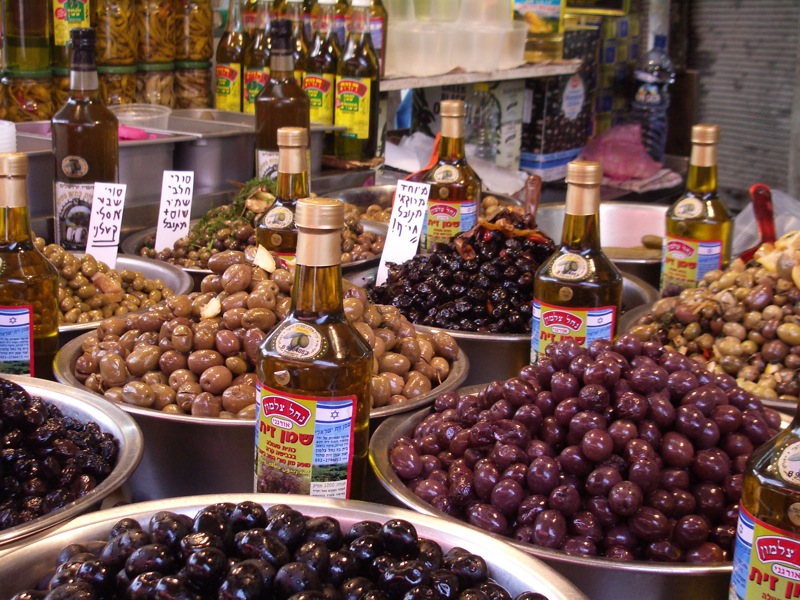
I spent two hours there and left with new questions and two conflicting feelings. The first was that it felt like home, both for better and worse. There were artisanal meats and cheeses, fair trade olive oils and vinegars and coffees, loads of incredible looking fresh and mostly organic fruits and vegetables, as well as some of the farmers themselves.
People knew about their food and products and could have intelligent conversations about farming methods and fair trade policies. I felt like part of the farmers market community I had felt a part of in Providence. It was a beautiful sight as well because the market was held at the old Tel Aviv port, with the Mediterranean as an uncanny backdrop. And it just felt nice to be shopping with a backpack and a tote, not guarding myself or my money as I do in the shuk, just casually tasting cherries and blueberries, wines and olives.
And yet, the other feeling I had was one of disappointment with Israel. While it’s just a start to the movement here, this farmers market just did some things plain wrong and contrary to so many of my own values and those that I attribute to the farmers markets of home.
For starters, the meat wasn’t kosher and I couldn’t eat it. When this happens in the US I understand it, but if there’s one place I should be able to buy kosher home-prepared pastrami I’d expect it to be this particular venue. There were also coffee stations where fair trade organic coffees were being sold in disposable plastic cups, with plastic lids and straws.
A pickle vendor (the only one) sold lacto-fermented pickles in cheap plastic containers which certainly leached plastic into the brine and probably the pickles as well. I asked the man why he didn’t use glass and he said, with disdain, “this is what we have.” Then I inquired about his lemonade (also sold in wasteful plastic cups) and it cost ten shekels a pop, with no promise of it being organic or low sugar or anything special. As thirsty as I was I would not pay a fortune for a few sips of lemonade when at the shuk fresh lemonade, which is not too sweet, costs two shekels.
In fact, this farmers market was so ridiculously expensive as compared to the shuk that I only bought purple potatoes and blackberries and then left after sampling all the free foods I could. The choice to hold the market at the port, in the North of Tel Aviv, pretty much shows the kind of constituency they’re hoping to develop: yuppie Tel Aviv types.
Had they held the market more in the center of the city perhaps the ideals would spread. Instead I was surrounded by iphone carrying Israelis enjoying a luxury market. At first this upset me because our farmers markets in the US are for everyone, right? And then I remembered that that’s not exactly true.
While the class differences at this Israeli farmers market (and in Israel in general) are more greatly exaggerated, the Providence Farmers markets were mostly serving the East Side citizens who believed in its mission and college students who felt similarly.
I thus left the farmers market dissatisfied with the start of the movement in Israel, and mostly, I believe, because I can see the class distinctions of the movement more clearly in Tel Aviv than I could in Providence where I was more a part of society and less of an observer. I’m happy that such a market exists in Tel Aviv and in time it will hopefully improve, and I will do what I can to help it along. In the meantime, though, I think I’m just going to follow-through with a CSA I’ve been researching and spend less money on good veggies so I can cook them up in my kitchen without dealing with the harsh reality that not everyone can eat the way I eat.
Sandor Katz eating his wild fermentation and famous sauerkraut.
“Social Change is another form of fermentation. Ideas ferment, as they spread and mutate and inspire movements for change,” Sandor Katz.
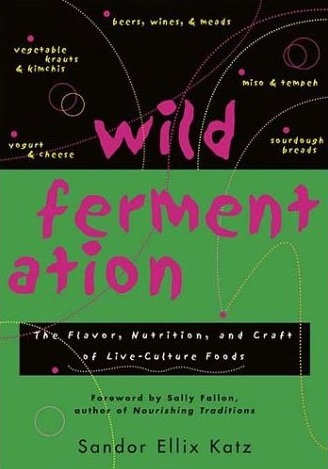
I sat down to read Sandor Katz’s “Wild Fermentation: The Flavor, Nutrition, and Craft of Live-Culture Foods” to help me along with my recreational pickling and fermenting skills. I was hoping to learn a bit about the how-tos when making cheese, meads, bread and kimchi. To my surprise and pleasure I found myself reading a cookbook plus a manifesto –– a guidebook to reclaiming our food supply and living a self-sufficient lifestyle.
An unconventional cookbook, a mission statement with recipes, and a manual to reclaiming the microbial nutrients in our diet, Sandor Katz (also goes by Sandorkraut) supplies a simple, subversive and tasty vision for helping to change and preserve our world through fermenting our food at home.
As he writes of the bubbles that fermentation produces, he himself bubbles with excitement over “doing it yourself” and taking yourself out of the industrial food chain. What makes Sandorkraut’s work so relevant and inspiring is his own personal story, which he slowly weaves into the book chapter by chapter.
An AIDS victim, Sandorkraut has come to rely on fermented foods to help him battle an impending death. He writes that “fermented foods not only nourish, they help protect us form potentially harmful organisms and contribute to immunity.”
Fermentation is not his only method of combating AIDS, but it is one that he considers to be of the utmost importance to his personal health and body’s resistance to the disease. His giddiness and glee over fermentation, which for him is “a health regimen, a gourmet art, a multicultural adventure, a form of activism, and a spiritual path, all rolled into one,” is simply moving.
So what exactly is fermentation? Well, it is the age-old process of preserving and processing foods by harnessing the power of naturally occurring bacteria and employing them to begin the process of breaking down our foods. We all eat yogurt from the supermarket with acidophilus, not necessarily realizing that yogurt is just one of many live-culture ferments rich in pro-biotics.
In fact, Sandorkraut includes various yogurt recipes in his section on dairy ferments. This ancient process makes foods like cereal grains and vegetables much more nutritionally accessible to the human body. “Fermentation not only preserves nutrients, but it breaks them down into more easily digestible forms,” he writes. He cites soybeans as an example of a protein-rich food that is virtually indigestible unless the complex proteins are broken down into digestible amino acids, which explains the Asian food ferments of miso, tempeh and tamari.
Perhaps an even more poignant reason to ferment that Katz cites is pure common ecological sense: food preservation. Organisms produce bio-preservatives such as alcohol, lactic acid and acetic acid during fermentation that retain nutrients and prevent spoilage. With rising food prices and at home gardening on a rise, an abundance of fruits and vegetables can last an entire year if properly pickled, jammed, brewed, etc.
In fact, as the controversy over Shmitta was heating up this past fall in Israel, I wondered whether or not an Israeli fully in touch with its own culture of live-culture fermentation could properly preserve the right foods and not need to find intricate Talmudic loopholes to make it through the year.
Sandorkraut takes the reader chapter by chapter detailing the various methods of fermentation (i.e. chapter 5 – Vegetable Ferments; chapter 8 – Breads and Pancakes).
He also gives a somewhat simplified and generalized history of fermented foods and our modern food culture that offers interesting little tidbits about food history and culture. However, as a whole this recipe book and call to social change wrapped up into one was a page-turner for me from day one. I nearly cried while reading one of his final chapters about coming to terms with death in nature, in which he includes a few words about what he’s learned from living with AIDS.
Since reading the book I’ve had detailed conversations with my older Israeli relative who still makes live-cultured pickles, sauerkrauts and breads in the Ashkenazi tradition. I didn’t expect that fermentation would help connect me to my own culture, but then again, as Sally Fallon writes in the introduction, “The science and art of fermentation is, in fact, the basis of human culture: without culturing, there is no culture.”
The book was an unexpected treat that will rest on my bookshelf and not just in my kitchen, because as much as I hope to utilize his non-didactic approach to food preservation, I hope even more to internalize Sandorkraut’s revolutionary message and vision.
‘Wild Fermentation’ is distributed in the UK by www.greenbooks.co.uk, and published in the US by Chelsea Green.
Jeff Yoskowitz is a writer & filmmaker, living in Tel Aviv for a year on a scholarship from Brown University. Jews relationship with pigs, and food and health in general, are some of the issues that really fire Jeff up. Haaretz, The Forward and Meatpaper are some of the recent places Jeff has published his articles.
SO you went to the store and forgot your reusable shopping bag, you folded under the pressure and took a plastic one so that you could bring your groceries home. I’m sure that this almost NEVER happens, but once in a while it does… What to do?
Store empty grocery sacks, rolled into empty cardboard paper towel rolls. They’re great for the car to use as disposable trash bags. Or in your diaper bag for an emergency.
Instead of getting newspaper print on your dishes when you move, plastic grocery bags can act as a great alternative to be used as a protective cushion when packing dishes or breakables.
Wearing dress shoes? Need to make a quick trip into the muddy garden? Use the bag as an over shoe!
Use grocery bags to line your trashcans around the house. It’s much easier to clean up the mess: just pick them up, tie the top and out they go.
Out of a dish-sponge? Use a bag! They work (almost) as good. The best part is that you can use them on shabbat (no squeezing issues)
As part of our mission to foresee a green, environmentally-sound future for Israel, its neighbors and the world, we’ll be occasionally featuring blogs from the regional blogosphere that also care about all things green, especially those in Arab countries where green issues are relatively undeveloped.
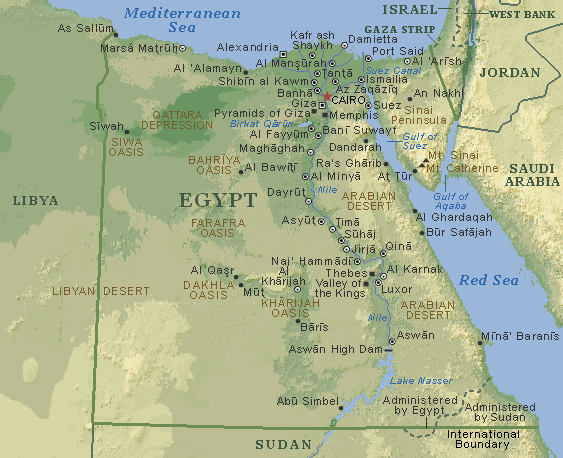
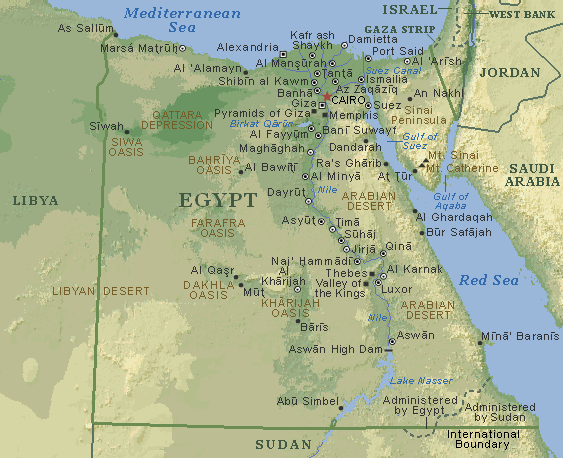
Last week we featured environmental blogs from Lebanon and Jordan, and this week we’ll be featuring some of Egypt’s environmental voices.
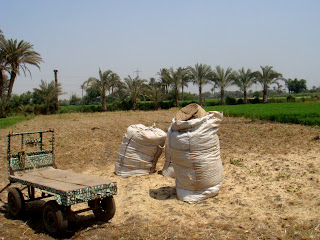
Maryanne Stroud Gabbani at Living in Egypt wrote about garbage dumping at the Sakkara archaeological dig sites, and also recently wrote about the wheat harvest in Egypt and how it has changed over the years. The wheat used to be threshed by cattle walking on it, but now these processes are done by machines. The spring ritual of the wheat harvest (which we celebrated this week with Shavuot) is especially emphasized this year because of the recent food price hikes.
Both of them came up with very creative ideas for reusing things that would otherwise end up in the garbage bin, and we are going to reward them handsomely with a Yoav Kotik earring and ring set each – made out of reused Israeli beer caps.
We applaud the Heschel Center for this creative type of seminar which is super green in two ways: it’s about the environment, and it eliminates all of the transportation needs associated with conventional seminars. This is a seminar on a carbon emission diet.
The Seminar is called Lu’ach Ve’Ru’ach – The Hebrew Calendar, Shavuot, Justice and the Earth and is being hosted by the deputy director of the Heschel Center, Dr. Jeremy Benstein. There are three ways to participate:
Last week, Green Prophet reported from the Cleantech 2008 expo, the annual exhibition of environmentally-friendly technologies and innovations in Israel. The talk of the town (or Airport City, at least) was the sun, following the announcement that the Israel Electric Company is going to pay families producing clean energy via solar panels. The sun’s nemesis, water, also featured heavily and Green Prophet spoke to a number of businesses working on solutions to the crisis of one of the regions most scarce resources.
“Forty per cent of household water can actually be reused,” says Ilan Katz, managing director of Water Arc, a new initiative to reduce the demand for water in urban areas. So-called “grey-water” includes waste water from showers, washing machines and bathroom sinks which can be reused for flushing toilets, which accounts for around 35% of the total water used by an average Israeli household, as well as watering plants and gardens.
Last month, hundreds of Tel Aviv residents spent their Friday afternoon marching up Rothschild Boulevard in support of the Clean Air Act, stuck in the Knesset for the past three years. Knesset lawmakers must have been paying attention – last week the act passed its first reading.
Living green means living healthy as well. Did you know that when you flush the toilet with the lid up droplets of water can spray up to twenty feet in the air. If you put the lid down it keeps sprayage down to a minimum and you can avoid picking up unwanted germs.
This has another added benefit. No more fighting between spouses about keeping the seat up or down. Now it’s just as inconvenient for both parties…
When attempting to incorporate new elements and habits into our life what is the best way to do this? If I want to be greener, how do I go about doing it? If I want to be friendlier, how do I add this to my life?
In this week’s Weekly Bible segment the laws of the Nazir are discussed. The Nazir is a person who decides to accept upon himself a higher spiritual level. He may feel that he has been slipping, or just wants more spirituality in his life. He then will commit himself to be a Nazir for a specific time period during which he will refrain from all grape products, cutting any body hair and avoid anything that is spiritually impure. At the end of this period the Nazir brings an offering, including a sin offering in the temple and shaves all of the hair from his body.
Israel’s natural resources are few and far between. But one resource that Israel has in abundance is sunlight, and perhaps for that reason, Israel has been a world leader in solar energy.
Until now, most of Israel’s cutting edge solar technology companies have focused their energies abroad, in California’s Mojave Desert and elsewhere. A huge solar plant has never appeared on Israel’s horizon…Until now. The new plant is generating interest among alternative energy countries worldwide, and will be dedicated next week, on June 12th.
Finding win/win solutions to our environmental crises is a cornerstone of our philosophy here at Green Prophet. We know that there are days when a plastic bag just seems like a plastic bag, dammit; and you really need that gallon of milk but forgot to bring along the eco-friendly canvas tote you love to shop with, and you can’t seriously lug a gallon of milk up one of Jerusalem’s many hills without a bag of some sort. Seriously, we know.
So we love when going green is not only the right thing to do, but actually pays. That’s why we’re especially pleased that the Ministry of Tourism has announced, in advance of World Environment Day (June 5th) to implement strategies to “green” tourism.
The “win” for us: a clean environment as we relax on the beach, knowing that we are part of the solution and not the problem. The “win” for the Ministry: International studies indicate that 70% of tourists from the U.S., Australia and Britain will plonk down as much as $150 extra per week for a hotel that they know is environmentally friendly. Multiply that by millions of tourists, and the moolah really starts to add up.
Yesterday was much like any other summer day in Israel: sunny, hot and dry.
But for Alon Tamari, CEO of SolarPower Israel, it is not one that will be forgotten in a hurry: “It’s a historical day, there’s no other way to put it.” Along with the summer heat came the long-awaited announcement that the government will be offering financial incentives to Israeli households who produce their own clean electricity via solar panels.
“The Government started speaking about it three or four years ago and we expected the regulation in one or two years,” Tamari told Green Prophet at the Cleantech 2008 exhibition. “I’ve got 700 grey hairs since then,” said Tamari, pointing to his head. Earlier in the day at Cleantech, the Public Utilities Authority confirmed that they will be offering 20-year contracts with households to buy their solar electricity from them for NIS 2.01 per Kilowatt, which means saying “goodbye” to electricity bills and “hello” to a cheque each month from the Israel Electricity Company.
You wouldn’t generally think of Tel Aviv as a green oasis. A nightlife oasis, yes. A beachy oasis, yes. A trendy oasis, yeah, you could call it that too. But when you’re walking on busy Allenby Street or Dizengoff – the natural environment is probably the furthest thing from your urban experience.
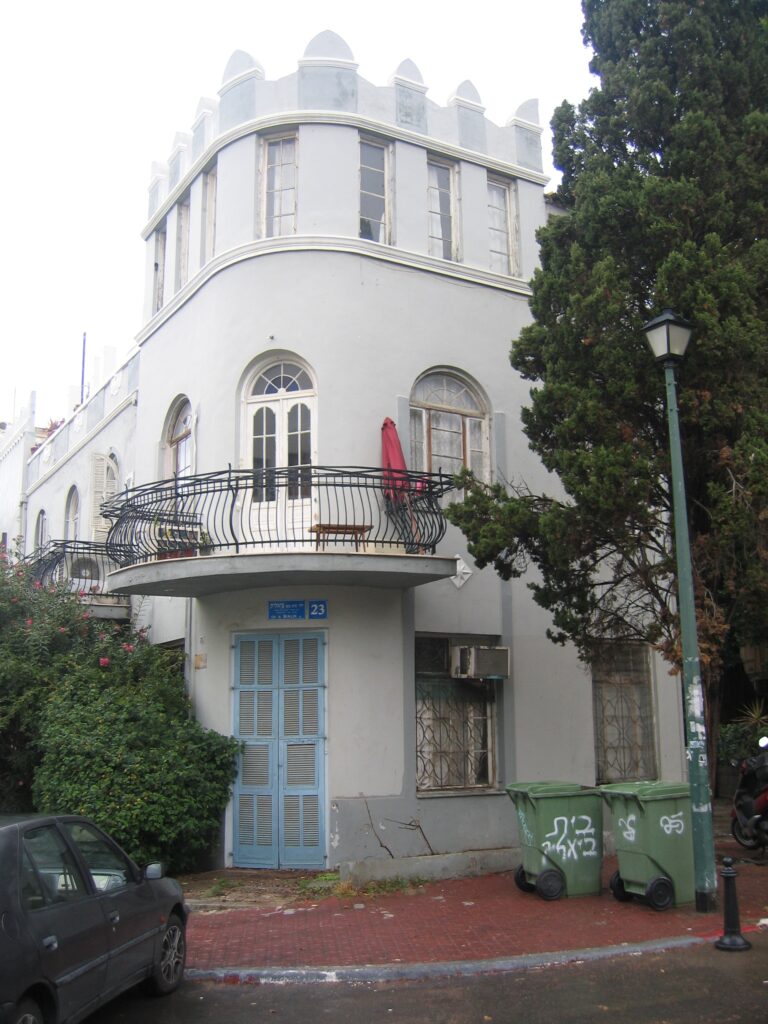
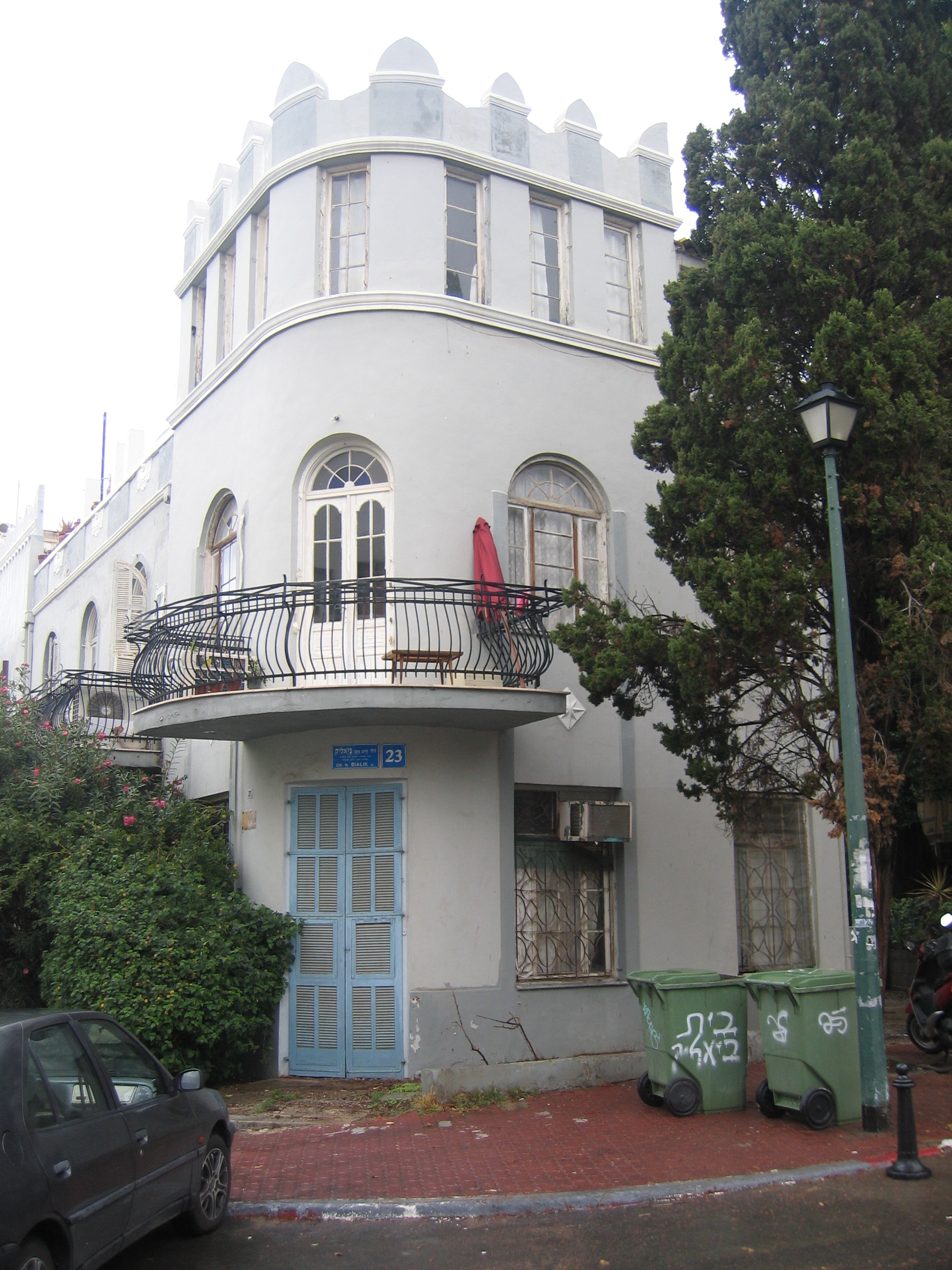
But tucked away in Bialik Square, in the center of Tel Aviv, a green oasis exists.
City Tree is a green housing project that, like the Eco-Housing Pilot Project of Jerusalem, has adopted an older building and made it suitable for sustainable living habits. City Tree may have it a little tougher than the Eco-Housing project, though, since their building is over 80 years old and is constructed in the historical Tel Aviv architecture style of the 1920s.

 I recently wrote about Environment California’s report on Formaldehyde in nursery furniture and the potential threat to our children’s health. Well, Friends of the Earth (FoE USA) are hot on the heels of this report and have released their own findings regarding toxic fire retardants common in baby products and it does not paint a pretty picture.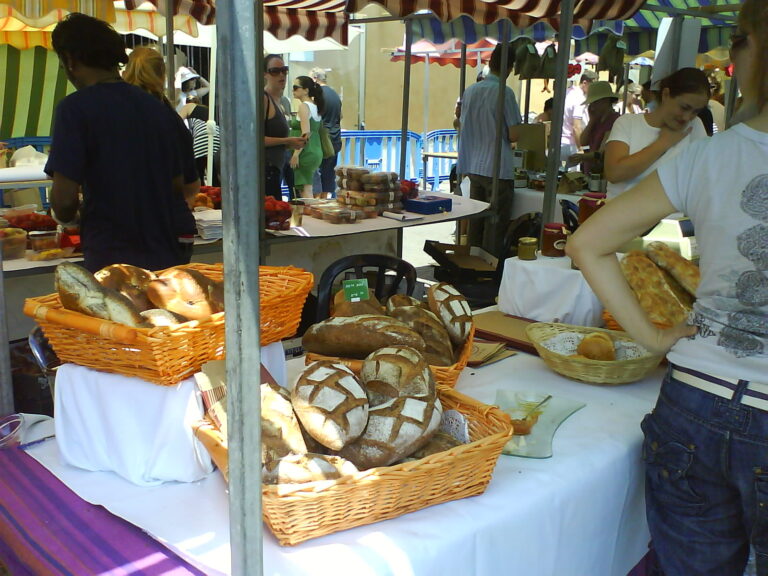



 As part of our mission to foresee a green, environmentally-sound future for Israel, its neighbors and the world, we’ll be occasionally featuring blogs from the regional blogosphere that also care about all things green, especially those in Arab countries where green issues are relatively undeveloped.
 Maryanne Stroud Gabbani at
 For those of you following our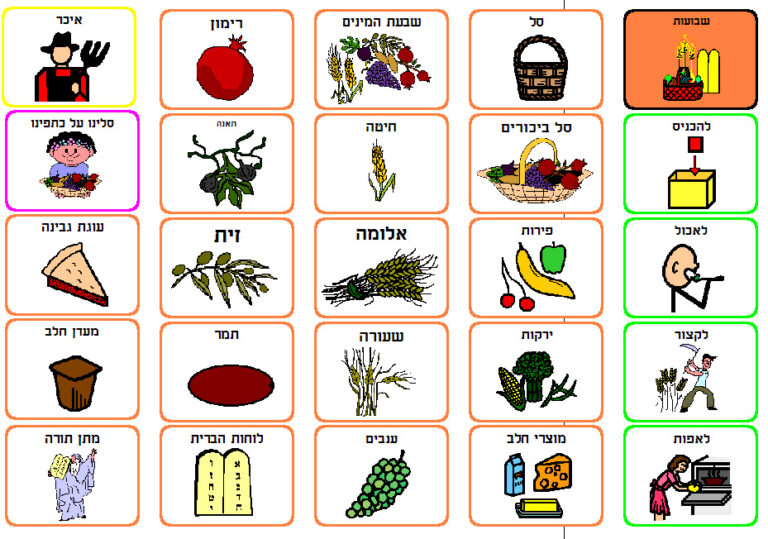








 yes. A trendy oasis, yeah, you could call it that too. But when you’re walking on busy Allenby Street or Dizengoff – the natural environment is probably the furthest thing from your urban experience.
 City Tree