
Home Blog Page 781

The Shmita year and its connection to the environment

4

Shmita year in Israel sabbath for the land
Thousands of years before green became hot, the Jewish people were observing the Shmitta, or shmita, a sabbatical year.

The Shmitta is documented in the bible as a year where farmers are forbidden to work the land in order to give the land a rest.

The Lord said to Moses on Mount Sinai. (2) Speak to the Israelites and say to them: ‘When you enter the land I am going to give you, the land itself must observe a sabbath to the Lord. (3) For six years sow your fields, and for six years prune your vineyards and gather their crops. (4) But in the seventh year the land is to have a sabbath of rest, a sabbath to the Lord. Do not sow your fields or prune your vineyards.’(Lev. 25: 1-4).

Talk about giving it a rest! In yesterday’s post we spoke about how radically we could cut down our emissions if the world would take upon itself the Jewish Sabbath. Now we would like you to consider the ramifications of taking a whole Sabbatical year.

For one out of seven years, religious Zionist farmers give the land a rest. No farming, no pruning, nada! Rabbis later on amended this law so that if there will be damage to your land as a result, you can take minimum care of your land so that you will not lose out in the long term.

It would take some pretty drastic planning ahead, stockpiling grains, pre-freezing fruits and veggies so that during the year off we could eat. But it could be feasible. The whole world could give it a try… The question is would it be good for the land?

Early crop rotation methods were mentioned in Roman literature, and referred to by several civilizations in Asia and Africa. Crop rotation is used in order to fortify the farmed land against depletion of its minerals. This isn’t quite the same, would a Sabbath replenish the land?

Israel’s Ministry of Foreign Affairs discusses this very same question on their website. Samuel Chayen explains that there is a current world-wide debate about sustainability; how to modify our current practices so that we can ensure a future for many years to come.

Chayen shares an anecdote: “Ten years ago, while attending a conference on Microbial Ecology, I listened to a “roundtable” debate dealing with Sustainable Agriculture. One of the speakers mentioned that in some places grazing land is abandoned every few years to let the grass grow and to enhance nitrogen assimilation on the roots of legumes by Rhizobacteria, thus increasing productivity in the following years.

“Given permission to speak, I pointed out that the Jewish law of Shmitta, the Sabbatical Year, provides exactly such orders for the Jewish farmer.”

Above image: ChameleonsEye / Shutterstock.com

Israeli Clothing Company Goes Green

7

clothes.jpg The truth hurts: that adorable sweater you found on sale at Banana Republic for $25 is no harmless indulgence. The production, transportation and washing of clothing is responsible for approximately 25 percent of an individual’s C02 emissions- -about one ton per person. In a move to green their products, Israeli clothing company Delta Galil has introduced a new feature into its RealCool Cotton brand: now RealCool garments will be treated with natural antibacterial and odor-repelling agents. These treatments counteract the growth of bacteria and odors in the fabric, so that clothing doesn’t have to be washed as often or with hot water.

Dan Zaslavsky's Tower That Vacuums Up Greenhouse Gases

19

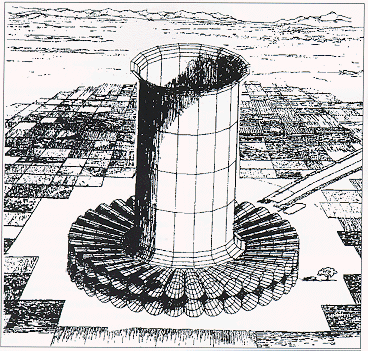
energy-tower-green-prophet.gif
Energy, we all need it for practically everything we do.

With global warming accelerating and fossil fuels expected to run out in decades, the hunt is on for alternative energy sources.

Professor Dan Zaslavsky from the Technion in Haifa has come up with a solution – the Energy Tower – which will not only reduce the costs of energy from our pockets but from our planet as well.

“It’s a radically simple idea. We could easily produce between 15 to 20 times the total electricity the world uses today,” he says.

Knafo Klimor Architects Design True "Green House" Living For China

3

knafo klimor israel china architects eco-apartment photoApartments for China, outfitted with individual greenhouses. We’d live in one of these eco-abodes.

Outdoor vegetable gardens are nice, but as it turns out, they are so 2007. Now Technion Institute researchers Tagit Klimor and David Knafo have developed a design for high-rise apartments that will have their own self-sustaining greenhouses.

The greenhouse spaces will enable families to grow produce for their own consumption, with enough left over to generate additional income.

Each apartment will have a trellised greenhouse space measuring approximately 100 feet. These areas would be climate controlled and employ a system that uses soilless growing media (such as coconut, peat and other organic mixtures), a liquid fertilization system, and an advanced drip irrigation system.

The irrigation system will use recycled water from the apartments and rainwater collected from the rooftop. The building will also feature solar heating and cooling systems and a geothermal system.

The True Cost of Free Parking in Tel Aviv

10

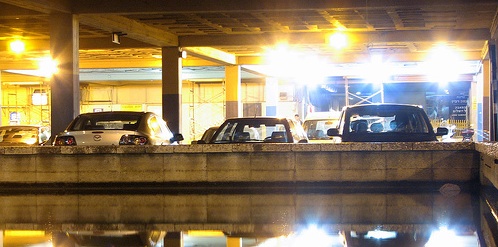
rabin-square-green-prophet.jpg
(Parking at Rabin Square and pool of water in the parking lot.)

People who live in Israel and who have to negotiate its roads might not feel that they have arrived in Gan Eden (“Eden”). As the standard of living increases on a yearly basis, so does the number of cars and parking lots. Any of our readers try and find a parking spot in north Tel Aviv on any given day of the week? You can circle for an hour and still be at a loss as to where to park – even for a fee.

The Porter School of Environmental Studies at Tel Aviv University recently held a conference to address their concerns about mushrooming parking lots in Israeli cities: “How much parking do we need in Israel’s major cities?” they ask.

“How long do we spend searching for a space to park? What are the costs of “free” parking? Is it time to start charging drivers a price that reflects the real cost of their parking place?”

Car drivers still enjoy free parking in many countries around the world. In the USA, for example, drivers park for free on 99% of all their car trips. Israel is certainly no exception to the rule. Even in Tel Aviv, the city with the highest demand for parking, most drivers still park for free or in exchange for an exceptionally small fee.Drivers may park for free, but is parking truly free?

As the saying goes, there is no such thing as a “free lunch.” And so it is with parking. The cost of parking is simply hidden – it has been transferred from the driver of the car to the general public.

When parking is free, we all want to use it. With free parking, car use goes up, and with it all the negative impacts in terms of search time, traffic congestion, environmental pollution, and road safety. Studies have shown that in some neighborhoods 74% of all car traffic consists of drivers searching for a parking place!

What are the solutions? So far, there is little agreement among experts or the public at large. Various suggestions have included limiting parking spaces or placing a tax on parking spaces around the city. While the solutions may still provide free parking, each of them comes with a cost. At the conference, both the academic world and the Tel Aviv Municipality presented approaches to escaping the parking deadlock.

As far as we are concerned, it’s better to ditch the car and take the bus or a moneet shirut.

Zenith Solar’s Light of a Thousand Suns

5
solar energy field in ramat hanegev
The year 2020 onwards will be the decade of action for renewable energy. This is a solar energy field in Israel’s Negev Desert.

Deep in the heart of the Negev Desert, there is but one natural resource: the sun. David Faiman from Ben Gurion University has found a way to use solar energy to concentrate the light of a 1,000 suns.

Using reflective mirrors made from silicon, David has built a series of mirrors that concentrate the penetrating desert rays back to a large reflector dish.

The solution is one of a few in the world that may make solar energy a viable energy alternative within the next few years. And if Faiman and his startup company Zenith Solar are right, their solution will be able to provide enough energy for 10% of Israel’s population (1,0000 MW) using only 12 square kilometres of land.

This equals pollution-free energy for about one million people.

Says Faiman: “Traditional photovoltaic cells do two things: collect sunlight and generate electricity from it. What we’ve done is simply split those two functions, so that the sunlight is collected and concentrated by a dish-shaped mirror, and a small number of concentrator cells generate electricity from that highly concentrated sunlight.

“Photovoltaic material is far too expensive to waste on something that can be accomplished with cheap glass and steel.”

People are dying in Israeli cities from pollution. New solutions can’t come fast enough.

Update: Zenith Solar filed for bankruptcy in 2013.

Breaking the Waves With SDE Energy

0

tel aviv hot beachAccording to a company press release the Israeli tidal wave energy company S.D.E. began talks with Sri Lankan officials to construct and install a 200 MW power plant at an estimated cost of $130 million.

If negotiations are successful, they say, the plant will be the first of its kind to produce electricity at a commercial quantity from sea waves.

Once the plant is completed and fully operated, an agreement is expected to be signed for the construction of more power plants on the island.