“In the midst of uncertain time, renewable energy remains consistent and steadfast in its expansion,” said Francesco La Camera, IRENA’s Director-General. “A more decentralised energy system, with a growing share of renewables and more market players, is structurally more resilient.”
Health insurance is a regulated financial product. Insurers operate under binding contracts, overseen by state insurance commissioners, that legally obligate them to pay claims meeting policy terms. Policyholders who believe a covered claim was wrongfully denied have legal recourse through state regulatory channels.
The New Zealand Merino Company, now rebranded as Zentera, has quietly removed the phrase “world’s leading ethical wool brand” from its website, a notable change that comes after a disturbing investigation by PETA Asia-Pacific into the company’s ZQ-certified wool supply chain, PETA reports to Green Prophet.
Somehow vegetables with short seasons excite the imagination and appetite more sharply than produce that’s available all year around. Good Middle Eastern cooks have many recipes for delicate fava beans, and this turmeric-fragrant soup is one.
“In the midst of uncertain time, renewable energy remains consistent and steadfast in its expansion,” said Francesco La Camera, IRENA’s Director-General. “A more decentralised energy system, with a growing share of renewables and more market players, is structurally more resilient.”
Health insurance is a regulated financial product. Insurers operate under binding contracts, overseen by state insurance commissioners, that legally obligate them to pay claims meeting policy terms. Policyholders who believe a covered claim was wrongfully denied have legal recourse through state regulatory channels.
The New Zealand Merino Company, now rebranded as Zentera, has quietly removed the phrase “world’s leading ethical wool brand” from its website, a notable change that comes after a disturbing investigation by PETA Asia-Pacific into the company’s ZQ-certified wool supply chain, PETA reports to Green Prophet.
Somehow vegetables with short seasons excite the imagination and appetite more sharply than produce that’s available all year around. Good Middle Eastern cooks have many recipes for delicate fava beans, and this turmeric-fragrant soup is one.
“In the midst of uncertain time, renewable energy remains consistent and steadfast in its expansion,” said Francesco La Camera, IRENA’s Director-General. “A more decentralised energy system, with a growing share of renewables and more market players, is structurally more resilient.”
Health insurance is a regulated financial product. Insurers operate under binding contracts, overseen by state insurance commissioners, that legally obligate them to pay claims meeting policy terms. Policyholders who believe a covered claim was wrongfully denied have legal recourse through state regulatory channels.
The New Zealand Merino Company, now rebranded as Zentera, has quietly removed the phrase “world’s leading ethical wool brand” from its website, a notable change that comes after a disturbing investigation by PETA Asia-Pacific into the company’s ZQ-certified wool supply chain, PETA reports to Green Prophet.
Somehow vegetables with short seasons excite the imagination and appetite more sharply than produce that’s available all year around. Good Middle Eastern cooks have many recipes for delicate fava beans, and this turmeric-fragrant soup is one.
“In the midst of uncertain time, renewable energy remains consistent and steadfast in its expansion,” said Francesco La Camera, IRENA’s Director-General. “A more decentralised energy system, with a growing share of renewables and more market players, is structurally more resilient.”
Health insurance is a regulated financial product. Insurers operate under binding contracts, overseen by state insurance commissioners, that legally obligate them to pay claims meeting policy terms. Policyholders who believe a covered claim was wrongfully denied have legal recourse through state regulatory channels.
The New Zealand Merino Company, now rebranded as Zentera, has quietly removed the phrase “world’s leading ethical wool brand” from its website, a notable change that comes after a disturbing investigation by PETA Asia-Pacific into the company’s ZQ-certified wool supply chain, PETA reports to Green Prophet.
Somehow vegetables with short seasons excite the imagination and appetite more sharply than produce that’s available all year around. Good Middle Eastern cooks have many recipes for delicate fava beans, and this turmeric-fragrant soup is one.
“In the midst of uncertain time, renewable energy remains consistent and steadfast in its expansion,” said Francesco La Camera, IRENA’s Director-General. “A more decentralised energy system, with a growing share of renewables and more market players, is structurally more resilient.”
Health insurance is a regulated financial product. Insurers operate under binding contracts, overseen by state insurance commissioners, that legally obligate them to pay claims meeting policy terms. Policyholders who believe a covered claim was wrongfully denied have legal recourse through state regulatory channels.
The New Zealand Merino Company, now rebranded as Zentera, has quietly removed the phrase “world’s leading ethical wool brand” from its website, a notable change that comes after a disturbing investigation by PETA Asia-Pacific into the company’s ZQ-certified wool supply chain, PETA reports to Green Prophet.
Somehow vegetables with short seasons excite the imagination and appetite more sharply than produce that’s available all year around. Good Middle Eastern cooks have many recipes for delicate fava beans, and this turmeric-fragrant soup is one.
“In the midst of uncertain time, renewable energy remains consistent and steadfast in its expansion,” said Francesco La Camera, IRENA’s Director-General. “A more decentralised energy system, with a growing share of renewables and more market players, is structurally more resilient.”
Health insurance is a regulated financial product. Insurers operate under binding contracts, overseen by state insurance commissioners, that legally obligate them to pay claims meeting policy terms. Policyholders who believe a covered claim was wrongfully denied have legal recourse through state regulatory channels.
The New Zealand Merino Company, now rebranded as Zentera, has quietly removed the phrase “world’s leading ethical wool brand” from its website, a notable change that comes after a disturbing investigation by PETA Asia-Pacific into the company’s ZQ-certified wool supply chain, PETA reports to Green Prophet.
Somehow vegetables with short seasons excite the imagination and appetite more sharply than produce that’s available all year around. Good Middle Eastern cooks have many recipes for delicate fava beans, and this turmeric-fragrant soup is one.
“In the midst of uncertain time, renewable energy remains consistent and steadfast in its expansion,” said Francesco La Camera, IRENA’s Director-General. “A more decentralised energy system, with a growing share of renewables and more market players, is structurally more resilient.”
Health insurance is a regulated financial product. Insurers operate under binding contracts, overseen by state insurance commissioners, that legally obligate them to pay claims meeting policy terms. Policyholders who believe a covered claim was wrongfully denied have legal recourse through state regulatory channels.
The New Zealand Merino Company, now rebranded as Zentera, has quietly removed the phrase “world’s leading ethical wool brand” from its website, a notable change that comes after a disturbing investigation by PETA Asia-Pacific into the company’s ZQ-certified wool supply chain, PETA reports to Green Prophet.
Somehow vegetables with short seasons excite the imagination and appetite more sharply than produce that’s available all year around. Good Middle Eastern cooks have many recipes for delicate fava beans, and this turmeric-fragrant soup is one.
“In the midst of uncertain time, renewable energy remains consistent and steadfast in its expansion,” said Francesco La Camera, IRENA’s Director-General. “A more decentralised energy system, with a growing share of renewables and more market players, is structurally more resilient.”
Health insurance is a regulated financial product. Insurers operate under binding contracts, overseen by state insurance commissioners, that legally obligate them to pay claims meeting policy terms. Policyholders who believe a covered claim was wrongfully denied have legal recourse through state regulatory channels.
The New Zealand Merino Company, now rebranded as Zentera, has quietly removed the phrase “world’s leading ethical wool brand” from its website, a notable change that comes after a disturbing investigation by PETA Asia-Pacific into the company’s ZQ-certified wool supply chain, PETA reports to Green Prophet.
Somehow vegetables with short seasons excite the imagination and appetite more sharply than produce that’s available all year around. Good Middle Eastern cooks have many recipes for delicate fava beans, and this turmeric-fragrant soup is one.
It’s bad for the environment, but you know you want it. You want those strawberries in the dead of winter. You know you should be eating local produce year round to avoid all of the carbon emissions associated with flying in food from distant places or using energy guzzling greenhouses to grow produce that is out of season… but we’re spoiled modern folk and sometimes you just want those strawberries in January.
Thanks to 2 year old Israeli company, Trio Energy Systems, we may be able to satisfy those cravings with a little less guilt. Having taken into account that the reason most greenhouses waste energy is because a lot of energy is required in order to keep them warm during colder weather and much of the heat dissipates, they’ve come up with a solution that minimizes energy consumption in the greenhouse.
There is a yearning for ecologically and environmentally responsible choices that I’ve been observing in Tel Aviv, especially among a select group of young, influential artists. There are continual hurdles for them, though, showing how sometimes thinking green and acting green don’t always go hand in hand.
Hayarkon 70 is a disparate group of artists in Tel Aviv that meets a few times a week in an old run-down apartment. The group also runs and operates an artist gallery that also houses studios and offices for a number of young artists. They host many parties and gallery openings and rooftop concerts and add a unique culture to Tel Aviv. I see this community as representative of the general desire many Israelis have to improve their ways, reflecting the demand there is for green technology and services that are practical, easy and affordable.
My first interaction with this community came as members were discussing whether or not to make a full switch to Ecover dish soap at a weekly meeting, and for a brief while there was Ecover in the kitchen because someone met a supplier and got a good deal. After the Ecover meeting most people are aware that Ecover is better than regular dish soap (or maybe not?) but in the shared kitchen of artist studios, when dish soap runs out, some artist who needed to clean dishes and either missed the meeting or didn’t want to spend the extra money goes and buys the green fairy junk and then everybody is stuck finishing off the conventional soap.
Man, alternative energy solutions can’t come fast enough. The world is teetering on the verge of runaway climate change (some predictors say there’s less than 100 months), and gas prices are killing us not only at the gas station, but are affecting everything we buy from food to clothes to you name it. Racing to get an edge in the market is America’s AES, who’s obviously got a serious interest and investment in Israeli clean technology.
Green Prophet reported a massive wind energy deal AES was in with Mey Golan (estimated $500 million), and now we read, the company is keen on investing in Israeli biofuel through GNRY. According to Globes (who we are not going to link to because they archive after 1 week), AES Corporation is in negotiations to invest in the Israeli alternative energy company GNRY Ltd to the tune of a deal worth NIS 25-27 million ($8 million).
But now there’s another way to tour Israel without getting into a car, a train, a bus, or a plane. Run the City sightjogging.
The first sightjogging company in Israel (which promotes sightseeing as you jog), Run the City currently offers various running tours of Tel Aviv and Jerusalem. Their team of experienced recreational runners will pick you up from your hotel and run you around town, pointing out sights of historical and cultural interest based on the tour you selected. (And if you can’t remember the last time you put on those running shoes, don’t worry – they promise you’ll still be smiling throughout the run.)
In this week’s green book review, guest reviewer Rabbi Julian Sinclair unpicks the recent ‘Breakthrough’ by US writers Ted Nordhaus & Michael Shellenberger.
Last month Al Gore gave a rousing speech on climate change, throwing down an audacious challenge to the American people. By 2020, Gore declared, let American by powered 100% by renewable sources of energy.
Gore appealed to the Apollo Project as the model for an enterprise of such grandeur. In 1961 President Kennedy announced his goal that America put a man on the moon within a decade. Kennedy’s challenge captured America’s imagination and galvanized the American computer, aeronautics and space industries. As wildly ambitious as the aim at first appeared, the United States reached it with 15 months to spare. In his speech, Gore announced that we need a new Apollo Mission for energy today.
Painting a vision of this magnitude represented something of a departure for Al Gore in his thinking about how to move people on climate change. He has done more than anyone to raise awareness of the issue, but at first he appeared to think that simply laying out the inconvenient truth about global warming would be sufficient to mobilize action. When it didn’t, he started musing about the inconvenient evolution of the human fear gland that was designed to respond to immediate, emotional stimuli rather than cognitive and scientific input.
If you cook in bulk you will be making efficient use of your oven’s energy. Cook meals in large quantities, and set aside extra portions for another day. Professional chefs will tell you that for them cooking a meal for 6 and 60 takes almost the same prep-work.
When you’re done portion and freeze it. Reheating uses less energy than preparing a new meal and will save you time too. This will also help keep your freezer running more efficiently.
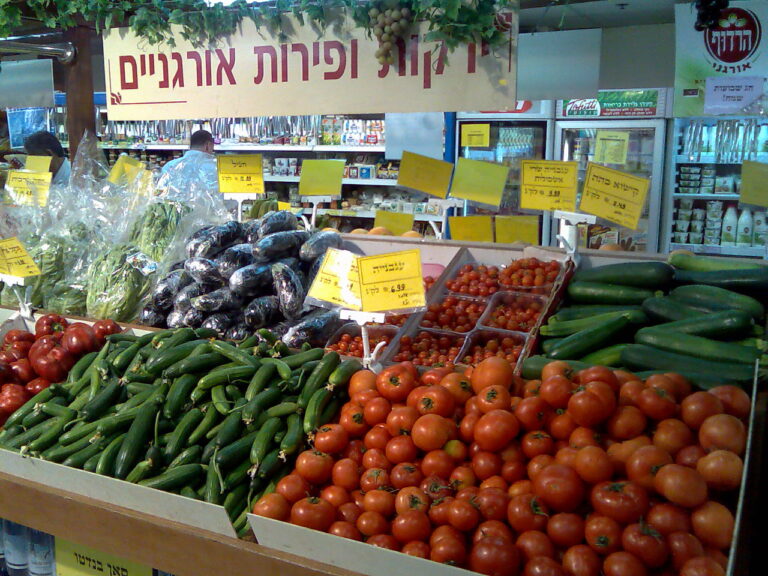
If you’re going to shell out the extra shekels for organic food, you’re want to be confident that you’re getting the real deal.
Personally, I think the price of organic food is worth paying, whether you’re buying it for selfish reasons (taste, avoiding nasty chemicals and GMOs) or altruistic ones (treading lightly our small country) and until recently, as far as I was concerned, anything in Israel labelled with the O-Word must be licensed and inspected by a government-authorised organisation.
So it came as a surprise to find out recently that organic labelling in Israel isn’t such as a clear-cut issue. A new law was passed by the Knesset last week with the intention of ensuring that organic food on sale in Israel really is organic. But the Israel Bio-organic Agriculture Association (IBOAA) claims that the law will not prohibit or limit the use of the term ‘organic’, and that any farmer will still be able to label his produce as they wish, reports Ha’aretz.
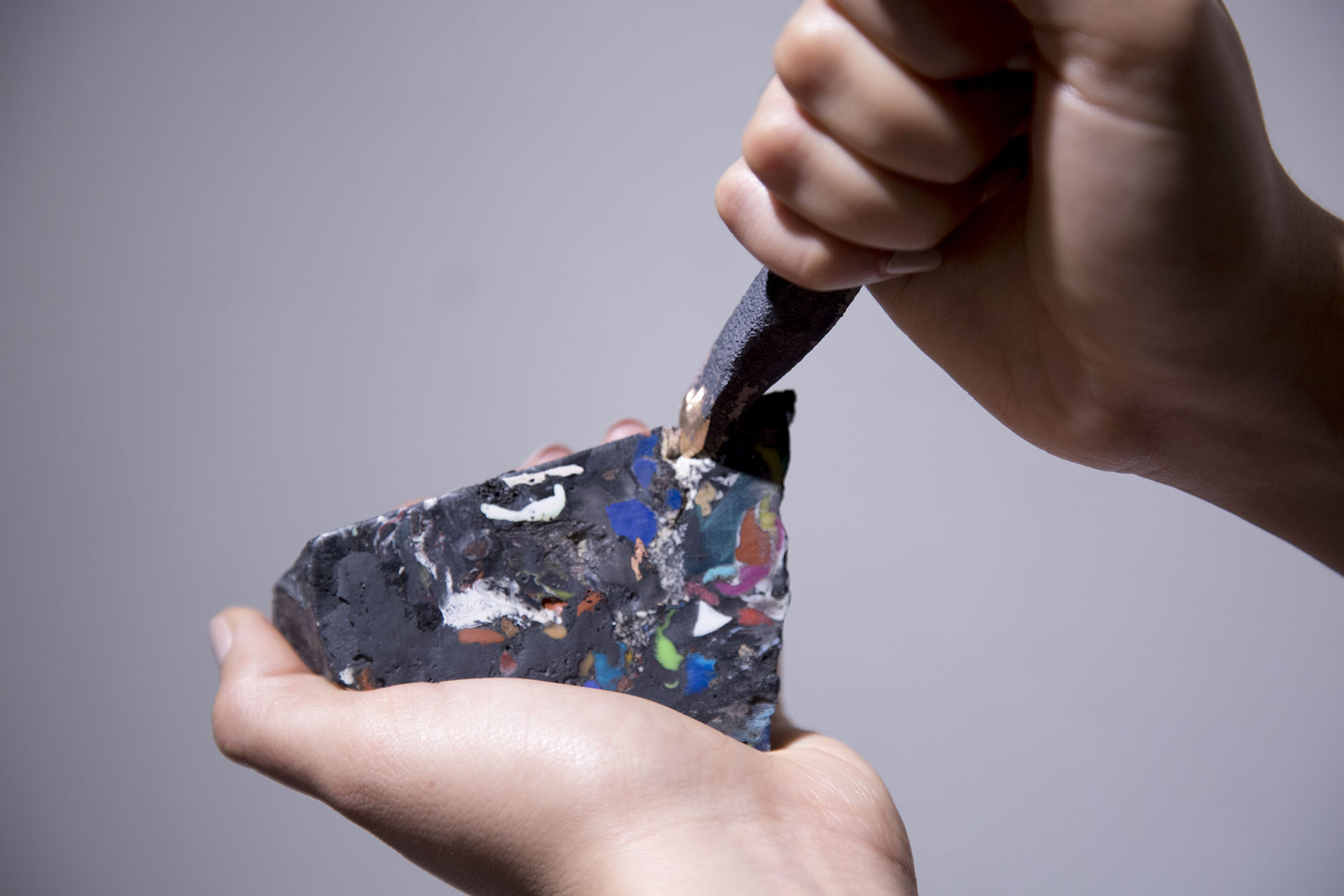
Lithoplast, a new material from old plastic by Shahar Livne
Here at Green Prophet we’re big fans of environmentally friendly design. While it is greener, of course, to be a minimalist and avoid purchasing new products altogether – that sort of extreme attitude works for only a limited number of eco folks. For the rest of us, we can alleviate our consciences by supporting sustainable products.
So what is sustainable design?
Sustainable design (which is sometimes also referred to as eco design, green design, or environmentally friendly design) is the design of objects, buildings, you-name-it in compliance with the principles on environmental, social, and economic sustainability.
On Green Prophet, we’ve featured a range of sustainable designers – ranging from those who upcycle existing waste materials into new products (thus avoiding having perfectly good materials end up in landfills and eliminating the need to use additional resources), to those who create products that generate their own energy, to those who use resources harvested organically with sustainable agricultural practices. The possibilities are endless.
To recap some of our favorites, here’s a hitlist of 10 sustainable Israeli designers that deserve our support.
1. Elanit Neutra, handbag designer extraordinaire, encourages us to get more mileage out of our purses by creating her designs out of recycled tire inner tubes. If you think her designs are only suitable for female auto mechanics and other various tomboys – think again. The chic black tones and geometric ridges of the tires make for an unforgettable fashion statement.
Inbal Dayagi
2. In other sustainable accessories, Inbal Dayagi has created an alternative to the energy-guzzling iPod. Her space-age looking boom box that is based on the aesthetics of the hula hoop not only looks cool, but its wheels recharge the music maker’s batteries as you groove along. Groovy sustainable grooves.
3. Street cool is also a factor in Abu YoYo‘s line of bags, wallets, book covers, kitchen accessories and purses made out of nothing other than street-side advertising – billboard material. Abu YoYo uses the existing designs and logos on the materials and takes them one step cooler. Considering the fact that about 6,900 meters of the toxic plastic substance are produced and disposed of in Tel Aviv alone every month – she’s doing us all a green and beautiful favor.
4. Men’s suits have never been more sustainable than with Israeli clothing company, Bagir’s, Eco-GIR line – where every suit is made of out 100% recycled materials (namely, 30 PET plastic bottles). Now that’s what I call Eurotrash. Good Eurotrash. And for those men not brave enough to wear a plastic suit just yet, Bagir also makes suits out of organic cotton.
5. For the ladies looking to build a more sustainable wardrobe, Cotton’s organic clothes are soft on the environment. Cotton’s motto, Individuality, Comfort, and Care for the Environment shows in the company’s actions: they use only organic cotton, produce all of their clothes in Israel (eliminating unnecessary transportation and carbon emissions), and feature environmental messages in their window displays and catalogs.
6. In the sustainable art scene, Inbal Limor recycles ubiquitous and omnipresent plastic bags into high art. Using the plastic bags that her family and friends religiously collect for her, she transforms the material into sculptures and frame-able artwork. Lucky for us, because otherwise these nasty non-biodegradable bags would end up in some gross landfill.
Yoav Kotik earrings
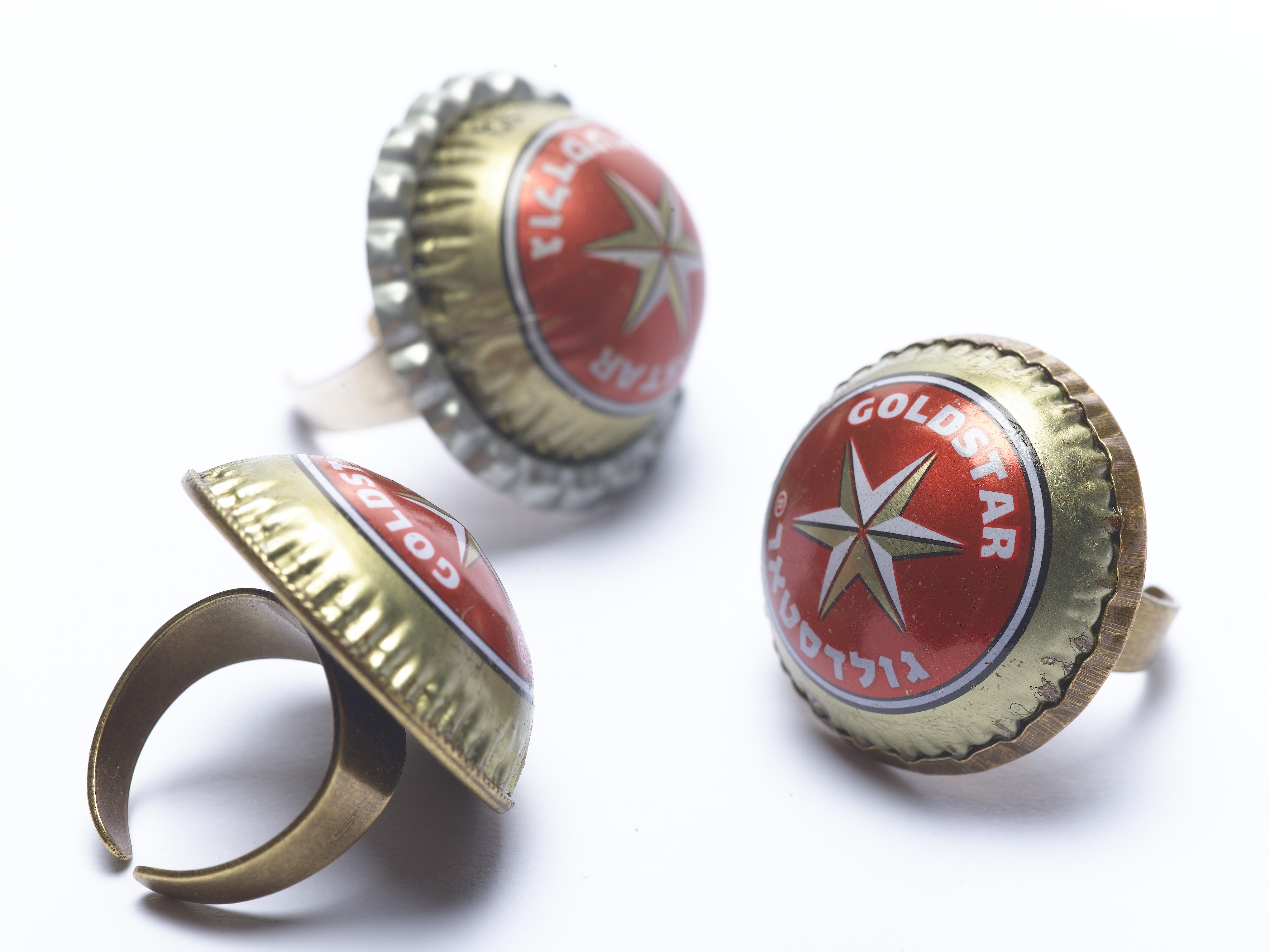
7. Yoav Kotik, another Israeli recycle artist, uses mostly aluminum cans, caps, and paraphernalia as his medium. Having recently exhibited an exhibition of recycled spring flowers at the Periscope Gallery in Tel Aviv, Kotik also creates light fixtures, home accessories, and jewellery made out of Israeli beer caps.
In the artist statement accompanying his recent show, he explained that he wishes to challenge the concept of what is considered garbage. We couldn’t agree more.
Lots of people these days make light of trash, not understanding how serious its effects are on the environment. Merav Feiglin turns that around and creates wonderful, whimsical, hilarious Trashlights. Combining bizarre and unusual materials such as shaving brushes, Barbie dolls, coffee grinders, and rubber alligators, her lamps truly have something for everyone. Sustainably speaking, her creations prevent these unusable items from ending up in the trash if they are your thing.
In terms of design, since many of the elements are old, her lamps have a warm retro feel. Nothing trashy about that.
9. In other trash design, Erez Mulay creates wastepaper baskets made out of… wasted paper. Pun intended. The materials used in his clever design reflect the function of the product itself (and find a use for hard-to-recycle glossy magazine paper). Even better, Mulay hires people with emotional disabilities to make the baskets – thus making his products environmentally and socially sustainable. Well done.
10. The last of our ten sustainable Israeli designers is Tel Aviv based design studio, Junktion, which stands at the intersection of waste and whimsy. Using whatever discarded materials they find in the city, they reinvent existing materials in clever, funny, and thought provoking ways. Our favorite is the suitcase-turned-medicine cabinet. (The bicycle chair, at the top of the post, isn’t too shabby either.)
Shahar Livne mines plastic waste
Got a great sustainable designer to tell us about? Like Shahar Livne? Share it with us via [email protected] we we will add their name to an upcoming story.
For most people, solar energy conjures up images of rectangular panels on roofs or lined up in rows somewhere in the middle of the desert. And indeed, this is what we can expect to see over the next few years, as Israel begins to develop its most significant natural (and renewable) resource – the sun.
But how will the next generation of solar energy look? Could solar energy production transcend its sterile, technical image and become an element that actually enriches the landscape?
Here is a good example of how it could do just that.
How many shades of green can a Jaffa orange be? Israeli fruit and vegetable grower and supplier Mehadrin (owned by Hadarim, a property and building group, and a succession of other parent companies) is working with British supermarket chain Tesco in a bid to mark all its Jaffa oranges with the Carbon Trust label, a carbon footprint. This label will show that 125kg of carbon per kilogram of oranges was used or created during the growing, handling and shipping of the product.
Mehadrin is so far the only Israeli food company to be working on displaying the carbon measurement of its products (see Bagir, which is carbon labeling its eco suits), and in doing so is cleverly tapping into environmental issues that are close to many British consumers’ hearts (and I speak as a sensitive British consuming expat).
During the summertime if you put your shades (trisim) down in the morning it will help keep your house cooler for the rest of the day. And don’t just use shades for your house! With the right name-brands you too can be cool as your protect your eyes…
Last Thursday fifty Muslim clerics gathered in Umm el-Fahm for a conference to raise awareness regarding environmental issues among imams. The first of its kind, the conference was an important stepping stone in improving the quality of the environment in Israeli-Arab towns.
Organized partially by the director of Environmental Quality Unit Northern Triangle and long term environmental and social activist, Mohammad Rabah Aghbarieh, the event was held at the Umm el-Fahm Science and Art Center.
In addition to helping organize the conference, Rabah Aghbarieh prepared materials together with the Environmental Protection Ministry that every imam took home. These materials included a poster with an outline of basic environmental guidelines to be hung in his mosque, stickers stating that environmental protection is a religious commandment, and a CD containing sources from the Koran and hadith supporting environmental issues, general environmental information sources, a movie about the ministry, and other informational resources.
Tons of soot is being released into the air annually as forest fires rage from California to the Amazon to Siberia and Indonesia. Climate scientists have generally assumed that the main effect of smoke on climate is cooling, as the floating particles can reflect some solar energy back to space as well as increasing cloud size and lifespan. But new joint research at the Weizmann Institute of Science, the University of Maryland, Baltimore County (UMBC), and NASA may cause them to rethink soot’s role in shaping the Earth’s climate.
Air-borne particles such as soot – known collectively as aerosols – rise into the atmosphere where they interact with clouds. Understanding what happens when the two meet is extremely complicated, in part because clouds are highly dynamic systems that both reflect the sun’s energy back into space, cooling the upper atmosphere, and trap heat underneath, warming the lower atmosphere and the Earth’s surface. Aerosols, in turn, can have both heating and cooling effects on clouds.
On the one hand, water droplets form around the aerosol particles and these may extend the cloud cover. On the other hand, particles, especially soot, absorb the sun’s radiation, stabilizing the atmosphere and thus reducing cloud formation.
“Nature is a language – can’t you read? Nature is a language – can’t anybody read?”
Morrissey & Marr: The Smiths, ‘Ask’ (1986) as played live in Tel Aviv last week.
We here at Green Prophet don’t often blow our own green shofar, but it’s always good to get praise from others, particularly when it’s in the national media. We were delighted last week to be described in a Ha’aretz books supplement book review as: “the useful (and, yes, hip) Israeli environmental blog in English.”
Thanks to the writer Daniel Orenstein, a postdoctoral fellow at the Technion and a faculty member of the Arava Institute, for that. Orenstein’s kind words came in the middle of a powerful review that blossomed into an overview of the burgeoning green revolution here in Israel: what the situation is, and what we as Individuals can do, as well as the politicians (see MK Dr. Dov Khenin’s plans for greening Tel Aviv sustainably here).
He ends his review, titled ‘What do we do now?’ with a punchy call for action from all of us, and emphasises the need for us to apply pressure to those with political clout:
“Greening should be a project we can all engage in. For this to be the case, we need legislation that will place the proper incentives on environmentally sound decisions, help people pay for the high up-front costs of energy efficiency, and make polluters pay for environmentally damaging activities. And for that, we need an abundance of genuine environmental advocates sitting in [the] Knesset whose concerns are for the long-term well-being of the land and people of Israel.”






 As the Green Prophet archives will tell you, Israel is no stranger to environmentally friendly tourism. Not only is there a variety of

















 And don’t just use shades for your house! With the right name-brands you too can be cool as your protect your eyes…