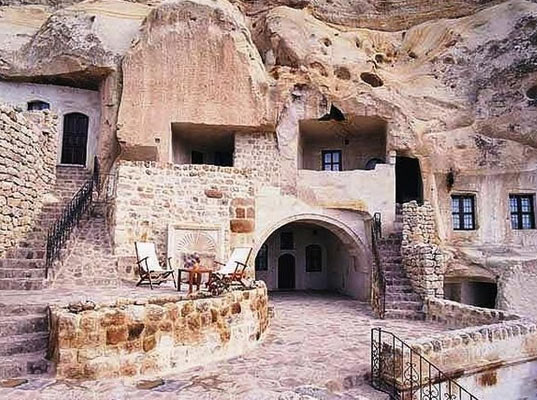
Carved out of volcanic rock, these 700-year-old homes have survived seven centuries. Now that’s what we call sustainable.
Since we wrote about Hassan Fathy’s mud buildings, we’ve been dying to find other examples of such earthy architecture in the Middle East. We later stumbled upon the House of Saud. Turns out that royalty once lived in mud huts.
Certainly modern inventions are worth mentioning, such as Ginger Dosier’s home-grown bricks, as are efforts to preserve existing structures such as Bahrain’s architectural heritage. But nothing we’ve encountered yet deserves the eco, efficient, friendly, green, sustainable award as much as these seven century old cave homes that are for rent or for sale in Iran.
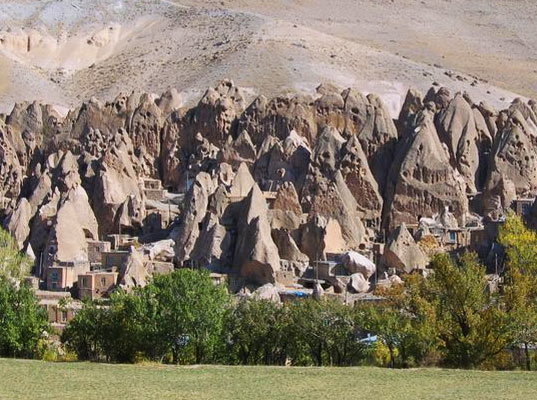
They look like they might have been conceived by Salvador Dali and built by Antoni Gaudí, but indeed these cave homes are much much older than that.
Carved into the volcanic rock at the foot of Mt. Sahand in Northeast Iran, the homes comprise both under and above ground space.
The underground spaces benefit from lower temperatures, thus reducing the energy requirement for cooling in this arid region. And the rest of the buildings have been updated with modern doors, windows and other fittings.
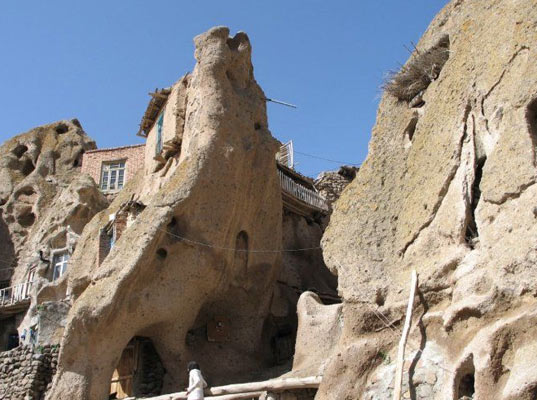
Inconceivably, these homes are either for rent or for sale, and are surrounded by various hotels, restaurants, and reportedly, special mineral water that has “healing properties.”
Might these buildings suggest that what is of the earth can be cool, too? We think so, though we don’t necessarily recommend that you chisel into your nearest dells without professional help, and perhaps a permit too.
More architecture news from the Middle East:
Interview With Entity Green, Jordan’s Sustainable Development Organization
Foster + Partners in Jordan: What’s Sustainable About a Green Airport?
Architectural Design To Memorialize Assault On Free Speech In Turkey
 Solar Millennium AG is the next in a string of companies to withdraw its bid from the tumultuous Ashelim tender in Israel.
 A weekly Green Prophet series that looks at the Arabic “green” blogosphere and online communities.
 Dubai’s government is developing more organic farms, but oil-dependent desalination plants used for water casts a shadow on their carbon footprint