Kansas City is attempting to revive protections against conversion therapy with a new ordinance carefully designed to withstand recent First Amendment challenges. Rather than banning conversion therapy by name, the proposal targets harmful therapeutic practices linked to increased risks of depression and self-harm, creating what supporters hope could become a legal model for other U.S. cities.
Choosing a sustainable senior living community means looking beyond appearances to care quality, nutrition, safety, social connection, and long-term well-being.
NuCicer has developed Nuchi, a new class of chickpea with 50% more protein and 25% less fat than conventional varieties. Co-founder Kathryn Cook explains how wild chickpea genetics, AI-guided breeding, and centuries-old biodiversity could transform the future of sustainable protein.
Canada's forests generate billions of dollars in economic value each year, yet vast amounts of irregular timber are downgraded to wood chips or biomass. A collaboration between researchers at Carleton University and Aalto University is challenging that model, demonstrating how "ugly wood" can be transformed into high-value architecture while reducing waste and storing more carbon in buildings.
Corporate training videos often require repeated filming, travel, and production resources every time policies or personnel change. AI-powered face swap tools offer a more sustainable approach by extending the life of digital training content, reducing unnecessary reshoots, and helping organizations communicate more efficiently—provided they are used transparently with clear consent and ethical governance.
Kansas City is attempting to revive protections against conversion therapy with a new ordinance carefully designed to withstand recent First Amendment challenges. Rather than banning conversion therapy by name, the proposal targets harmful therapeutic practices linked to increased risks of depression and self-harm, creating what supporters hope could become a legal model for other U.S. cities.
Choosing a sustainable senior living community means looking beyond appearances to care quality, nutrition, safety, social connection, and long-term well-being.
NuCicer has developed Nuchi, a new class of chickpea with 50% more protein and 25% less fat than conventional varieties. Co-founder Kathryn Cook explains how wild chickpea genetics, AI-guided breeding, and centuries-old biodiversity could transform the future of sustainable protein.
Canada's forests generate billions of dollars in economic value each year, yet vast amounts of irregular timber are downgraded to wood chips or biomass. A collaboration between researchers at Carleton University and Aalto University is challenging that model, demonstrating how "ugly wood" can be transformed into high-value architecture while reducing waste and storing more carbon in buildings.
Corporate training videos often require repeated filming, travel, and production resources every time policies or personnel change. AI-powered face swap tools offer a more sustainable approach by extending the life of digital training content, reducing unnecessary reshoots, and helping organizations communicate more efficiently—provided they are used transparently with clear consent and ethical governance.
Kansas City is attempting to revive protections against conversion therapy with a new ordinance carefully designed to withstand recent First Amendment challenges. Rather than banning conversion therapy by name, the proposal targets harmful therapeutic practices linked to increased risks of depression and self-harm, creating what supporters hope could become a legal model for other U.S. cities.
Choosing a sustainable senior living community means looking beyond appearances to care quality, nutrition, safety, social connection, and long-term well-being.
NuCicer has developed Nuchi, a new class of chickpea with 50% more protein and 25% less fat than conventional varieties. Co-founder Kathryn Cook explains how wild chickpea genetics, AI-guided breeding, and centuries-old biodiversity could transform the future of sustainable protein.
Canada's forests generate billions of dollars in economic value each year, yet vast amounts of irregular timber are downgraded to wood chips or biomass. A collaboration between researchers at Carleton University and Aalto University is challenging that model, demonstrating how "ugly wood" can be transformed into high-value architecture while reducing waste and storing more carbon in buildings.
Corporate training videos often require repeated filming, travel, and production resources every time policies or personnel change. AI-powered face swap tools offer a more sustainable approach by extending the life of digital training content, reducing unnecessary reshoots, and helping organizations communicate more efficiently—provided they are used transparently with clear consent and ethical governance.
Kansas City is attempting to revive protections against conversion therapy with a new ordinance carefully designed to withstand recent First Amendment challenges. Rather than banning conversion therapy by name, the proposal targets harmful therapeutic practices linked to increased risks of depression and self-harm, creating what supporters hope could become a legal model for other U.S. cities.
Choosing a sustainable senior living community means looking beyond appearances to care quality, nutrition, safety, social connection, and long-term well-being.
NuCicer has developed Nuchi, a new class of chickpea with 50% more protein and 25% less fat than conventional varieties. Co-founder Kathryn Cook explains how wild chickpea genetics, AI-guided breeding, and centuries-old biodiversity could transform the future of sustainable protein.
Canada's forests generate billions of dollars in economic value each year, yet vast amounts of irregular timber are downgraded to wood chips or biomass. A collaboration between researchers at Carleton University and Aalto University is challenging that model, demonstrating how "ugly wood" can be transformed into high-value architecture while reducing waste and storing more carbon in buildings.
Corporate training videos often require repeated filming, travel, and production resources every time policies or personnel change. AI-powered face swap tools offer a more sustainable approach by extending the life of digital training content, reducing unnecessary reshoots, and helping organizations communicate more efficiently—provided they are used transparently with clear consent and ethical governance.
Kansas City is attempting to revive protections against conversion therapy with a new ordinance carefully designed to withstand recent First Amendment challenges. Rather than banning conversion therapy by name, the proposal targets harmful therapeutic practices linked to increased risks of depression and self-harm, creating what supporters hope could become a legal model for other U.S. cities.
Choosing a sustainable senior living community means looking beyond appearances to care quality, nutrition, safety, social connection, and long-term well-being.
NuCicer has developed Nuchi, a new class of chickpea with 50% more protein and 25% less fat than conventional varieties. Co-founder Kathryn Cook explains how wild chickpea genetics, AI-guided breeding, and centuries-old biodiversity could transform the future of sustainable protein.
Canada's forests generate billions of dollars in economic value each year, yet vast amounts of irregular timber are downgraded to wood chips or biomass. A collaboration between researchers at Carleton University and Aalto University is challenging that model, demonstrating how "ugly wood" can be transformed into high-value architecture while reducing waste and storing more carbon in buildings.
Corporate training videos often require repeated filming, travel, and production resources every time policies or personnel change. AI-powered face swap tools offer a more sustainable approach by extending the life of digital training content, reducing unnecessary reshoots, and helping organizations communicate more efficiently—provided they are used transparently with clear consent and ethical governance.
Kansas City is attempting to revive protections against conversion therapy with a new ordinance carefully designed to withstand recent First Amendment challenges. Rather than banning conversion therapy by name, the proposal targets harmful therapeutic practices linked to increased risks of depression and self-harm, creating what supporters hope could become a legal model for other U.S. cities.
Choosing a sustainable senior living community means looking beyond appearances to care quality, nutrition, safety, social connection, and long-term well-being.
NuCicer has developed Nuchi, a new class of chickpea with 50% more protein and 25% less fat than conventional varieties. Co-founder Kathryn Cook explains how wild chickpea genetics, AI-guided breeding, and centuries-old biodiversity could transform the future of sustainable protein.
Canada's forests generate billions of dollars in economic value each year, yet vast amounts of irregular timber are downgraded to wood chips or biomass. A collaboration between researchers at Carleton University and Aalto University is challenging that model, demonstrating how "ugly wood" can be transformed into high-value architecture while reducing waste and storing more carbon in buildings.
Corporate training videos often require repeated filming, travel, and production resources every time policies or personnel change. AI-powered face swap tools offer a more sustainable approach by extending the life of digital training content, reducing unnecessary reshoots, and helping organizations communicate more efficiently—provided they are used transparently with clear consent and ethical governance.
Kansas City is attempting to revive protections against conversion therapy with a new ordinance carefully designed to withstand recent First Amendment challenges. Rather than banning conversion therapy by name, the proposal targets harmful therapeutic practices linked to increased risks of depression and self-harm, creating what supporters hope could become a legal model for other U.S. cities.
Choosing a sustainable senior living community means looking beyond appearances to care quality, nutrition, safety, social connection, and long-term well-being.
NuCicer has developed Nuchi, a new class of chickpea with 50% more protein and 25% less fat than conventional varieties. Co-founder Kathryn Cook explains how wild chickpea genetics, AI-guided breeding, and centuries-old biodiversity could transform the future of sustainable protein.
Canada's forests generate billions of dollars in economic value each year, yet vast amounts of irregular timber are downgraded to wood chips or biomass. A collaboration between researchers at Carleton University and Aalto University is challenging that model, demonstrating how "ugly wood" can be transformed into high-value architecture while reducing waste and storing more carbon in buildings.
Corporate training videos often require repeated filming, travel, and production resources every time policies or personnel change. AI-powered face swap tools offer a more sustainable approach by extending the life of digital training content, reducing unnecessary reshoots, and helping organizations communicate more efficiently—provided they are used transparently with clear consent and ethical governance.
Kansas City is attempting to revive protections against conversion therapy with a new ordinance carefully designed to withstand recent First Amendment challenges. Rather than banning conversion therapy by name, the proposal targets harmful therapeutic practices linked to increased risks of depression and self-harm, creating what supporters hope could become a legal model for other U.S. cities.
Choosing a sustainable senior living community means looking beyond appearances to care quality, nutrition, safety, social connection, and long-term well-being.
NuCicer has developed Nuchi, a new class of chickpea with 50% more protein and 25% less fat than conventional varieties. Co-founder Kathryn Cook explains how wild chickpea genetics, AI-guided breeding, and centuries-old biodiversity could transform the future of sustainable protein.
Canada's forests generate billions of dollars in economic value each year, yet vast amounts of irregular timber are downgraded to wood chips or biomass. A collaboration between researchers at Carleton University and Aalto University is challenging that model, demonstrating how "ugly wood" can be transformed into high-value architecture while reducing waste and storing more carbon in buildings.
Corporate training videos often require repeated filming, travel, and production resources every time policies or personnel change. AI-powered face swap tools offer a more sustainable approach by extending the life of digital training content, reducing unnecessary reshoots, and helping organizations communicate more efficiently—provided they are used transparently with clear consent and ethical governance.
A Namibian-German artist evoked enraged responses to his photographs of models wearing coronavirus masks created from common household goods including footwear, underwear, vegetables, and disposable panty liners.
The Instagram series, called “How-To Survive A Deadly Global Virus”, attracted angry viewer comments, with many describing the project as insensitive, offensive, and guilty of spreading dangerous misinformation. (See the project in full on the artist’s website – link here.)
Artist/designer Max Siedentopf quickly apologized to those offended by the images. “I apologize to everyone that felt offended by the series”, he said in a press release, “It was never my intention.”
“My work takes a critical and often ironical look at our surroundings,” he added. “It’s important for me to take people out of their comfort zone and see things from a different perspective, both positively and negatively.”
Said Siedentopf, “Ultimately, it’s up to them to interpret my work as they want to.”
Seidentopft created the series after viewing photos of people fearful of contracting coronavirus wearing all manner of makeshift masks. The acceleration of the COVID-19 pandemic has massively disrupted supply chains and incited an unprecedented (and ill-informed) consumer run. It’s likely that readers who venture outside – in any zip code – have seen people wearing painters’ masks, t-shirts, swaths of fabric, old Halloween masks, and headscarves tied across their mouths and noses, all a misguided means of self-protection. Better we all simply stay indoors. And follow sensible natural precautions like these described by Green Prophet Miriam Kresh.
Enter the mythology of masks. Common painter masks found at hardware stores screen out harmly vapors from the wearer. Surgical masks are designed to protect people from the mask wearer. The coveted and critically-needed N95 masks are respirators that can filter out 95 percent of airborne particles that can carry viruses (like SARS-CoV-2, which causes COVID-19).
Ironically, Wuhan, China – where the virus originated – is a manufacturing hub for masks. Before the outbreak, China produced about 50 percent of the world’s sanitary masks (7 billion a year) and 90 percent of the surgical masks used in the United States. Ravaged by coronavirus, the manufacturing shutdown on China’s Hubei province has manufacturers in Europe, Israel, Japan, and the United States are struggling to meet global demand.
Experts generally agree that N95 masks have little value in the community. United States surgeon general Jerome Adams has tweeted, “Seriously people – STOP BUYING MASKS! They are NOT effective in preventing general public from catching coronavirus, but if healthcare providers can’t get them to care for sick patients, it puts them and our communities at risk!”
Back to Siedentopf, who said he made the series of portraits to draw attention to paranoia and media coverage of the outbreak, not to make light of the global health crisis.
“I was expecting to uncloud the subject a little, focusing on the creativity of the masks and how you can find smart and creative solutions, as over the last two weeks there has been a lot of media clickbait paranoia around the virus, even though the Chinese Centre for Disease Control reported that over 80 per cent of cases have been extremely mild,” he explained.
“To put this into perspective, Malaria kills one to three million people per year, but you don’t see the news and public going crazy about that.” According to the Johns Hopkins global virus tracker as of this post reports over 681,000 confirmed cases with nearly 32,000 deaths.
The World Health Organization (WHO) has published advice on basic protective measures against coronavirus on its website, which includes washing hands regularly and maintaining distance from other people. (Link here.)
Stay home, stay safe, wash your hands, and read Green Prophet for inspirational, educational, and uplifting news.
Have you ever considered how long things take to deconstruct?
Every Easter in my life has included the après holiday hunt for the lone lost egg. After dying and decorating, hiding and hunting, one egg always gets left behind. It takes a week before its rotten stink leads reveals its hiding place – stuck behind a cushion, tucked in a shoe, growing mold in a flowerpot.
It’s a family joke; a holiday tradition. In a deodorized and sanitized first-world society, we’re mostly removed from the reality of natural decay. The following stats come from the U.S. National Park Service on how long it takes your trash to decompose.
That list is notional, since materials decompose differently depending on temperature, oxygen levels, presence of water, and chemical recipe of surrounding matter. And material degrades differently in the ocean.
It’s springtime, a time of renewal. But maybe spend a little time pondering the death of things. It may influence your product choices, and ensure that out longest lasting legacy isn’t the trash we generate.
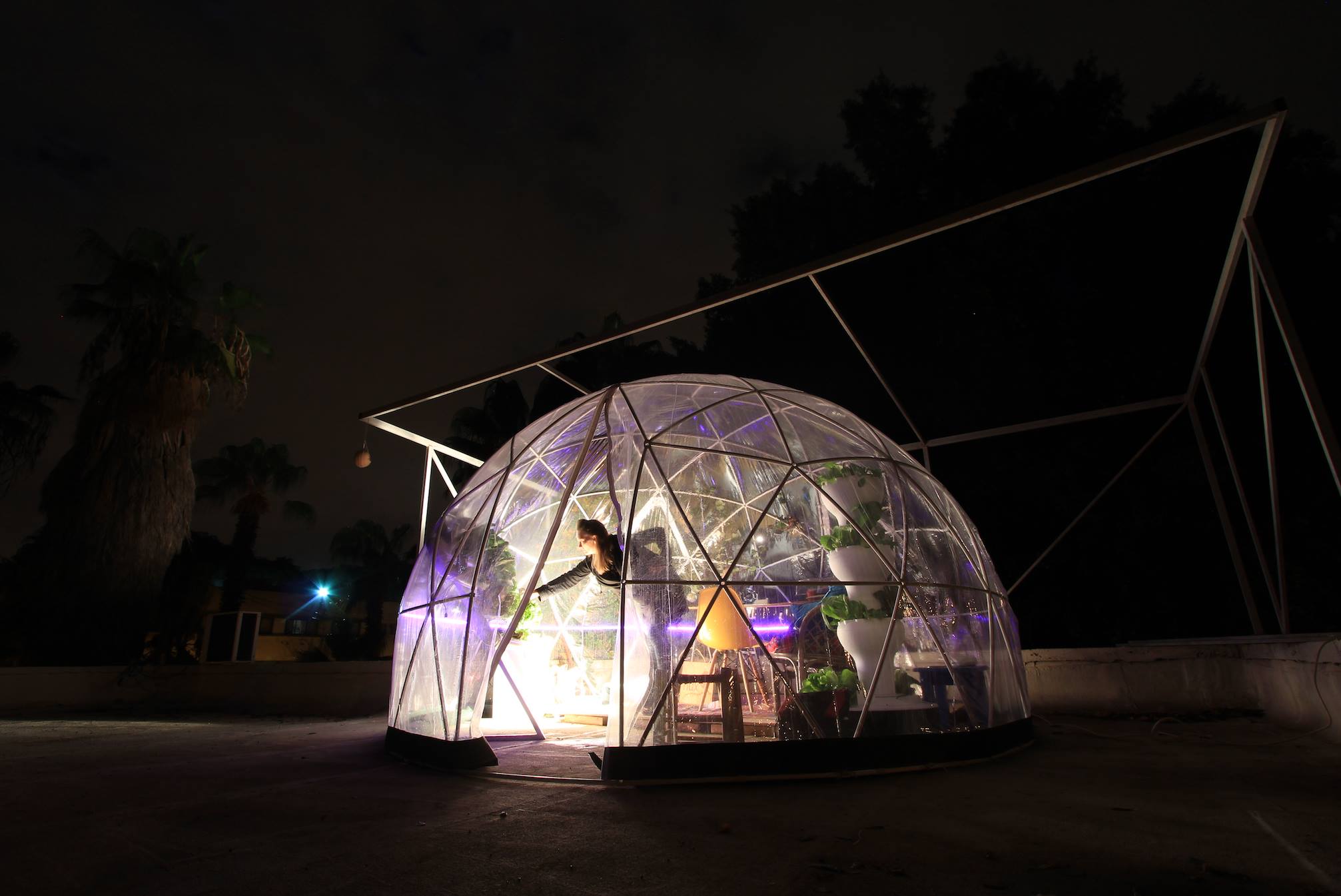
Artificial Intelligence is used in this biodome to grow bio-organic food with zero waste using the Eddy robot by flux.
The coronavirus pandemic and its economic fallout will trigger a ‘skyward surge’ in sustainable, responsible and impactful investing over the next 12 months, affirms the CEO of one of the world’s largest independent financial advisory organizations.
The prediction from the boss of deVere Group, which has more than $12bn under advisement, comes as Bloomberg analysis reveals that the average Environmental, Social and Governance (ESG) fund fell by half the decrease registered by the S&P 500 Index over the same period during the Covid-19 crisis.
ESG refers to a class of investing also known as “sustainable investing.” The umbrella term covers three main factors. ‘E’ is for ‘environment’ and includes issues such as climate change policies, carbon footprint, and use of renewable energies. ‘S’ is for ‘social’ and includes workers’ rights and protections. ‘G’ is for ‘governance’ and includes diversity of the board and corporate transparency.
Mr Green comments: “The coronavirus pandemic will trigger a ‘skyward surge’ in sustainable, responsible and impactful investing over the next 12 months for three key reasons.
“First, before the pandemic, research has revealed that investments that score well in terms of ESG credentials often outperform the market and have lower volatility over the long-run.
“Since the Covid-19 public health emergency up-ended the world, the latest broad analysis shows that ESG funds have typically continued to outperform others.”
He continues: “Second, the coronavirus pandemic has underscored the vulnerability and fragility of societies and the planet.
“It has underscored that increasingly companies will only survive and thrive if they operate with a nod from the wider court of public approval.
“It has underscored the complexity and interconnectedness of our world in terms of demand and supply, in trade and commerce – and how these can be under threat if not sustainable.”
Mr Green goes on to add: “Third, demographic shifts will support the trend. Millennials – those who were born in the time period ranging from the early 1980s to the mid-1990s and early 2000s – cite ESG investing as their top priority when considering investment opportunities.
“This is crucial because the biggest-ever generational transfer of wealth – likely to be around $30trn – from baby boomers to millennials will take place in the next few years.”
In January, deVere Group carried out a global survey that revealed 77% of millennials said that Environmental, Social and Governance (ESG) investing was their top priority when considering investment opportunities.
This survey highlighted that whilst traditional factors – such as anticipated returns (10%), past performance (7%), risk tolerance (4%) and tactical allocation (2%) – are important factors in millennial respondents’ investment decision-making, they are no longer enough by themselves.
Nigel Green concludes: “ESG investing was already going to reshape the investment landscape in this new decade – but the coronavirus will quicken the pace of this reshaping.
“Investors are increasingly aware that it is possible – and increasingly necessary – to make a profit while positively and proactively protecting people and the planet.
“As such, they will be making investment decisions after measuring the sustainability and societal impact of a sector or company as these criteria help to better determine their future financial performance, or in other words their risk and return.”
They started during times of war when there was not enough food. Planted in lawns and in backyards. This one was planted in a bomb crater. A Victory Garden planted in a bomb crater in London.
When a parking lot was bombed in London during World War II they planted a garden. When there was not enough food in America because the farmers were off at war, Uncle Sam told them to plant and Americans had food. Growing veggies in times of crises is not a new idea, as so-called Victory Gardens have been around ever since World War I.
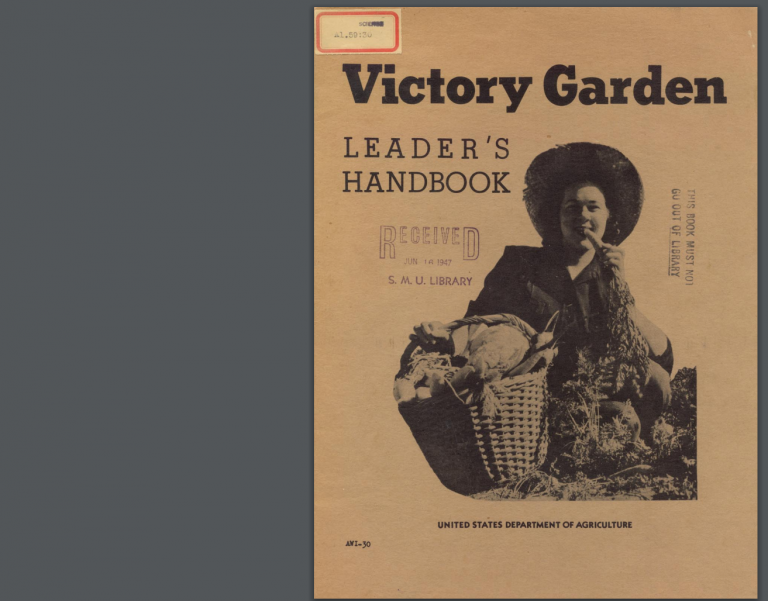
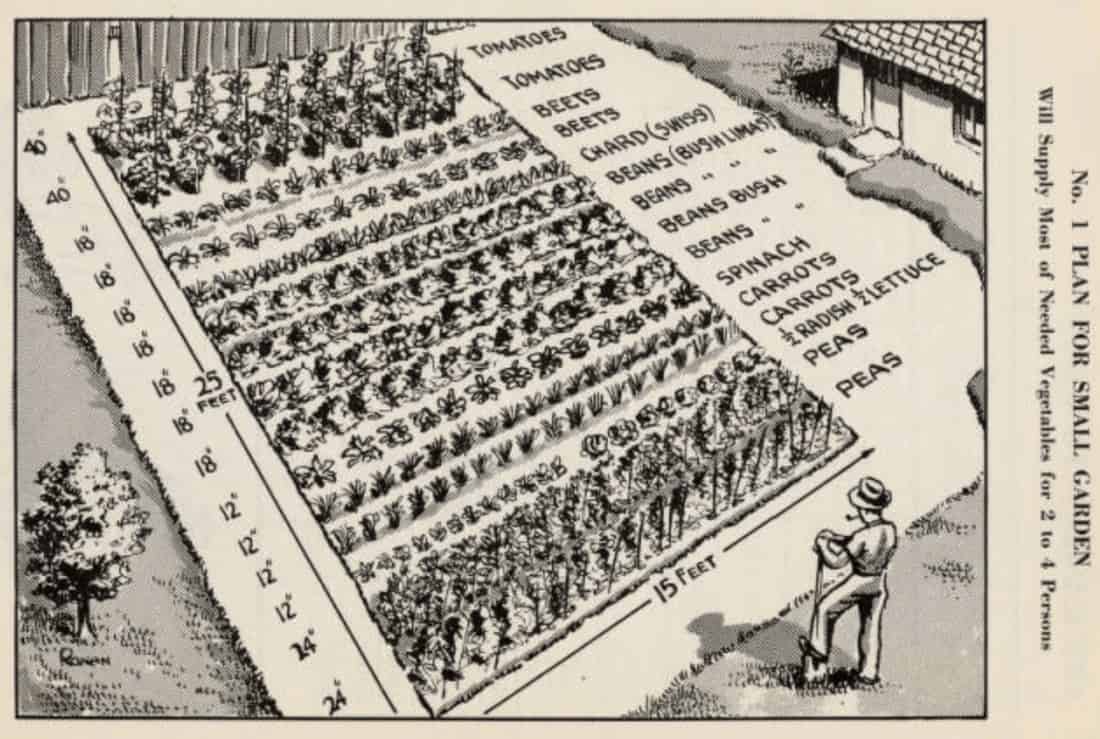
Victory Gardens were popular in both world wars; and the produce grown in them not only helped to supplement war time food shortages for families, but were a great morale booster as well. And we dug up an amazing old handbook for those who might want to follow the 1943 US Government plan.
“This is War Work” – caption from inside the Victory Gardens Handbook, circa 1943. You should check out the design. Fabulous.
The concept of home gardens has carried on to the present time, with both individual household garden plots as well as community garden projects such as the one I have been involved in for over a year now.
In my small 8×5 foot plot I grew large quantities of tomatoes, peppers, string beans, eggplant and other veggies like lettuce, kohlrabi and herbs like mint, lemon grass, parsley and thyme. You can also do this on your windowsill or at home, and here is a great list of medicinal herbs to start with.
Flowering echinacea, for all times.
In fact, so much was produced last summer in my little plot that a lot of veggies were given away to family, friends and even neighbors.
This small plot is now producing winter varieties conducive to the milder winter climate found in Israel. These include kale, Swiss chard, various herbs, carrots, cabbage and broccoli.
With the current Coronavirus (COVID-19) world pandemic crises now ravaging most countries, securing ample food supplies is turning out to be as serious as contracting the virus itself. As supplies of fresh vegetable produce become difficult to obtain, largely due to disruptions in supply lines, having a small Victory Garden is again making a lot of sense as it did for our grandparents during WWII.
There is only one small problem, however. The continual increase of people becoming infected by the virus and the resulting stay-at-home directives by governmental authorities is now preventing amateur farmers from working their garden plots; especially at a time when these fresh organic veggies and herbs are needed most.
Hopefully, the self-quarantine orders will ease soon, so we can plant our Spring and Summer crops. As I experienced last year, there’s nothing better and healthier than freshly picked garden veggies from one’s own plot. The rewards speak for themselves, as it did for our grandparents more than 70 years ago. In the meanwhile, if you can, dig in and get growing the old fashioned way.
We’ve learned over the years that knowing if we have it or not is the best prevention.
Okay so the skies are clear, and dolphins have returned to the water of Venice. We are at home with our kids and when we are not on Zoom trying on the next seminar (how about learning how to be a solar energy engineer?) –– some parts of the world are working day and night to solve covid-19. It can be solved and it can be done in record time compared to other pandemics. Meanwhile we wait it out.
One of the most terrible factors with this pandemic is the fear factor and facing the unknown. Will I have toilet paper, will I run out of yeast? There are solvable problems for all of these questions. Consider the water bidet that half the world already uses, that yeast can be culled for free in the air, and hey –– it’s Victory Garden and seed planting time. Worried about food? Grow your own. Our grandparents and parents did it.
People in the prime of their lives, or essential care workers in hospitals are being quarantined if they came in contact with a covid-19 patient unknowingly. A lot of harm to the healthcare system and to the economy could be put at ease if there were easier and more rapid tests the population could take.
There are companies –– and even amateur scientists who see how it’s done –– who have been working on quick tests to see if you have been exposed to covid-19. One biohacker in Sydney put together the materials to make 500 test kits. But the challenge is scaling up production fast with so much of China offline, while setting distribution targets that will get the test out there. In the United States the FDA needs to check the validity of tests before they go to consumers or hospitals, and they are one of the most rigorous testing bodies in the world. What America does everyone follows.
The New Scientist and other news outlets claim that a home blood test could be available at Boots, a UK pharmacy chain, and on Amazon by as early as today. While this is a quick and temporary option, nothing compares to robust lab equipment, used by laboratories and by companies that are working to find a vaccine or an antidote to corona. Quick home test kits are much less than shrunk down and less robust versions of the lab equipment called a PCR machine which is made by companies like Stilla Technologies. PCR machines amplify DNA found in blood or mucous to determine if it’s been altered by the virus.
Now if we thought the fight for toilet paper was bad…Fact: a single prick blood test, like that used by people with diabetes, has been developed. In many places around the world. Also fact, we don’t know when we will all get one, or two or three. We will need multiples if we want all clear for resuming a fraction of our normal lives until herd immunity or a vaccine is made.
Tests are good but are not a solution: The tests are expected to reveal if you have been exposed to the virus already but what it won’t do is spare you from reinfection. Scientists still haven’t figured out what reinfection rates are, and if immunity will protect you from covid-19’s tragic outcomes.
If we could all go back in a time machine and be better prepared for scary times. I’ve joined a number of forums for off-grid living. Off-grid means not connecting to the local electricity or water supply. It means relying on Mother Nature, luck, your wits and a lot of common sense and technology to get electricity power, water, work, and stuff done.
Teach your kids and yourself these skills and you know you will be able to survive.
How to light a fire. Sounds trivial. I was reading a Farley Mowatt book about when he went to visit the people of the deer in 1947, the first white guy to do it. His matches got wet and he didn’t have fire until he met the Inuit up north who showed him how to do it.
How to grow zucchini. Why zucchini? This is a plant that is easy to start with, it’s hard to kill, and when you do it you can get a bonanza of zucchini that let’s say in hunger mode you can turn into bread, flour, stir fry, something stuffed. Best case scenario you leave them on the porch of your mothers-in-law.
A toilet paper alternative: Remember that most bathrooms also contain a shower head. If you run out of water, you can easily wash your bottom in the shower. No big deal. Like the Bedouins do with their squat toilets. Most of the world uses bidets. You can too.
Grow micro-greens on your windowsill. You can order kits from the internet or simply make your own. You just need the seeds. When they sprout they are packed with nutrients.
Learn how to bake bread without a machine. Tortillas or flatbread are a good way to start. If you are more ambitious you can go all-natural by following our sourdough recipe. People have relied on wild yeasts to ferment their bread doughs, beer, and wine for thousands of years. By contrast, commercial yeast has only been around for about 100 years. It only became possible to culture-specific strains of yeast after Louis Pasteur discovered how yeast works. While commercial yeast yields safe, predictable beer and wine, mead, sourdough breads, with their delicious tang, still work beautifully in a modern kitchen.
No doubt this planetary shut-down has got you thinking. How can I make my contributions to this one great life count?
To say the very least, it’s an interesting time in the job market. Jobs are closing or restructuring due to the COVID-19 fiasco, and odds are, you may looking for a new job or wanting to transfer. Unless you can get yourself a self-sustaining cabin in the woods, then you may need to work somehow.
This is honestly a good time to get yourself in the green business. Carbon emissions are slowing because of the virus. Animals are taking over towns. And you deserve a career to help improve the planet when all is said and done.
One way you can do this is through the power of the Internet. Online counseling in the job market is valuable, and may be needed when you can no longer meet someone face-to-face. Here’s how an online job counselor can help.
Help Find Your Passion
Maybe you want to be in the business of going green, but you’re unsure how you can do it. Do you want to find the next renewable injury breakthrough? Do you want to start your own social NGO? Maybe you want to be a farmer who grows and sells their own food. All of these are noble choices that an online therapist can help you find.
An online therapist will talk about what skills you have and what careers can be a good fit for your job.
Helps You Find Your Experience
If you do find a job you want, you may feel like you’re not fit for the job because of experience requirements. Every job wants a certain amount of experience and a skill set that you may not have, and because of this, you may ignore jobs that would otherwise be a good fit for you.
However, there are ways for you to get a job even if you believe that you’re not a good fit for it. You’d be surprised by how many jobs will hire you even if you don’t have all the requirements. Having soft skills and some proof of your hardworking attitude are just a few ways you can get past the gatekeepers of a job. For example, getting hired in the organic food business can happen if you talk about your own diet and how good you are at prepping meals.
Getting You Out of the Job You Dislike
Life is too short for you to work at a job that makes you feel unhappy and uncomfortable. However, many people are in jobs that are repetitive and who treat them unfairly, especially in the middle of this crisis. With that said, a career counselor can help you make the transition. It can be hard to change a job, especially during this time. One way a career counselor may help is to teach you some work-from-home jobs or gigs you can take on in the meanwhile.
Helping You Have the Confidence
Sometimes, we don’t get the jobs we deserve because we aren’t confident enough. A little confidence goes a long way, and those who don’t have it may never apply for the job or have the confidence to do a follow-up call.
A counselor can help you get your confidence back, helping you to find reasons for your insecurities and allowing you to discover that sometimes, it’s okay for you to apply for a job even though you fear rejection.
Helping With Your Mental State
Besides, online job counseling, there is online therapy. Online therapy is a profession that is needed more than ever since many people are having to stay home and cope with businesses and the world itself closing down. Depression, anxiety, stress, and uncertainty are just a few symptoms you may be fearing. Online therapy can help you have some peace, and right now, it can be a safer option due to the fact that it is remote.
Having a job is important, but so is keeping your mental state in check. A good therapist and counselor can help with all aspects of your life, so speak to an online therapist near you and see what they can do for you. Chances are, you can speak to a counselor who is a perfect fit. If you’re dreaming about starting your own small business, ensure your success with our top resources:
Marie Miguel has been a writing and research expert for nearly a decade, covering a variety of health-related topics. Currently, she is contributing to the expansion and growth of a free online mental health resource with BetterHelp.com. With an interest and dedication to addressing stigmas associated with mental health, she continues to specifically target subjects related to anxiety and depression.
Countries with fossil fuel-dependent economies are making a marked shift towards renewable energy. See Arab loan to fund renewables. Substantial financial investments in solar and wind projects throughout the Middle East and North Africa have gained global recognition as the hydrocarbon market looks to bolster alternative economies.
Despite the recent move to renewable energy, the Arab nations currently invest very little in comparison to the rest of the world. The United States and Europe have invested over $40 billion, respectively. China’s investments exceed $126.6 billion. In comparison, the Middle East and Africa have invested only $10 billion in renewable projects and infrastructure.
In addition to a heightened awareness of the environmental impact of the fossil fuel industry, the main drivers for change are economic. Solar and wind energy can now compete with conventional energy sources due to falling prices. Advances in technology, such as marine desalination, also contribute to the evolving industry.
Experts project global oil consumption to peak in the next 20 years. Motivated by the prospect of economic decline, oil and gas companies in Arab nations are analyzing the growth of the non-oil industry within the energy sector. An increase in domestic energy consumption is also driving the exploration of economical alternatives to the fossil fuel industry. In Saudi Arabia, the demand for domestic energy has increased by 60% in the last 10 years.
Diversification Within the Energy Industry
The potential success of a renewable energy economy hinges on a comprehensive plan that focuses on diversification within the energy economy.However, the increased investment in renewable projects has not resulted in a decrease in oil production. According to OPEC figures, the oil and gas sector in Saudi Arabia accounts for 50% of the country’s GDP. Thirty percent of the United Arab Emirates’ economy comes from gas and oil, and the industry accounts for 92% of Kuwait’s export revenues. These figures demonstrate that while Arab nations are investing in renewable energy, the transition from an oil-rich economy to a new alternative will not be a linear one.
With a significant dependence on the global economy, the oil and gas industries are paying close attention to new policies, such as a potential carbon tax, and exploring new approaches to a rapidly changing global economy and climate. Investing in renewable energy does not necessarily equal a slowing down of the fossil fuel market. However, it does signal a decisive move toward changing the way people consume energy domestically. If countries can harness alternative energy at home, they can export more oil and gas.
Companies are exploring and implementing various strategies to see how best to incorporate renewable energy domestically. The company responsible for distributing the majority of gas in Egypt, the Middle East and North Africa, TAQA Arabia, is one example. The company is looking into a system that promotes the use of solar energy during the day, while still relying on traditional energy sources at night.
Investing in a Brighter Future
Geography plays an outsized role in the Arab nations’ decision to invest in renewable energy. Oil economy-dependent countries in northern regions, such as Russia and Canada, will not feel the effects of climate change with the same immediacy as the Middle East. That reality leaves the region in a more vulnerable situation than their competitors, especially as the market faces other challenges in the forthcoming years.
The United Arab Emirates, Saudi Arabia, Egypt and Morocco have the greatest investments in renewable energy. One of the main incentives to move toward an economy with a strong reliance on renewable energy is the creation of new jobs. Diversification both within the energy industry and other disciplines, such as manufacturing or shipping, would increase stability as countries transition away from a fossil-fuel-dominated economy. For example, Morocco has created over 13,000 new jobs by building a market for solar water heaters.
There are also several government-supported projects looking to support renewable energy. For example, the Saudi Industrial Development Fund launched a project titled the Renewable Energy Financing Package, designed to aid in the development and growth of non-oil sectors. It will support not only the potential job market within the renewable energy sector, but also aid complementary technology, such as water storage, that will benefit from the diversity of projects.
One example of corresponding technology in the realm of renewable energy is sustainable water systems, such as desalination through reverse osmosis. Water is an integral piece of economic security for both the fossil fuel and renewable energy industry. Future investments in sustainable water infrastructure are essential to the creation and longevity of renewable systems.
The fossil fuel industry is paying attention to potential policies such as a carbon tax, and are adjusting based on substantial changes to the worldwide oil market in the upcoming years. There has been a noticeable change in tone when oil and gas companies talk about climate change and renewable energy. Particularly throughout the Middle East and North Africa, there is recent transparency regarding non-oil alternatives.
With Aramco now mentioning climate change and looking to lower their greenhouse gas emissions and Petroleum Development Oman’s investment in new projects, the future of renewable energy throughout the region is bright. To establish future economic stability, investing in renewables instead of oil will diversify bolster the economy and lead to more jobs within the energy sector.
—
Emily covers topics in sustainability and renewable energy, and you can read her latest work on her blog, Conservation Folks.
Daugava river, Latvia. A construction robot working where manual crews can’t reach.
Many technologies are being developed and implemented that will shape the future of this industry. Notably, the development of commercial robots can help automate many processes in the construction industry to improve efficiency, accuracy, and deal with the problem of the skilled labor shortage.
Unfortunately, commercial robots don’t play a significant role in the construction industry now. This is about to change, and the construction industry should be ready for a total takeover by industrial robots. In the light of anticipated changes, here the main ways through which robotics will disrupt the construction industry in this decade.
Lowering Operation Costs
Many businesses are installing robots to increase efficiency, speed, and lower operating costs. The construction industry is highly competitive, and business owners are looking for ways to reduce operational costs to remain competitive. There are many benefits of automating tasks in the construction industry, especially the repetitive and tedious ones.
One significant benefit is that it makes the process more efficient and less expensive in the long run. Also, industrial robots in construction industries take away the human aspect of human operations. The introduction of robots in this industry can be a game-changer because better craftmanship adds an extra layer of value to construction projects. Cobots may be the solution that the construction industry needs to lower its operating costs.
Improved Efficiency
Construction works are usually tedious, and they require a lot of concentration. With time, human workers get tired, burned out, or even bored with their work. These factors eventually affect the quality of their work. It’s no surprise that the construction industry has experienced a skilled labor shortage for many years now.
The best thing about introducing robots in this industry is that they won’t have any of these issues. Robots won’t get tired nor bored with their work. As long as they are programmed correctly, they will perform their tasks with the highest degree of efficiency. This will not only improve the outcome of the construction projects, but it will also increase productivity in the industry.
On-demand and Custom Development of Materials
A construction project undergoes many steps, right from planning, development, and the actual construction. For many years, these processes have remained manual, with little changes. The introduction of robots will change the current makeup by enabling the onsite development of materials.
The use of 3D-printing robots will enable the production of parts needed in the project, thus eliminating the need to transport these materials over long distances. It will also increase project turnaround since it reduces the delays involved in ordering materials for the project. The introduction of robots will also improve the quality of building and finishes since contractors can make changes with minimal loss of materials.
Logistics and Management
Besides simple robotics, the construction industry can utilize artificial intelligence and other software to handle logistics and management aspects of construction projects. The construction industry is still taking baby steps towards automating the logistics and management side of operations. Most of these tasks are still completed manually. The industrial players can take advantage of technological development to ensure prudent use of resources in a construction project.
The introduction of robots in the construction industry will not only improve productivity, but it will also enhance the safety of construction workers and streamline collaborative tasks and projects. Instead of suspending construction projects due to lack of skilled labor, robots will ensure these projects are completed as scheduled and within the stipulated budget.
Reiki is a powerful form of stress relief. The idea is that energy auras pass through your hands. You can do reiki on people, animals, even trees and the planet.
Stress has been around since time immemorial. From the meditation techniques developed by the ancients to newer models of therapy and mindfulness, humans have been constantly devoted to finding new ways to achieve center and balance.
Today is no different. Our challenges may be different than they were thousands of years ago, but we’re still on the lookout for ways to calm our nerves and achieve clarity in times of distress. While the old reliables like meditation and yoga are as effective and popular as ever, technology and plant medicine are lending themselves to even more methods for stress-relief.
If you’re feeling stressed out, interested in diversifying your wellness toolbox, or looking for new ways to achieve a sense of calm, read on for some innovative techniques you may not have heard about yet:
Binaural beats
Binaural beats are audio recordings that use sound frequencies to trigger natural responses in our brains such as calm, focus, and alertness.
The human brain operates on a number of brainwave frequencies that are associated with different mental states. When our brains are in the alpha state, for instance, we’re feeling relaxed but alert. The theta state is associated with deep meditation, and the beta state is associated with clarity and mental alertness.
These brainwave frequencies are measured in hertz. The human ear can’t hear sounds at these frequencies, but experts have figured out that by producing two moderately different sounds, one in each ear, they will cancel each other out, thereby allowing us to “hear” the sound frequencies associated with the mental states we wish to achieve.
For example, the alpha state falls between 9-14 hertz. We wouldn’t be able to hear sounds at that low frequency, but if we listen to tones through headphones that fall at, say 300 hertz on the left, and 291 hertz on the right, we’re left with the 9 hertz it takes to ‘entrain’ our minds to reach the alpha state.
But enough with the sonic theory. If you go on YouTube, you’ll be able to find thousands of binaural beat recordings tailored to every mood. They’re often designed for meditation, sleep, focus, and even lucid dreaming.
These videos attract thousands upon thousands of viewers who find that these safe, mood-altering tones help them relax and focus. Binaural beats have even hit the mainstream, and more and more people are tuning in for insomnia, stress-relief, and meditation.
ASMR
Another YouTube phenomenon that’s growing steadily in popularity, ASMR (autonomous sensory meridian response) is winning many over with its ability to evoke feelings of relaxation through mere sound.
ASMR videos use calming sounds, images, and triggers that produce a sort of tingly feeling in the body. Though research is still lacking in describing what, exactly, produces these responses, anyone who’s ever gotten chills from the sound of someone lightly whispering, smacking their lips, or gently tapping their fingers will know exactly what ASMR is about.
Today, you can find thousands of ASMR videos on YouTube, as well as ASMR personalities who have earned their own sponsorships and national media attention. ASMR videos often use audio and visual triggers and can be integrated into role-playing stories such as scalp-massages and visits to the spa to recreate feelings of comfort, pampering, and bliss.
Relaxation is a Keyboard Click Away
We’ll never stop looking for ways to overcome our stress, and that’s a good thing. As technology improves and neuroscience tells us more and more about how our minds work, we’ll continue to find ways to silence restless thoughts and reach healthier, more relaxed mindsets. Online therapists provide another more convenient means to get help, along with online guided meditations, streamable yoga classes, and even new forms of herbal remedies. These new techniques aren’t the answer to our problems, and there’s no reason to abandon the old-standbys. But when it comes to dealing with stress and lack of focus, you can never have too many tools in your therapeutic toolbox.
An idyllic isolation A Frame cabin for good times and less good times
Thank God for Sweden and Swedish forests. They can be as gnarly as Canada’s in the early summer. You need constant protection and refuge from the bugs. But if you have an adequate supply of netting and a comfortable cabin, building a small dream nest in the forest is a doable thing. Or if you live in a desert area or on a river, you can also do these just fine.
Another name for tiny home?
Now that we are isolating from each other it might be time to think about gearing down a bit and building a new future reality.
Cabin Porn’s founder Zach Klein built a small community for his high-tech and media friends in Upstate New York that they call Beaver Brook. Check them out. They are idealistic in their cooking, building, and DIY approach. They had the call of the wild.
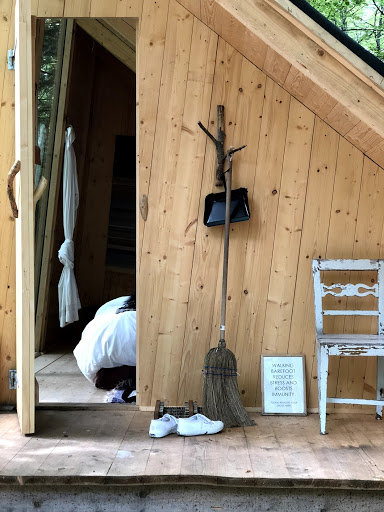
If you are renting in a big city or stuck with a mortgage, I am sure you have heard the call of the wild. Now might be the time to start building a nook in the woods, and I have the perfect plan for you. I was searching for a perfect and low cost A frame cabin blueprint for years. Then I saw the lifestyle and cabins of the folks at Stedsans in the Woods in Sweden. They run a forest to table restaurant and getaway deep in the woods.
I love the off centered, non conforming, off centered placement of the panels and the frame of their cabin. This gives it a “super human” in the woods feeling, that I can only compare to a revered Japanese ceramic tea cup used in a tea ceremony. It just gives you that feeling of perfect harmony in all its off centeredness.
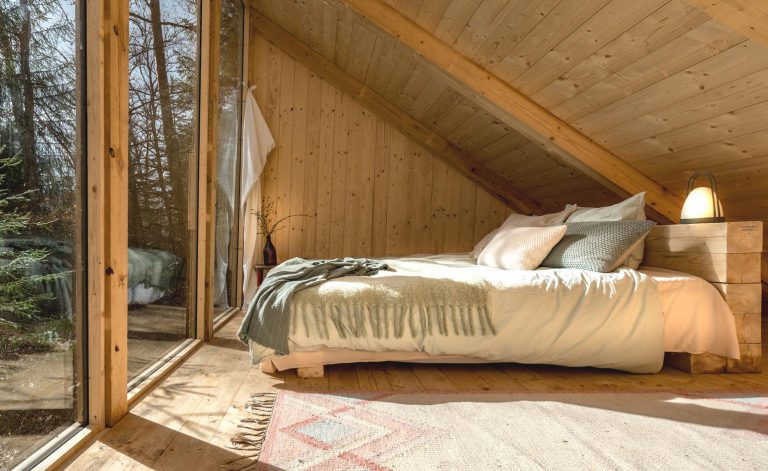
Inside the cabin you are going to build 😉 Love the off-centered angle placement of the wood. Same angle matches the large window to the left.
I have a property in Canada, some 200 acres of thick and intelligent forest and although there is an old farmhouse on it, I have been dreaming about building a smaller cabin, like the one I found at Mette’s Swedish forest retreat.
Stedsans In The Woods is built by couple Mette Helbæk and Flemming Hansen, who sold their Copenhagen home and rooftop restaurant, Stedsans ØsterGRO (Stedsans in the Woods), and moved their family just across the water to an 18-acre plot of forest beside Lake Halla in West Sweden.
The focus of Stedsans ØsterGRO is to make guest experience hyperlocal fresh ingredients and simplified forest cooking. Visitors there find an idyllic, food-centred experience. Kickstarter helped make it happen.
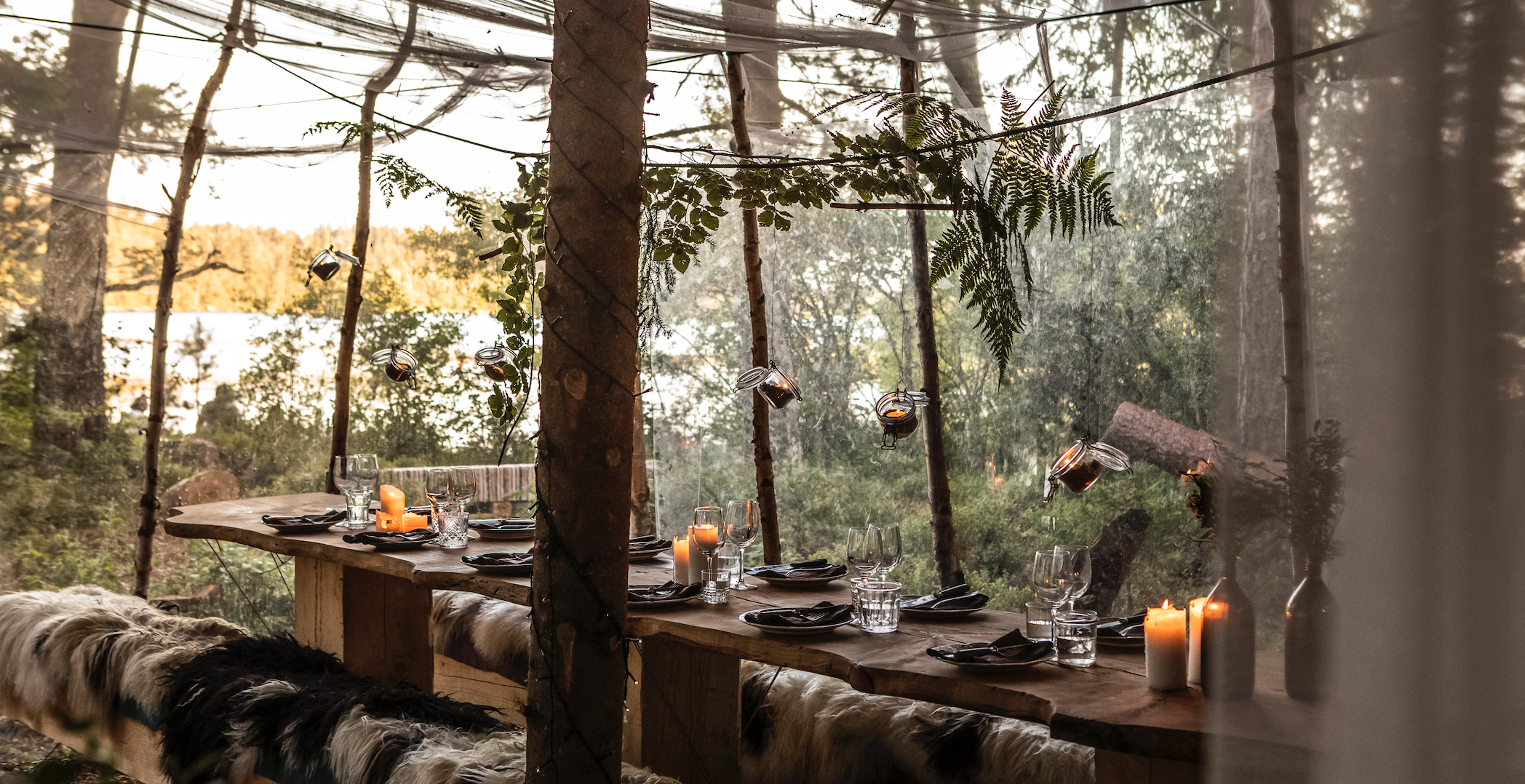
The forest restaurant
Beyond the food one of the big attractions at Stedsans is the floating sauna. That’s what first found me on Instagram. I was looking for simple A frame cabins for building a writing retreat and everything they did at Stedsans in the Woods caught my attention and made me say, wow: I want to be there. For isolation, and maybe even forever?
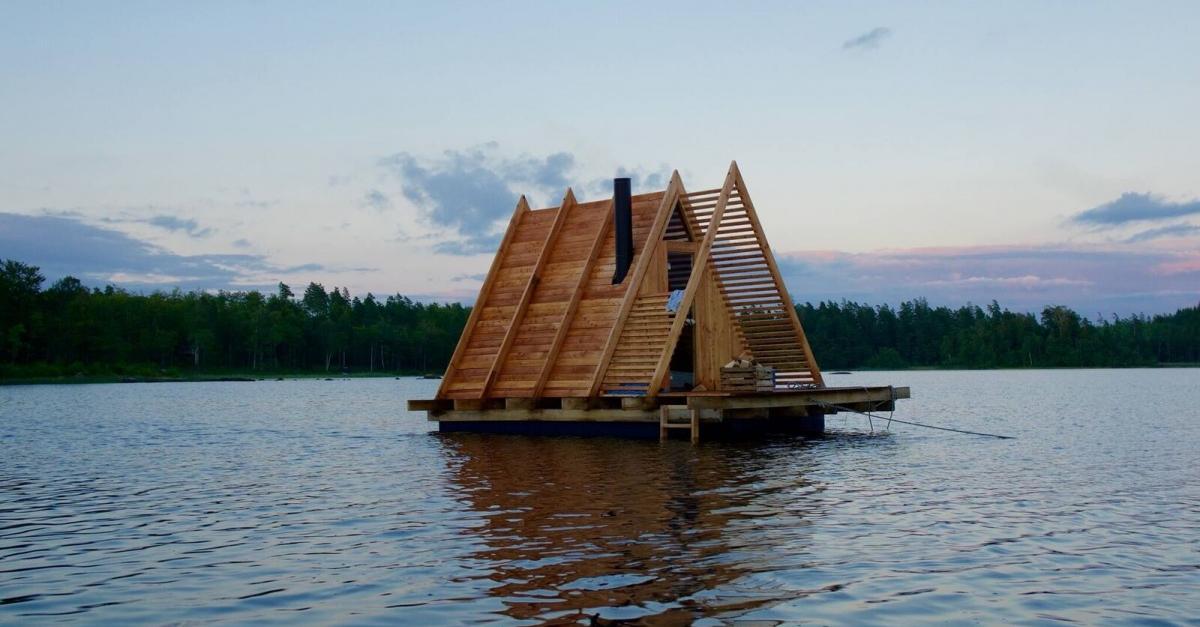
Float away forever in isolation in this sauna
In Swedish Stedsans means “a sense of location” and at their retreat guests eat in tents and sleep in simple A frame cabins and tents under the stars.
Among the activities you can do there is foraging expeditions. Find mushrooms like gigantic ceps (get our forest mushroom vegan cookie recipe here) and taste the food from their small permaculture farm, which includes a healthy insect hotel and a range of medicinal plants.
Chefs prepare you food from what you see, with meat roasting on the fire, or herbs ground in a mortar and pestle.
We all need a lot more going back to the roots right now. Don’t you feel it too?
Artificial Intelligence is used in this biodome to grow bio-organic food with zero waste using the Eddy robot by flux. The robotic solution was developed by a team of Israeli engineers.
The life of an engineering student is never easy! It’s a rigorous course, that hardly leaves any candidate scope for private space during their study years. There are ample debates and discussions about the course and future of engineering as a career opportunity. However, today, in 2020, with the development of technology and upgradation of the new-age living, the engineering community has changed. It has contributed to significant additions in technology. And this makes students aspire to be an engineer and pursue a career that brings then a promising job and career. Hence, students must learn about engineering and have a basic overview of it right in their high-school. There are a few leading high-schools that design an exciting and informative course for the same. To know more about this, you can check out engineering summer school.
Today, engineering still happens to be one of the most popular and profitable subjects that students want to major in. The engineers get engaged in all aspects of technology, which comprises new materials, medicine, energy, electronics, transportation, and many more. If you want to pursue engineering and are in two minds, you need to consider the following pointers:
1. It is one of the highest-paid professions
The starting earning for engineers is the highest for most college degrees. A chemical engineer with a bachelor’s degree would earn anything like $57,000. It was a Forbes estimate based on the statistics in 2015. Chances the amount has increased today. And with more experience, an engineer has the opportunity to add to his salary.
2. There are lucrative job opportunities
It’s mostly gossip that engineering students don’t get their desired jobs! The truth is engineering jobs are still the ones that have increased demand. Interestingly, engineers are hardly unemployed. So, you can always stay secure of a job, should you pursue an engineering course.
3. An engineering degree can help you become a CEO
It is interesting to note that the majority of Fortune 500 CEOs have engineering as their under-graduation degree. Other popular degrees that CEOs opt-in for apart from engineering is economics and business administration. The engineers are skilled in working with a competent team and can lead teams and projects. Also, engineers study business and economics. Hence, it is a natural fit when someone wants to climb high up the management level or want to start a brand-new company.
Solar panels collect energy from the sun. Only engineers can build this sort of dream. Want to run a company like this one day? Get a degree in engineering.
4. Engineering helps to unlock avenues for layers of professional advancement
Engineers have skills that help them in professional advancement. It also leads to personal development, as well. Simply put, engineers will know the way to assess and resolve problems, effectively work in a team, smoothly interact with other teammates, cater to the deadlines, and efficiently manage projects and staff. The study of engineering involves the end-to-end study and also brings in travel opportunities.
Ormat is a geoengineering company that makes energy from deep inside the earth. Only engineers need apply!
5. Engineering can help you with a prospective career
Do you score high in maths and science? And do you have no idea about what you want to do in life? If you’ve answered yes to both these questions, chances are you can make use of your engineering degree. It helps you to land with a prospective job and then shift to any other direction that you might deem fit. Also, it’s interesting to note that engineers don’t merely study maths and science. They also learn about communication, economics, ethics, and business management. Later on, they can use their experience to start a business.
6. Engineers have job satisfaction
Job security and fulfilment translates to happiness. Engineers have experienced a stable job, flexible working hours, job security, increased salaries, excellent benefits, and many more.
7. Engineers can make a difference
Create sustainable food for life in the desert or on Mars? Only engineers can do this.
Some of the real-world issues get addressed by the engineers! They can come up with advanced machinery that helps in accomplishing a challenging task. Most engineers work towards contributing a better way of living by resolving issues like pollutions, updating living conditions, harnessing energy sources, generating new structures, and coming up with advanced medical discoveries. Engineers can apply ethics to know answers to a few crucial questions.
8. Engineering as a subject has a glorious history
It is interesting to know that engineering, in a rather new-age sense, traces back its history to the Roman Era. The term “Engineer” gets inspired by a Latin word, which means “ingenuity.” The Roman engineers designed the heated floors, developed aqueducts, and many more. They have ample accomplishments to their credit. Engineers have always been associated with developing useful and essential structures. For instance, a set of engineers did develop the Egyptian and Aztec pyramids, Hanging Gardens of Babylon, and the Great Wall of China as well.
Hence, students must know whether they have the correct aptitude for pursuing engineering or not. A well-designed course in a high-school can create the perfect foundation for interested candidates to pursue engineering as a degree and career for life.
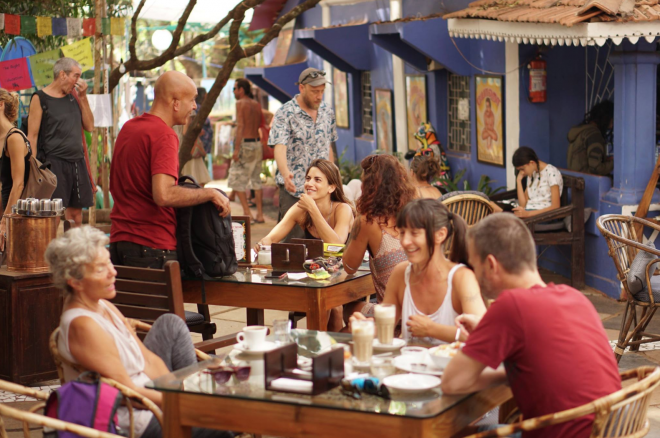
Artjuna, my favorite hangout in Goa, and where I started my journey in yoga.
Two years ago I took my family to India for a holiday. I didn’t have any expectations but I knew that something would change in me. India is the place for that people would tell me over the years, and as the birthplace of yoga it’s the ideal way for you to jump into yoga as a beginner or as a seasoned practitioner. People that do end up wanting to take their yoga to the next level do end up travelling to India –– to Pune or Rishikesh –– one of the spiritual centers.
I found myself at neither of those places but at a cafe-cum-community center called Artjuna in Goa, where I met Ian, a yoga teacher. Two years ago I jumped into yoga again after leaving it for more than 15 years. Now in my 40s I see some amazing changes in myself.
Since starting yoga and being with Ian every day for 5 weeks, first off it gave me a mission while travelling. I put my kids in a local school The Yellow School run by hippies and took my morning class. It was hot and sweaty and there were ants on the floor here and there, agriculture brush burning in the background every morning, but after the session I felt good and strong and found myself reaching for healthier food, like salads, every day. After 5 weeks there was a transformation. But it wasn’t only in the way I looked.
Yoga helps you deal.
Ian, my yoga teacher, and my dog, Navad
Some months after we returned from India my dad who had travelled with us started complaining about a pain in his back. After some complicated weeks in the summer we found out that he had cancer and it would be a difficult and fast disease. We would lose my dad 5 months later. And I think that journey with him, from diagnosis to palliative care gave me post-traumatic stress that I am trying to deal with.
Yoga helped me deal with the crisis then, and still deal with the crisis now –– sometimes I even amused my dad from his hospital bed (and the nurses too) when I stood on my head. It helped us deal with the long hours of visiting each other and it helped me calm down to sleep through the night beside him.
I sometimes cry on my yoga mat in practice, and a few tears slipped out of the corner of my eyes this morning thinking about my dad. But yoga helps you deal in a few ways:
Yoga helps you look at the situation for what it is.
Most of our life is spent running around with our lives. From here to there. Carpooling the kids if you have them; running from one meeting or social activity to the other if you don’t -– or also do! Life today moves faster than it ever did. Yoga helps you quieten, sit for a moment, listen to yourself and recenter. It gives you space to remember, face your fears or loss and look at it. Yoga helps us move in human-scale time. Not robot time, not AI time, not a NY minute.
Yoga builds your immune system.
All of the asanas or yoga poses affect and stimulate your vagus nerve which runs from your head down your spine. It simply makes you healthier in stressful situations that might, God forbid, also cause you to get sick.
Yoga helps you move forward.
In a way, and this is probably a spiritual matter, beyond body resilience, practicing the asanas puts the mind-body continuum in its rightful place. Dramas no longer needs to be so dramatic. Other people’s problems irritate you less. You might have more compassion.
One of the things I might like to do one day when my kids are older is take a yoga teacher training course in India. A simple one is 200 hours, but there are 300 and 500 hours too. Some people emerge with a Yoga Alliance certification –- depending on the one you want. Like in SCUBA diving there are different associations. Now I wouldn’t do it because I don’t want to be a teacher (I mean, well I am to my kids, I guess) … I don’t want to open a studio –– but I’d be interested in a teacher course because I crave that me time. A teacher training class, if you do it in a place like India, can be a 4-week vacation to yourself, not from yourself or your problems.
If you are into yoga you will know what I mean. You can find classes for students of all skill levels, so no need to worry about how you are going to look in hot pink yoga pants from Lululemon. I wear Iyengar pants that look like an unsexy diaper. But I know that the serious yoga schools will not only help you with exercise and movement, they will give you life skills in how to eat, breath and basically live this one great life.
Travel to Mecca and Medina is simply cancelled this year by Saudi Arabia over fears that the coronavirus will spread. Millions of Muslims make the pilgrimage every year. Cancelling foreigners from travelling to the holiest sites in Islam is considered an extraordinary decision, and not one we have ever seen before, even during MERS, Ebola fears at Hajj, a SARS breakouts and alarm and the occasional stampede.
In fact more people have been killed at Hajj during a stampede that all of the people affected by coronavirus so far. The latest deadliest stampede killed more than 2000 people in 2015:
Saudi Arabia does not want an outbreak like Iran so the oil-rich monarchy cancelled Hajj last week. The center of the western East breakout is Iran in the Shia city of Qom where the faithful kiss and touch a shrine every year.
Shia Muslim defiantly saying he will lick the shrine in Qon, Iran. That he is not afraid of coronavirus.
“Saudi Arabia renews its support for all international measures to limit the spread of this virus and urges its citizens to exercise caution before travelling to countries experiencing coronavirus outbreaks,” the Saudi foreign ministry said in a statement announcing the decision.
“We ask God Almighty to spare all humanity from all harm.”
Previous epidemics during Hajj
Disease outbreaks have been a concern in the past and we have covered the SARS and MERS outbreaks as they spread, offering tips to stay out of harm’s way.
Hajj, the journey to Mecca and Medina is required of all Muslims once in their life, if they are able. Al Jazeera reported that in 632 pilgrims fought of malaria; then there was cholera in 1821 killing 20,000 pilgrims. Cholera again in 1865 killed 15,000 and then spread viciously around the world.
The virus that causes the illness named COVID-19 has infected more than 80,000 people globally, mainly in China. In the Middle East, the hardest hit nation is Israel.
Israel has clamped down on travel into Israel and people returning from European countries, China, Japan, are sent to self-isolate or quarantine. Events for the upcoming holiday of Purim are cancelled, like the annual parade in Holon.
In Bahrain, which confirmed 33 cases as of Thursday last week, the authorities stopped all flights to Iraq and Lebanon.
Iranian President Hassan Rouhani said there were no immediate plans to quarantine Iranian cities but acknowledged it may take “one, two or three weeks” to get control of the virus.

 Have you ever considered how long things take to deconstruct?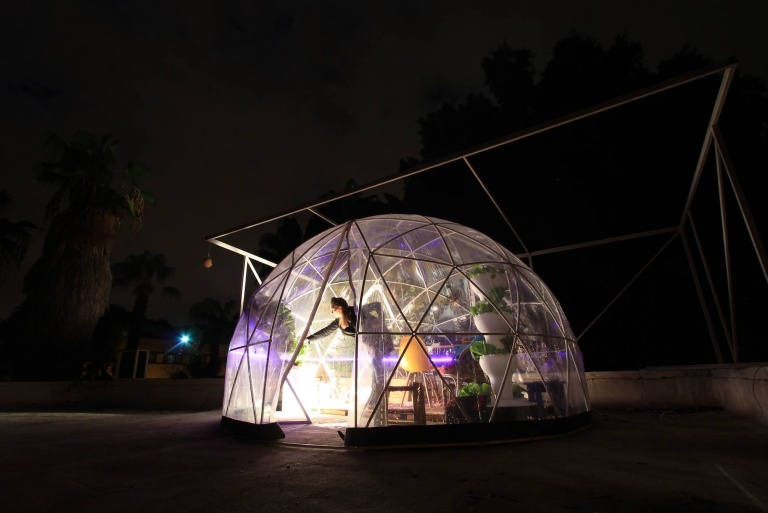





























Artist provokes anger with his alternative COVID-19 masks
A Namibian-German artist evoked enraged responses to his photographs of models wearing coronavirus masks created from common household goods including footwear, underwear, vegetables, and disposable panty liners.
The Instagram series, called “How-To Survive A Deadly Global Virus”, attracted angry viewer comments, with many describing the project as insensitive, offensive, and guilty of spreading dangerous misinformation. (See the project in full on the artist’s website – link here.)
Artist/designer Max Siedentopf quickly apologized to those offended by the images. “I apologize to everyone that felt offended by the series”, he said in a press release, “It was never my intention.”
“My work takes a critical and often ironical look at our surroundings,” he added. “It’s important for me to take people out of their comfort zone and see things from a different perspective, both positively and negatively.”
Said Siedentopf, “Ultimately, it’s up to them to interpret my work as they want to.”
Seidentopft created the series after viewing photos of people fearful of contracting coronavirus wearing all manner of makeshift masks. The acceleration of the COVID-19 pandemic has massively disrupted supply chains and incited an unprecedented (and ill-informed) consumer run. It’s likely that readers who venture outside – in any zip code – have seen people wearing painters’ masks, t-shirts, swaths of fabric, old Halloween masks, and headscarves tied across their mouths and noses, all a misguided means of self-protection. Better we all simply stay indoors. And follow sensible natural precautions like these described by Green Prophet Miriam Kresh.
Enter the mythology of masks. Common painter masks found at hardware stores screen out harmly vapors from the wearer. Surgical masks are designed to protect people from the mask wearer. The coveted and critically-needed N95 masks are respirators that can filter out 95 percent of airborne particles that can carry viruses (like SARS-CoV-2, which causes COVID-19).
Ironically, Wuhan, China – where the virus originated – is a manufacturing hub for masks. Before the outbreak, China produced about 50 percent of the world’s sanitary masks (7 billion a year) and 90 percent of the surgical masks used in the United States. Ravaged by coronavirus, the manufacturing shutdown on China’s Hubei province has manufacturers in Europe, Israel, Japan, and the United States are struggling to meet global demand.
Experts generally agree that N95 masks have little value in the community. United States surgeon general Jerome Adams has tweeted, “Seriously people – STOP BUYING MASKS! They are NOT effective in preventing general public from catching coronavirus, but if healthcare providers can’t get them to care for sick patients, it puts them and our communities at risk!”
Back to Siedentopf, who said he made the series of portraits to draw attention to paranoia and media coverage of the outbreak, not to make light of the global health crisis.
“I was expecting to uncloud the subject a little, focusing on the creativity of the masks and how you can find smart and creative solutions, as over the last two weeks there has been a lot of media clickbait paranoia around the virus, even though the Chinese Centre for Disease Control reported that over 80 per cent of cases have been extremely mild,” he explained.
“To put this into perspective, Malaria kills one to three million people per year, but you don’t see the news and public going crazy about that.” According to the Johns Hopkins global virus tracker as of this post reports over 681,000 confirmed cases with nearly 32,000 deaths.
The World Health Organization (WHO) has published advice on basic protective measures against coronavirus on its website, which includes washing hands regularly and maintaining distance from other people. (Link here.)
Stay home, stay safe, wash your hands, and read Green Prophet for inspirational, educational, and uplifting news.