

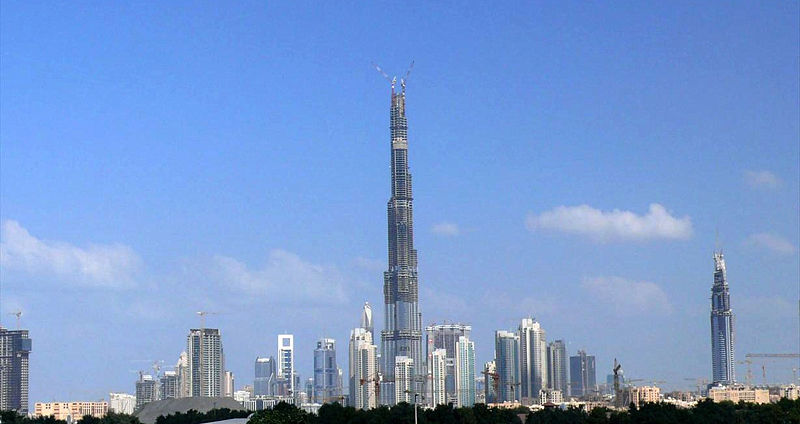
Burj built without thinking where the poop would go

Burj Dubai, glass buildings, In'Flector panels, insulation, green design, sustainable design, eco design, architecture, urban, Middle East, Dubai, Abu Dhabi

After having a hefty meal at the restaurant on the top of the World’s Tallest Building in Dubai… you excuse yourself from the table and head to the W.C…and without even thinking about it, you flush the toilet.

Where does the poop go?

We wish we could take credit for being the first to ask this question about Burj, in the United Arab Emirates. It’s the world’s tallest building but has no sewage system.

Where does all the poop go? Terry Gross from America’s NPR radio station did that for us.

Actually, before her, Kate Ascher from Columbia University’s Graduate School of Architecture wrote everything you ever wanted to know about skyscrapers in a book called “The Heights: Anatomy of a Skyscraper.”

Poop truck traffic jams video

All due credit aside, did you ever wonder what happens when a toilet is flushed on the 100th floor of a high-rise? And where all that poop and pee lands up when it finally makes it back down to earth? If so, read on…

After having a hefty meal at the restaurant on the top of the World’s Tallest Building in Dubai, maybe you even secretly indulged in Hamour – one of the UAE’s most endangered fish species, you excuse yourself from the table and head to the toliet.

You do what everybody does and without even thinking about it, you flush the toilet.

Your number one and two then travels 160 floors at breakneck pace, past luxury apartments, gravity interrupted by a sophisticated system of bends in the pipes that slows it down. These pipes are soundproofed by the way, because nobody wants to listen to traveling excrement all day.

Anywhere else in the world, the waste would land in a septic system and then slowly make its way to the municipal wastewater treatment plant. In greener buildings, it might even go through a network of filters so that it can be re-used for landscaping or flushing more toilets.

But this is not what happens at the Burj Khalifa. The sewage system at the Burj is non-existent.

Some unfortunate soul – mostly likely several actually – collect the waste by truck. Gizmodo estimates that at full occupancy that could amount to a good 13 tonnes of human excrement every day, but the Burj isn’t operating at full occupancy, so let’s reduce that number. Let’s cut it down to 8 tonnes – a very conservative number. You have to admit, that’s still a lot of sh#t.

Ok, what then?

Well, since the Burj Khalifa was built in such haste that nobody thought about where the poop would go, those souls have to drive this high falutin’ waste to a wastewater treatment plant, where they often stand in line for up to 24 hours to deposit their pungent truckload.

That’s one tower down. But Dubai has 63 buildings that stand taller than 656 ft, and hundreds more that are smaller than that.

Holy crap. Can someone help these guys out?

Update in 2017 the city decided to invest in a sewage system. It will be completed only by 2025.
Tafline Laylin
Tafline Laylinhttp://www.greenprophet.com
As a tour leader who led “eco-friendly” camping trips throughout North America, Tafline soon realized that she was instead leaving behind a trail of gas fumes, plastic bottles and Pringles. In fact, wherever she traveled – whether it was Viet Nam or South Africa or England – it became clear how inefficiently the mandate to re-think our consumer culture is reaching the general public. Born in Iran, raised in South Africa and the United States, she currently splits her time between Africa and the Middle East. Tafline can be reached at tafline (at) greenprophet (dot) com.

Read More

4 COMMENTS
  1. Some one once told me that being part of a municipal sewer system is rather the exception than the rule in Saudi and other Gulf states, that most people rely on weekly truck pick ups of the waste water because it doesn’t rain enough to justify sewers for drainage and it’s cheaper that way for promoters. I am sceptical about this being true, can anyone confirm or refute please?

TRENDING

Interview with America’s water reuse expert BioprocessH20 on challenges and the future of water

Food processors, industrial manufacturers, automobile manufacturers, oil and gas companies and more all need to be mindful of the wastewater they produce when they conduct their core business.

Investing in the Middle East? These 20 Energy consultants can de-risk your portfolio

For instance is your clean tech firm or company in wastewater treatment considering an office in Riyadh or should you stick with Dubai?  Below is a curated spotlight on 20 firms that shine for their deep expertise and proven ability to manage the complex risks of sustainable energy investment.

Wastewater plants are a hidden climate issue, and we’re measuring it all wrong

Wastewater treatment plants are a hidden source of greenhouse gas emissions, releasing methane, nitrous oxide, and fossil CO₂. A new study calls for smarter monitoring and tailored emission factors. U.S. firms like Jacobs, AECOM, and Black & Veatch are key players in building climate-resilient wastewater infrastructure.

Global Progress and Setbacks: Tracking Water Quality Indicators Toward SDG 6 by 2030

The United Nations has 17 objectives that paint a more resource-conscious and fair world called the Sustainable Development Goals (SDGs). The sixth mission is to “ensure access to clean water and sanitation for all” by 2030. The turn of the decade will happen before too long, so assessing progress and moments for improvement at this stage is critical. How is SDG 6 going, and what can humanity do to achieve it?

How Pape-Dawson’s Water Engineering Services Support Climate Adaptation and Drought Mitigation

Drought and climate change no longer surprise us—they define today’s water reality. Pape-Dawson meets these trials with practical, site-specific solutions rooted in water sustainability engineering.

Yerukim Forms a New Green Economy Where the Money is Really Green

The Yerukim members who pick up the recyclables get to keep the monetary reward, the public earns "green" bills that can be used in shops, and business owners get to be associated with environmentalism.

Choosing Riyadh over Dubai? What Investors Should Know

Saudi Arabia is deploying capital at unmatched scale to catalyze tourism and advanced industry while rewiring its power-and-water backbone. The investable frontier is widening—especially in renewables, grid storage, water efficiency/desal retrofits, and hospitality operating platforms. Prudent investors will insist on phased delivery, enforceable KPIs (energy, water, biodiversity), and RHQ/zone compliance—while pricing political-economy and reputational risks alongside growth upside.

Sell your cooking oil for biodiesel money

Want to make money on old french fry oil? Sell it.

Qatar Alternative Energy Summit Pairs Investors And Innovators

Alternative energy investors and innovators can meet n' greet in Doha, Qatar March 16 and 17.

Here’s How To Implement The Four Pillars Of Employee Engagement

If you throw a party for your work team and they are vegans, don't make it a barbecue. Know the sustainability values of your team to boost moral and retain good people.

Locals From Rishon Fight IKEA

Big Box stores are a pretty new concept in Israel, and thank God that not every Israeli city wants them in their backyard. A word from someone who has see the beautiful farmland around her hometown Newmarket, Ontario stripped and converted into vulgar strip malls of big box shops: they have no place in a healthy and sustainable town or city.

The Jewish National Fund Meets An Inconvenient Truth

According to the JNF, it has transformed thousands of acres of barren land into green forests in Israel. They state that each person emits about 23 tons of carbon per year, estimating that each tree planted can absorb one ton of carbon in its lifetime. That's a whole lot of trees you'd need to be planting. Could so many fit in Israel?

How to quiet noise from construction in your office

Streets need to be resurfaced in New York but the humming and grinding noise is unsettling. Noise is environmental pollution. 

Popular Categories