

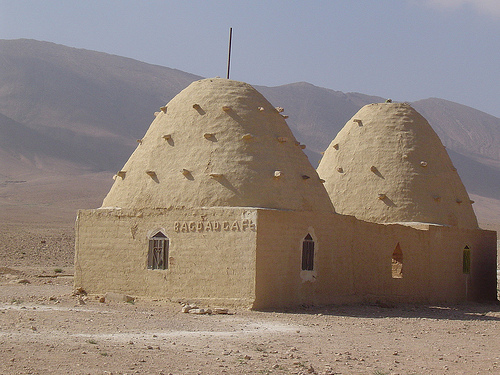
If we’d thought that talk about global warming in the Middle East should stay in the future tense, news from Syria suggests a lot is going to change in these parts, and fast.
A climate change domino effect has caused the eco-migration of villagers from their homes in about 160 Syrian villages, reports the AFP. Reporting from Damascus, some 160 villages in northern Syria were deserted in the years of 2007 and 2008 writes the news wire.
The original findings were drawn up by the International Institute for Sustainable Development (IISD) who warns of a potential armed conflict for control of water resources in the Middle East. Our worst nightmare has begun.
“The 2007/8 drought caused significant hardship in rural areas of Syria. In the northeast of the country, a reported 160 villages have been entirely abandoned and the inhabitants have had to move to urban areas,” it said.
The report continued that in Syria, Jordan, Israel and the occupied Palestinian territories, “climate change threatens to reduce the availability of scarce water resources, increase food insecurity, hinder economic growth and lead to large-scale population movements.”
We talked about eco migration earlier this year and even snorted a little when we heard an Israeli had left the country for fears of global warming. Is it time to start packing the backpacks and head to Canada and Siberia?
The Canadian-based organization said: “This could hold serious implications for peace in the region.”
Already considered the world’s most water-scarce region, the demand for water in the Middle East already outstrips supply. Over here in Green Prophet we can attest to the fact that the most important environment news over here seems to hinge around water.
However, in terms of global carbon emissions, it contributes less than one percent of the world total, except Israel.
The exception among Levant countries is Israel, “whose emissions — 11.8 metric tonnes per capita — exceed the European average of 10.05 tonnes,” they said.
Population growth will exacerbate the problem. But on a hopeful note, the gloom and doom report said there is “much that Middle Eastern governments and authorities, civil society and the international community can do to respond to climate change and the threats it may pose to regional peace and security.”
A culture of conservation, reducing GHGs and cooperating on water may help us Middle East dwellers turn the problems –- and potential threats –– around. There is time folks.
::AFP [image via ian.plumbe]
I remain hopeful.



[…] – in Egypt, loaves of bread were waved in protests to highlight this struggle. The link between climate change related factors and the war in Syria, however, hasn’t been as widely discussed. Yet, drought and ineffective […]
[…] – in Egypt, loaves of bread were waved in protests to highlight this struggle. The link between climate change related factors and the war in Syria, however, hasn’t been as widely discussed. Yet, drought and ineffective […]
[…] – in Egypt, loaves of bread were waved in protests to highlight this struggle. The link between climate change related factors and the war in Syria, however, hasn’t been as widely discussed. Yet, drought and ineffective […]
[…] – in Egypt, loaves of bread were waved in protests to highlight this struggle. The link between climate change related factors and the war in Syria, however, hasn’t been as widely discussed. Yet, drought and ineffective […]
[…] to climate change experts, our planet has a fever — melting glaciers are just one stark sign of the radical changes […]
By way of introduction I’m one of the authors of the report mentioned in this blog.
Thanks for your interest in our work and the excellent article you wrote on the issue. I just wanted to take this opportunity to clarify one point:
We make no claim in the report that the villages in Syria were evacuated as a direct result of anthropogenic climate change (the AFP article misquotes us). The villages were certainly abandoned as a result of a cyclical drought – but there’s no evidence to suggest that this is (or, for that matter, isn’t) the result of human-induced climate change.
That said climate change is certainly a serious issue which presents, we think, some real security concerns in the region which, as you note, need urgent attention and action.