
Building Integrated Photovoltaics Slash Energy Costs in Abu Dhabi

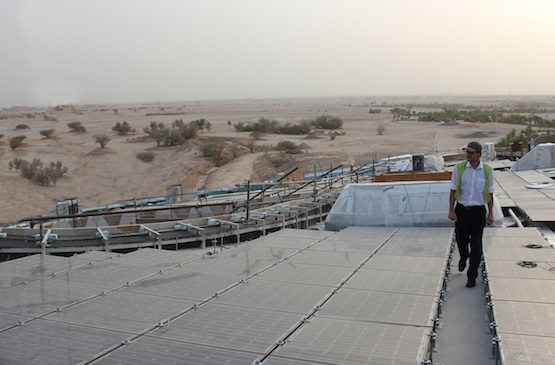
building integrated PV, BIPV, Dieter MoorDieter Moor of ertex solar examines the installation of his company’s solar project in Al Ain.

Finally the Middle East is attuned to the numerous benefits of solar energy, and large scale Photovoltaic (PV) and Concentrated Solar Power (CSP) plants are popping up all over the region. There’s Shams 1 outside of Abu Dhabi, the largest CSP plant in the world, Egypt’s hybrid CSP plant, Kuraymat, and most recently, Masdar inaugurated the largest PV plant in Africa, which is now generating a whopping 10 percent of Mauritania’s energy supply.

But small scale solar is catching on less quickly. In addition to being prohibitively expensive for most people, the government offers very little incentive for residents of the Middle East and North Africa (MENA) to coat their roofs with costly solar modules. It’s a shame, because a new study shows that affixing Building Integrated Photovoltaics (BIPV) to windows in Abu Dhabi could slash energy costs by as much as 33.5 percent.

BIPV = very good

Mohammad Katanbaf, an architect at KEO International Consultants Abu Dhabi, recently set out to determine how much energy businesses would save if they incorporated a certain number of BIPVs on their windows, according to The National.

For the sake of accuracy, he used very sophisticated computer modeling to match the United Arab Emirates’ specific climate, since temperature, wind, dust and other climatic conditions affect the efficiency of solar modules.

He told the paper that although he was expecting savings, their full extent surprised him. Trouble is, it’ll be a cold day in the desert if they are ever widely used, since the cost of BIPV modules is 30 percent higher than regular PV panels and even those aren’t hugely popular.

Elsewhere, feed-in-tariffs, a government protocol that purchases clean energy from whoever’s got extra, encourages residents and corporations to incorporate BIPVs or regular panels as a long term investment.

But in MENA, not only are governments a little slow to establish attractive FiT plans, but they also subsidize energy costs such that none but the most devout environmentalists are really motivated to spend the money necessary to either get off or reduce their dependence on the grid.

(Curiously, Iran did quit dirty energy subsidies and survived the ordeal – before the west intensified sanctions.)

Daniel Pedroso, Regional Manager of BIPV manufacturer Isofoton told The National that BIPVs won’t become a viable option in the Emirates until the government creates incentives that make the investment worthwhile.

The option is on the table, and Dubai’s Electricity and Water Authority (Dewa) is looking into it, but nobody is going to make sudden moves given the overall instability gripping the region.

And if you want to geek out on the stats, Katanbaf published his findings in the January edition of the journal Engineering.

Top image via ertex solar

Tafline Laylin
Tafline Laylinhttp://www.greenprophet.com
As a tour leader who led “eco-friendly” camping trips throughout North America, Tafline soon realized that she was instead leaving behind a trail of gas fumes, plastic bottles and Pringles. In fact, wherever she traveled – whether it was Viet Nam or South Africa or England – it became clear how inefficiently the mandate to re-think our consumer culture is reaching the general public. Born in Iran, raised in South Africa and the United States, she currently splits her time between Africa and the Middle East. Tafline can be reached at tafline (at) greenprophet (dot) com.

Read More

LEAVE A REPLY

Please enter your comment!
Please enter your name here

TRENDING

AI data centers are triggering panic, instead of cleantech opportunities

AI may unintentionally become the economic engine that finally modernizes America’s aging grid. California is experiencing a massive AI data center boom, ranking 3rd in the U.S. with 227 operating centers and 54 more in development as of April 2026, according to Stanford.

Korean researchers create battery from greenhouse gases

Professor Ji-Soo Jang, in collaboration with Professor Taekwang Yoon of Ajou University and Professor Hansel Kim of Chungbuk National University, has developed a novel energy device that generates electricity during the process of capturing greenhouse gases.

Saving Gourmet Wild Plants For The Future

Think of truffles, a gourmet wild food. The European...

Should You Invest in the Private Market?

startustartup Unlike public stock exchanges, which offer daily trading, strict...

Middle-Eastern spices and natural medicine (A through C)

In the Middle East, aromatic traditional foods are regarded...

How to quiet noise from construction in your office

Streets need to be resurfaced in New York but the humming and grinding noise is unsettling. Noise is environmental pollution. 

EarthX and a blueprint for sustainable investing

Trammell S. Crow, a Dallas-based businessman and father of four, is focusing his efforts on impact investing, and media that focuses on saving the planet through EarthX.

Mining Afghanistan’s Mineral Discoveries Similar to Avatar

Now that American forces in Afghanistan are commemorating the longest period of any war that America has been involved in, including the 1965-73 Vietnam War, the recent discoveries of large and extremely valuable mineral and metal deposits may finally bring to light a reason to continue the presence of US fighting forces in this war torn and backward country.

From Pilot Plant to Global Stage: How Aduro Clean Technologies’ 2026 Expansion Signals a Turning Point for Chemical Recycling Investors Like Yazan Al Homsi

The company's Next Generation Process (NGP) Pilot Plant in London, Ontario, has officially moved into initial operating campaigns, generating the kind of structured, repeatable data that separates laboratory promise from commercial viability.

Nobul’s Regan McGee on Shareholder Value: “Complacency Is the Silent Killer” 

Why the governance framework designed to protect shareholders so...

Should You Invest in the Private Market?

startustartup Unlike public stock exchanges, which offer daily trading, strict...

How to build a 100-year-company

Kongō Gumi is a Japanese construction company, purportedly founded in 578 A.D., making it the world's oldest documented company. What can we learn about building sustainable businesses from them?

How AI Helps SaaS Companies Reduce Repetitive Customer Support Work

SaaS products are designed for large numbers of users with different levels of experience, and also in renewable energy.

Popular Categories