A Yellow Submarine in Every Garage?

submarine privateThe rich and famous are now buying private submarines. Good or bad for the environment? Brian explores.

My search for bamboo yarn took me to an industrial part of Beijing. The air here smelled of hot steel and coal. I walked past some of the warehouses and workshops behind the Made in China label and came upon a group of men huddled around the gleaming metal object. Maybe I shouldn’t have been surprised to find a miniature submarine here in this dusty megalopolis, 175km from the nearest sea. I quickly stepped past, wanting to believe what I was seeing while avoiding the glare of  the welder’s arc. I later learned that this was the submarine Tao Xiangli had built for himself using $4600 worth of barrels and other recycled parts. Tao’s submarine is 20 foot long, weighs 1.6 tons and has a maximum depth of 10 meters.

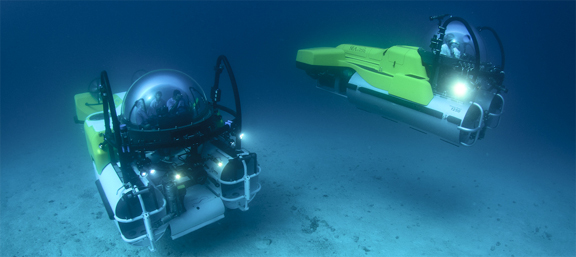
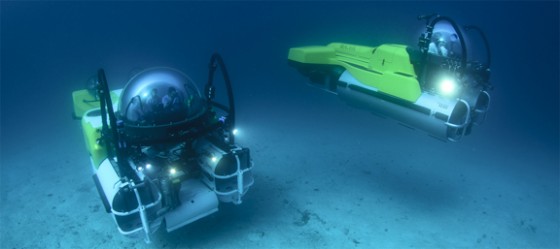
Who wouldn’t want their own submarine to enjoy the beauty of undersea life without getting cold and wet?  Seamagine Hydrospace Corporation of the US hopes their luxury submarines will become the latest must-have toys for the wealthy. Seamagine submarines might not have the character or personal craftsmanship as Tao’s sub, but their Undersea Hunter model can carry up to three people to a depth of 1500 feet (475m).  They certainly look like a fun way to spend a million dollars!

For those of us not in that category of wealth, there is another option. There are about 20 tourist submarines in the world.  The Sindbad club of Egypt offers trips aboard their Mark III submarine to tourists of this Red Sea resort. There are also tourist submarines in Tenerife and Cyprus.

[youtube]http://youtu.be/rbSKhH8fzS4[/youtube]

What will submarines mean for the undersea environment? As divers we are told to avoid stirring up the bottom or allowing our fins to touch the coral reef.  But over the years I saw the number of intact fan corals in the Florida keys diminished.

A single fin kick can wipe out hundreds of years of coral growth.

The sheer number of people who dive in these places became clear to me during one dive when my scuba instructor noticed a bubble on a piece of coral and found that it was actually a diver’s lost contact lens!

Will submarines destroy coral reefs just as jet skis destroy sea grass? It is certainly a possibility.  But as Green Prophet’s Laurie Balbo found, more eyes underwater means that the sea bottom is no longer “out of sight, out of mind.”

Submarine photo via Seamagine.com

Brian Nitz
Brian Nitzhttp://www.greenprophet.com
Brian remembers when a single tear dredged up a nation's guilt. The tear belonged to an Italian-American actor known as Iron-Eyes Cody, the guilt was displaced from centuries of Native American mistreatment and redirected into a new environmental awareness. A 10-year-old Brian wondered, 'What are they... No, what are we doing to this country?' From a family of engineers, farmers and tinkerers Brian's father was a physics teacher. He remembers the day his father drove up to watch a coal power plant's new scrubbers turn smoke from dirty grey-back to steamy white. Surely technology would solve every problem. But then he noticed that breathing was difficult when the wind blew a certain way. While sailing, he often saw a yellow-brown line on the horizon. The stars were beginning to disappear. Gas mileage peaked when Reagan was still president. Solar panels installed in the 1970s were torn from roofs as they were no longer cost-effective to maintain. Racism, public policy and low oil prices transformed suburban life and cities began to sprawl out and absorb farmland. Brian only began to understand the root causes of "doughnut cities" when he moved to Ireland in 2001 and watched history repeat itself. Brian doesn't think environmentalism is 'rocket science', but understanding how to apply it within a society requires wisdom and education. In his travels through Europe, North America, Asia and the Middle East, Brian has learned that great ideas come from everywhere and that sharing mistakes is just as important as sharing ideas.
2 COMMENTS

Comments are closed.

TRENDING

Jordan’s $6 Billion Aqaba–Amman Desalination Project from the Red Sea Moves Forward

In 2025, the Jordanian government signed agreements with a consortium led by Meridiam and SUEZ, alongside VINCI Construction and Orascom Construction. Under a 30-year concession agreement, the consortium will design, build, finance, operate, and maintain the system before transferring it back to the Jordanian government. The total investment is estimated at approximately $6 billion USD.

Celebrate International Seagrass Day

Seagrasses are “land plants” that have moved into ocean habitats. They have roots, stems, leaves, flowers, fruits and seeds. There are only about 70 species of seagrasses, representing just 0.02% of all flowering plant species. 

The Saudi Startup Turning Desalination’s Toxic Waste Into Its Own Disinfectant

For millennia, the Middle East's water crisis seemed an immutable fact of geography — a region defined as much by what it lacked as by what lay beneath its sands. Today, a convergence of plummeting solar costs, advancing membrane technology, and hard-won engineering expertise is rewriting that story.

Ethiopians are Looking to Somaliland for Red Sea Access as Global Powers Move In

Somaliland, for its part, has operated as a de facto independent state since 1991. It has its own government, elections, currency, and security forces. It’s often described as one of the more stable and democratic political systems in the region, despite never being formally recognized internationally. 

Peace hospital opens between Jordan and Israel

The proposed medical centre, described by Emek HaMaayanot Regional Council head Itamar Matiash as “a centre for cancer treatment, so that people from Jordan or further away could come and receive treatment,” would become the flagship of a wider cluster of medical, academic and innovation-based services planned for the Israeli half of the zone.

Should You Invest in the Private Market?

startustartup Unlike public stock exchanges, which offer daily trading, strict...

How to build a 100-year-company

Kongō Gumi is a Japanese construction company, purportedly founded in 578 A.D., making it the world's oldest documented company. What can we learn about building sustainable businesses from them?

From Pilot Plant to Global Stage: How Aduro Clean Technologies’ 2026 Expansion Signals a Turning Point for Chemical Recycling Investors Like Yazan Al Homsi

The company's Next Generation Process (NGP) Pilot Plant in London, Ontario, has officially moved into initial operating campaigns, generating the kind of structured, repeatable data that separates laboratory promise from commercial viability.

How AI Helps SaaS Companies Reduce Repetitive Customer Support Work

SaaS products are designed for large numbers of users with different levels of experience, and also in renewable energy.

Pulling Water from the Air

Faced with water shortage in Amman, Laurie digs up...

Turning Your Energy Consultancy into an LLC: 4 Legal Steps for Founders in Texas

If you are starting a renewable energy business in Texas, learn how to start an LLC by the books.

Tracking the Impacts of a Hydroelectric Dam Along the Tigris River

For the next two months, I'll be taking a break from my usual Green Prophet posts to report on a transnational environmental issue: the Ilısu Dam currently under construction in Turkey, and the ways it will transform life along the Tigris River.

6 Payment Processors With the Fastest Onboarding for SMBs

Get your SMB up and running fast with these 6 payment processors. Compare the quickest onboarding options to start accepting customer payments without delay.

Related Articles

Popular Categories