
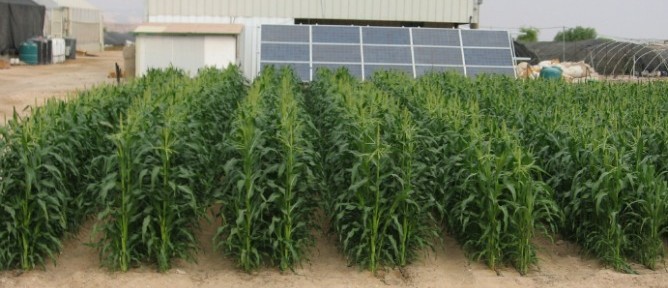


Growing the most crop per drop of water is an Israeli specialty. With little rain and a hot desert sun as unforgiving as the Sahara, Israel’s high-tech researchers and farmers have combined their expertise to grow a cornucopia of salt-tolerant crops in dry desert conditions. People from hungry countries far and wide come to learn from Israel’s expertise.
Now, a new research project by two desert research institutes has strung several Israeli agriculture and clean-tech specialties together to help alleviate world hunger and push back the desert through an artificial desert oasis using low-cost desalination technology that runs on solar power.
A small model is up and running in the desert north of the Dead Sea, while the researchers aim to build a larger testing and training facility for agronomists from across Israel and other countries.
This new desert oasis, engineered by researchers from Ben-Gurion University and the Central and Northern Arava Research and Development center, follows decades of Israeli accomplishments in plant genetics married with desalination and solar energy advances.
Deserts get little or no rainfall, but often there are aquifers deep below the surface that may hold an abundance of water. The problem is getting the salt out of this water so it can be useful for farmers to grow cash crops. The new oasis solves the problem with an ecosystem that produces a variety of freshwater and salt-hardy crops that feed on saline wastewater from the desalination process. It’s in tune with Mother Earth and affordable for some of the poorest farmers subsisting on areas of encroaching desert.
From the outset, the main idea was to create a solution to feed the world’s hungry, says Rami Messalem from Ben-Gurion University’s Zuckerberg Institute for Water Research. A Jewish philanthropist from Switzerland gave the researchers the fuel to develop the sustainable system, which hinges on a low-energy desalination nano-filter designed and engineered at Messalem’s lab.
Ben-Gurion University’s Rami Messalem has been researching desalination membranes since the 1960s.
With experience in membrane technology since the 1960s, Messalem says this filter is unique because it runs on about a quarter of the power that traditional desalination units require. This means that fewer expensive solar panels are needed to support it off-grid, although the oasis can also run on electricity from the grid.
The entire system was designed with cash-strapped countries in mind.
 “There is no use to try and compete with huge companies who make the best membrane which can do the right job. It’s very easy to make these kinds of filters and put them out into the market,” Messalem tells ISRAEL21c. “What we are using here has been designed very cleverly, and we’ve accomplished this with some tricks.”
He notes, “One of the biggest challenges when using desalination technologies is what to do with the waste concentrate — the brine. We found that there are some plants like the red beet, which is a halophyte, a plant that likes salty water.”
Brackish water cannot be sent back down into the soil because it pollutes the groundwater below. Red beets are one solution for soaking it up above ground, and another is using the concentrate to raise ornamental fish in the desert, a business already proven successful in Israel.
Test oasis up and running
The desalination filter in the new oasis system removes the undesirable salts while leaving in the minerals to sustain plant life. In fact, the filters are engineered in such a way, explains Messalem, that farmer could use less fertilizer for their crops — a bonus for the environment, too.
The solar-powered model oasis, located on a quarter of an acre near the Dead Sea, is successfully sustaining four different crops. Each system would be custom-made to maximize each customer’s particular crop needs and energy availability.
This is good news for regions in the Middle East and Africa where micro-farmers are losing ground to desertification.
A 1.25-acre area has been leased to develop into an operational demonstration site and field school where Israel’s thousands of agricultural visitors could come to learn the new oasis method every year. Learning directly from the people who built it could be a life-changing experience for those looking to farm for their future, such as the Nigerian rebels who come to Israel to learn how to trade their weapons for plows.
This story is reprinted from the source at www.israel21c.org – ISRAEL21c


My name is Rebecca Gambiza i am the Exevutive Director of a company called Xhib-it events management company in Zimbabwe and we are based in the Capital city Harare.
Besides events management we are also into environment issues, we publish the first environment magazine in the country titled Green Focus. We will be happy to publish your articles in the Green Focus as our readers will be happy to know what Israel is doing on the environment front.
We will have an online magazine where we will have readers from around the world reading your artiles.
below is our vision and mission of the magazine. i hope you will be interested in participating in this magazine.
GREEN FOCUS EXECUTIVE SUMMARY
The Green Focus Magazine is a publication owned by Xhib-it Events Management Company, supported entirely by advertising, grants and partnerships, and is distributed for free in Zimbabwe. The magazine is directed at all environment issues at social and business levels throughout the world. It covers environmental regulatory developments as well as topics related to corporate environmental performance.
The magazine is printed from eco-friendly material,contemporary in look and appeal. Quality content is the constant goal. The magazine is enlightening and newsworthy and thought-provoking. It appeals to a broad readership. No magazine like it is available in Zimbabwe today.
The magazine is published quarterly with increased press runs throughout the first year and aims for a circulation of 10,000 Growth is ensured through sample distribution, organizational membership, and direct mail to targeted list of environmentalists, organizations and members of the public.
EDITORIAL MISSION
Green Focus explores a diversity of environmental topics from novel angles without preaching, pleading, or bias. The magazine has raise the bar on environmental thinking with a mix of world-class journalism, cutting-edge research, and provocative ideas.
The Green Focus includes:
The legislative environment – through the Ministry of Environment and its agents
The Green Social environment featuring corporate, individuals and other environment NGO activities, keeping track of all activities and achievements on the environment front.
Topical Features written by world-class authors who challenge conventional wisdom and dig deep into issues with sharp prose, measured insights, wit, and humor, capturing imagination and jump-starting discussion on environment issues.
Journal Watch keeps readers abreast of ground breaking environment research being conducted around the globe selected from a number of journals available publicly on a variety of themes: forests, oceans, energy, climate, ecology, economics, genetics, public health, public policy and more.
Solutions and Innovations explore new technologies and creative ideas, giving readers a close-up look at the environment’s frontiers.
The Interview Column will give relevant activists in the environment sector a chance to share with the public their expert opinion and environment friendly tips on areas of interest.
Schools and Community Updates promote active interest and participation at grassroots level on environment. This section will accommodate reports from schools and communities, written by school children and other able community leaders.
The Feedback Section is an interactive column that will publish feedback, responses and letters to the editor from readers.
Green Business News promotes the ‘greening the economy’ concept by exploring other environment corporate activities, in addition to those of Friends of the Environment members.
Editor’s Note is a comment section that spells out the position of the magazine on critical environmental matters.
The Faith Perspective captures the role of the church in environment matters. The
Importance of the church and its theological approach in this debate cannot be over-emphasized. In this section, we invite the faith voice from faith and religious leaders in Zimbabwe, as relates to the environment, particularly climate change.
Diary of events provides a calendar of the most important environment dates in the year, with a brief explanation of their history and what they stand for.
Kind regards
Rebecca Gambiza
Executive Director
[email protected]
http://www.xhib-it.co.zw
00263778127502
The Great big forests have been stripped from most of the Earth for Greed of Money by the Wicked. The trees are our Main Source of Oxygen on this Plant.
The Forest Trees scrubs the Pollution out of the air and makes Oxygen from the rain and dirt that it grows in.
The Forest Trees do more than just make Oxygen they stop Soil Erosion, just Look at the 1930 Dust Bowl. Greed by our Government taxes led farmers to clear cut all their Forest and farm all the land they were being Tax on. They had to farm it to pay for the Taxes. Why leave the Trees when food crop makes Money. This did not Help the Depression that effected most all Worldwide. Near the end of this year 2012 and next year 2013 more than 100 million will suffer from Malnutrition lack of food and Dehydration lack of water. Many will not make it and die!
Soon many will run out of Safe Drinking Water from pollution going into the world’s water supply.
In the United States of America alone more than 45 Million Americans Received Food Stamps and that number is going up every day every year for more than 3 years in a row now.
The Pollution and CO2 Carbon Dioxide go into the Tree Bark as a shield from most bugs so they do not eat the tree.
Less Forest less Oxygen this is why the moon. That has no Oxygen is very cold on the side without Sun Light, And hot as ever on the side with Sun Light. Way too cold and too hot to live there. You would need at least 10 times the Energy we use on Earth to even live there and life on the Moon would be very short.
The cost of food is going to go through the roof so to speak To The MOON and meat soon will be the most costly thing in the store World Wide. The GOV is stockpiling food for who the poor, the rich, Americans or give it to those that would cut off you head if you are caught in their country with The Lord’s Word a BIBLE. Your gov for many years has been giving millions in food to countries that hate you that carry a BIBLE. It is Illegal and Forbidden to be caught with a Bible and end up like Paul Marshall Johnson, Jr.
The Lord’s Little Helper
Paul Felix Schott
There is enough Solar Energy on Earth to Power all are needs and more.