EcoReef Antlers For Coral Reef Restoration

eco reef ecoreef ceramic reefsInstalled already in Qatar, reef recovery time can be decreased from 50 to 100 years to 7 to 15 with these ceramic antler-like artificial reefs. 

One of the great dilemmas for marine protected areas is ensuring marine ecosystems overcome issues related to “shifting baselines”: the extent to which marine areas have been driven from their “natural baseline state” due to anthropogenic activity and natural changes. Unfortunately, conservation plans often select baselines that already represent a disturbed state. The result is a continuous decline in ecosystem integrity, as next generations of managers resets their baseline to even lower marine ecological states. A partial solution to this is restoration – an active form of conservation. However coral reef restoration (either as coral reef art or ugly electric cages) been no easy task given the lengthy period of time it takes for corals to grow – between 0.06 to 3.9 cm a year.

Thankfully, a new product called EcoReef has been on the market and it is showing to be an effective coral reef restorer that could work for the Middle East reefs in the Gulf and the Red Sea. 

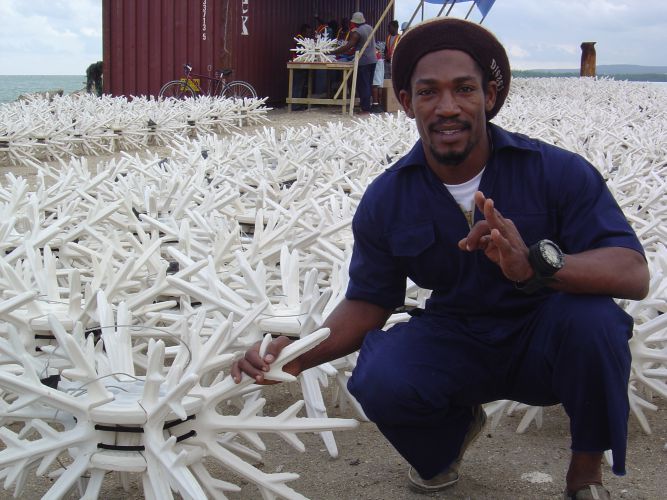
Ecoreef is a patented ceramic rock structure that is easily assembled together and anchored to the seafloor (see above). Their antler like shape mimics the staghorn growth of certain Acroporas while providing the foundations for algae and coral to colonize the structure and intricate channels to protect juvenile fish.

There are many benefits to EcoReefs. First, the modules are made from ceramic, an ideal material because it is pH neutral, non-toxic and chemically inert in seawater. Although initially they may seem like strange “foreign” structures covering the sea bed, over time corals and other invertebrates fill in and overtop the structure to complete the living reef and amazingly recreate a natural setting (although not original) that attracts fish and restores an ecosystem in an area which has been sadly pulverized by blast fishing or scraped by trawlers.

It is estimated that with these ceramic structures the recovery time of pulverized reefs can be reduced from 50 to 100 years to just 7 to 15 years. this is extremely good news for marine conservationists.

Second, EcoReefs projects are highly cost-effective and relatively easy to scale and assemble on the field. According to the website, EcoReefs provides more habitat for more organisms at a lower cost per organism compared to other common artificial reefs (tires, biorock, coral nubbins, rock piles)  lowering the per unit cost to $2.10  compared to $31.80 for tire reefs.

This superior performance is attributed to the high amount of useable surface area per EcoReefs module (1.27m2) combined with the high suitability of ceramic for invertebrate settlement.

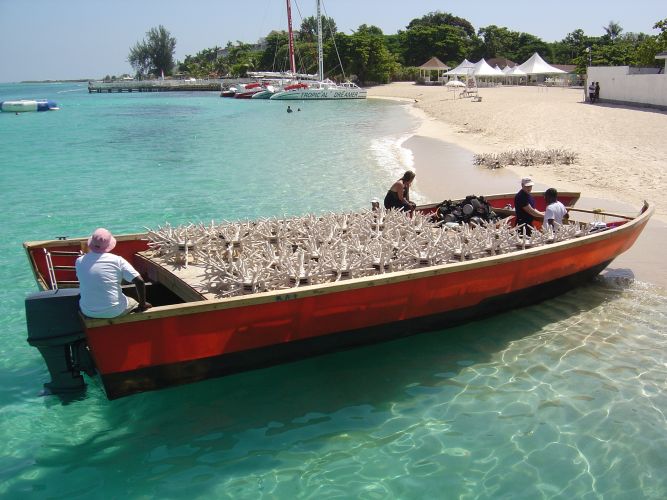
Finally Ecoreefs are easy to assemble and transport in the sea using smaller and low- impact boats.
ecoreef ceramic coral reef

Seacology and EcoReefs have worked collaboratively to restructure the reefs of Manado Tua Island, in Indonesia, which were completely wiped out in 2003 and have since then recovered. This short clip below shows how EcoReef has aided restoration for the benefit of the local community and ecosystem – it would be nice to see this introduced in the evolving Marine Protected Areas of the Red Sea and the Gulf of Aden.

[youtube]http://www.youtube.com/watch?v=SvKgHal5MNM[/youtube]

EcoReefs has been used for the first time in the Middle East by Dolphin Energy in Qatar, as part  of their corporate social responsibility projects, to restore local reefs.

Ahmed Ali al-Sayegh, CEO Dolphin Energy says: “EcoReefs installations slow water currents, shelter the small fish which keep coral clean and alive, and provide the necessary micro-environments for successful coral growth. Dolphin is pleased to have sourced a system that will contribute sensitively and positively to the marine environment in which we work.”

Notwithstanding this good news, we must avoid a situation whereby solutions such as Ecoreefs legitimize reef destruction with the excuse that they can easily restore. Once destroyed, reefs can never return to their original state and although they may “look” healthy , many of the ecosystem processes may not be restored, not even with EcoReefs.

::EcoReef

Linda Pappagallo
Linda Pappagallohttps://www.greenprophet.com/
Linda's love for nature started when at the age of eight she discovered, with her dog, a magical river in the valley of a mountainous region in Lebanon. For four years Linda and her dog explored along the river, until one day she saw construction scrapers pushing rock boulders down the valley to make way for new construction sites. The rubble came crashing into the river destroying her little paradise, and her pathetic reaction was to shout at the mechanic monsters. Of course that was not enough to stop the destructive processes. As she continued to observe severe environmental degradation across the different places she lived in the Middle East and Africa, these terrible images remained impressed in her mind. However, environmental issues where not her first love. Her initial academic and career choices veered towards sustainable economic development, with particular interest in savings led microfinance schemes. Nevertheless, through experience, she soon realized a seemingly obvious but undervalued concept. While humans can somewhat defend themselves from the greed of other humans, nature cannot. Also nature, the environment, is the main “system” that humans depend on, not economics. These conclusions changed her path and she is now studying a Masters in International Affairs with a concentration in Energy and the Environment in New York. Her interests lie on ecosystems management: that is how to preserve the integrity of an Ecosystem while allowing for sustainable economic development, in particular in the Middle East and Africa.
1 COMMENT

Comments are closed.

TRENDING

Jordan’s $6 Billion Aqaba–Amman Desalination Project from the Red Sea Moves Forward

In 2025, the Jordanian government signed agreements with a consortium led by Meridiam and SUEZ, alongside VINCI Construction and Orascom Construction. Under a 30-year concession agreement, the consortium will design, build, finance, operate, and maintain the system before transferring it back to the Jordanian government. The total investment is estimated at approximately $6 billion USD.

The Saudi Startup Turning Desalination’s Toxic Waste Into Its Own Disinfectant

For millennia, the Middle East's water crisis seemed an immutable fact of geography — a region defined as much by what it lacked as by what lay beneath its sands. Today, a convergence of plummeting solar costs, advancing membrane technology, and hard-won engineering expertise is rewriting that story.

BM Studios is designing systems, not just buildings in the UAE

Balsam Madi is an architect and systems thinker whose work bridges culture, sustainability, and design intelligence across the Middle East and Europe.

The life of a coral gives clues to the origins of our heartbeat

A joint study by Tel Aviv University (TAU) and the University of Haifa set out to solve a scientific mystery: how a soft coral is able to perform the rhythmic, pulsating movements of its tentacles without a central nervous system. The study’s findings may change the way we understand movement in the animal kingdom in general and particularly in corals.

Ethiopians are Looking to Somaliland for Red Sea Access as Global Powers Move In

Somaliland, for its part, has operated as a de facto independent state since 1991. It has its own government, elections, currency, and security forces. It’s often described as one of the more stable and democratic political systems in the region, despite never being formally recognized internationally. 

Should You Invest in the Private Market?

startustartup Unlike public stock exchanges, which offer daily trading, strict...

How to build a 100-year-company

Kongō Gumi is a Japanese construction company, purportedly founded in 578 A.D., making it the world's oldest documented company. What can we learn about building sustainable businesses from them?

From Pilot Plant to Global Stage: How Aduro Clean Technologies’ 2026 Expansion Signals a Turning Point for Chemical Recycling Investors Like Yazan Al Homsi

The company's Next Generation Process (NGP) Pilot Plant in London, Ontario, has officially moved into initial operating campaigns, generating the kind of structured, repeatable data that separates laboratory promise from commercial viability.

How AI Helps SaaS Companies Reduce Repetitive Customer Support Work

SaaS products are designed for large numbers of users with different levels of experience, and also in renewable energy.

Pulling Water from the Air

Faced with water shortage in Amman, Laurie digs up...

Turning Your Energy Consultancy into an LLC: 4 Legal Steps for Founders in Texas

If you are starting a renewable energy business in Texas, learn how to start an LLC by the books.

Tracking the Impacts of a Hydroelectric Dam Along the Tigris River

For the next two months, I'll be taking a break from my usual Green Prophet posts to report on a transnational environmental issue: the Ilısu Dam currently under construction in Turkey, and the ways it will transform life along the Tigris River.

6 Payment Processors With the Fastest Onboarding for SMBs

Get your SMB up and running fast with these 6 payment processors. Compare the quickest onboarding options to start accepting customer payments without delay.

Related Articles

Popular Categories