 Morocco already has the world’s most ambitious solar target. Now it is starting on wind.
Morocco’s ascendance in renewable development is continuing apace. Morocco’s state-run power utility has just invited companies to bid on five wind farm projects with a total power generation capacity of 850 megawatts, as part of its plan to build 2,000 MW of wind power by 2020.
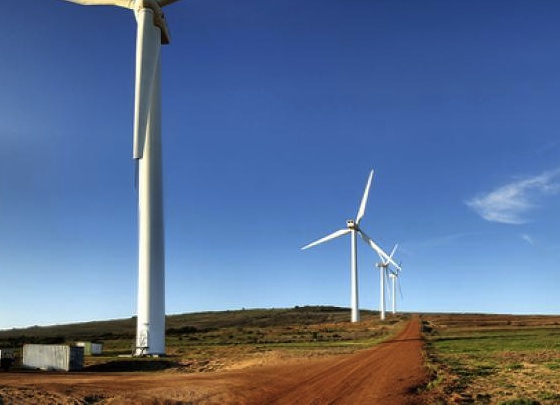
Its Atlantic coast has some of the best wind resources in the entire world, and pictured here is its first wind farm – that was already the largest in Africa when it was inaugurated in 2010.
ONE said it will take bids until March 2 from firms or consortia for “the development, design, financing, construction, operation and maintenance” of the five projects.
The bidding will go in two stages. Bidders who pass the preliminary, expression-of-interest phase will be invited to bid in an international tender, which will be launched in the second quarter of this year.
“The 850 megawatt wind farm project will be structured under a ‘build, own, operate and transfer’ scheme,” said Morocco’s state-owned utility, ONE – which is soliciting the bids.
Back in November, Morocco announced its beginning of a world first for wind power – the largest project in the world to combine two natural clean power allies, wind and water, in a hybrid power project rated at a little over 1 GW (1,070 megawatts) as part of Morocco’s ambitious renewable energy targets set just two years ago in 2009, to get 10% of its electricity from renewables by 2012.
“Our studies show that we can generate up to 25,000 megawatts from wind power alone,” a government official said.
The funding for this mega wind project is all local, unlike that for Morocco’s first steps towards being a part of the Desertec Industrial Initiative, which is set to supply a gigantic amount of power across the Mediterranean to Europe form North African deserts.
Since those solar and wind projects are to supply the EU, DII is funded by the EU, as part of its attempt to reduce its own carbon emissions by importing massive amounts of clean energy (solar and wind power) from the desert.
Paul de Son, now aggressively moving the DII project to realization, was once a head of Munich RE, the reinsurance company that must reimburse insurance companies that will increasingly be bankrupted by the havoc that climate destabilization is wrecking. Europe’s cap and trade in pollution, the European Trading Scheme (ETS) generates the funds in auctions from companies that emit carbon for the Clean Development Mechanism (CDM) that funds the ambitious clean energy project.
By contrast, this 850 MW wind project is all to be domestically funded by Morocco: a public-private partnership with ONE, the Energy Investments Company and the King Hassan Fund, all state owned. That is because, unlike the Morocco’s first DII project to supply the EU, this project goes to supply Morocco’s own very fast growing domestic needs.
Currently, Morocco has 280 MW of wind energy. The addition of the 850 MW project will get Morocco half way to its 2020 goal of 2,000 MW from wind power, at an expected cost of 31.5 billion dirhams ($3.6 billion).
Related:
Egypt’s Next Huge Wind Farm
Durban Gives 6 Reasons for the Middle East to Celebrate
Global Clean Energy Brokers Meet at Abu Dhabi Emergy Summit This Month