


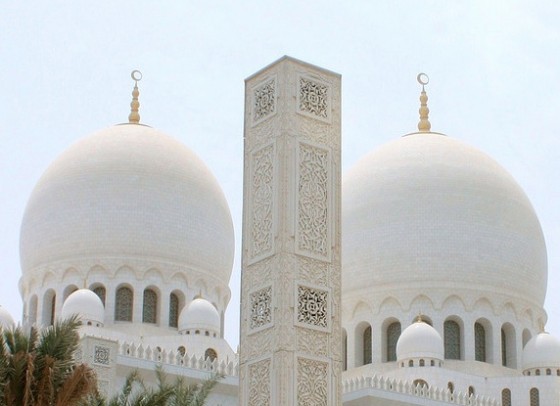
 A spiritual call to prayer or noise pollution? Some communities seek ban on mosque call in Israel
Should Israel be more lenient than Europe in the amount of noise that can emanate from a mosque call to prayer? These are the questions that Israeli government officials are asking recently, with some ministers looking to back a ban on mosque call to prayers. Muslims broadcast in a singing prayer, over a loudspeaker, when the faithful should start praying. The call is made five times daily, and when competing mosques pump up the volume the noise can be quite cacophonous!
I love the sound of the call to prayer five times daily, especially the one before daybreak and the one at dusk. But in some cities – I remember being rattled out of bed in a hostel in Istanbul by the call to prayer which was a bit unsettling – the question of religious freedom over the rights of others is coming into question.
Not all people believe that religious reason is enough to keep the loudspeakers on. Even beautiful sounds can become torture for people over time, especially when heard in the middle of slumber, or played at the time when baby is falling asleep.
In recent years, noise pollution has been studied on urban environments as a kind of pollution that can cause tension and stress, affecting the well-being of people. I remember loving to see signs in New York streets where honking was prohibited.
Car noise, bus engines, loud sound systems, truck brakes, screaming neighbors, barking dogs – and of course industrial noise is all a form of pollution. It not only harms people, noise pollution affects the marine environment as well.
In mixed neighborhoods and communities in Israel there is still an ongoing debate about the level of noise that should be able to come from mosque call to prayers. Unlike church bells that ring on Sundays only, usually, the Muslim call to prayer happens when most people are asleep.
Have your say. Sound pollution or a spiritual right? Should mosques be allowed to broadcast their call to prayer in any community?
::Haaretz
Image via jemmasmith




im in Sudan right now, it’s Friday and i have to suffer through 1 hour of prayer broadcast so loud that i feel like I am wearing noise cancelling headphones blasting Qur’an in my head. It’s one thing to have a system to call people to prayer. It’s another one to use this system to bother those who do not believe or abide by it. It’s loud, offensive and seriously intimidating.
This issue comes between religion and respect. It is ok to remind Muslims for the prayer time. But in order to respect non-Muslims, the volume can be tuned down to a comfortable level. In every mosque the volume is tuned to maximum until it become a source pollution. I believe in every religion prayers should be calm and peaceful and not to shout it out. At least Church bells are not broadcast through loudspeaker and only can be heard within a small area at a natural level. We shall not be ignorant and only think of our own religion. religion teach us to be a well manner person. thus we shall respect and understand each other.
I personally like the call to prayer. But the argument against is because it’s not the same as the Church bells once a week on Sunday mornings at 10 AM. There are 5 calls to prayer every day, and in some communities it’s very loud in the morning and evenings… it wakes up babies and disturbs people who don’t find the sound spiritual or soothing. There are also very loud announcements and sometimes calls for action through the speakers which some parts of the community object to. Today there is email, SMS alerts, newsletters and a variety of creative ways to get out the news.
I think It’s definetely OK for mosques to call prayer in Israel, because as you know ‘Karin’ b4 the british gave Palestine to the jewish,most of the population was muslim b4 they were invaded by the british, so I think that just as respect to muslims there, the call to prayer should be allowed there! If they stop the call to prayer in Israel, the bells of church aren’t allowed to ring on sundays either. Oh and FYI the call to prayer isn’t noise pollution or a ‘SONG’ it’s something that reminds muslims that they are muslims and never have to forget god, and ofcourse to pray. OK?
Muzzled NO but brought back to the old days were the Mwezi had enough strength in his voice to draw the believers. The problem is A. they can’t cope with the modern PA system; the rule is “the louder the better” B. their voices are often not trained to perform this beautiful “song”.
I myself wake before the first call it’s part of the rhythm of live slowly meeting a new day.
This apply also to the Christian way of expression their believe. I live in Kenya and this can be a terror!
If you worship Allah/God keep it inside your hearth or at least in the Mosque/Church.
Or in the synagogue…
Maybe there could be a new way for Muslims to hook up to the mosque via cell phones so the mosque calls the phone and the phone transmits the prayer. Just an idea…
Only respectful comments will be published as part of this post. Anything hateful will be deleted. Period.