After the Fire: Israel’s Carmel Forest Doesn’t Need Our Help

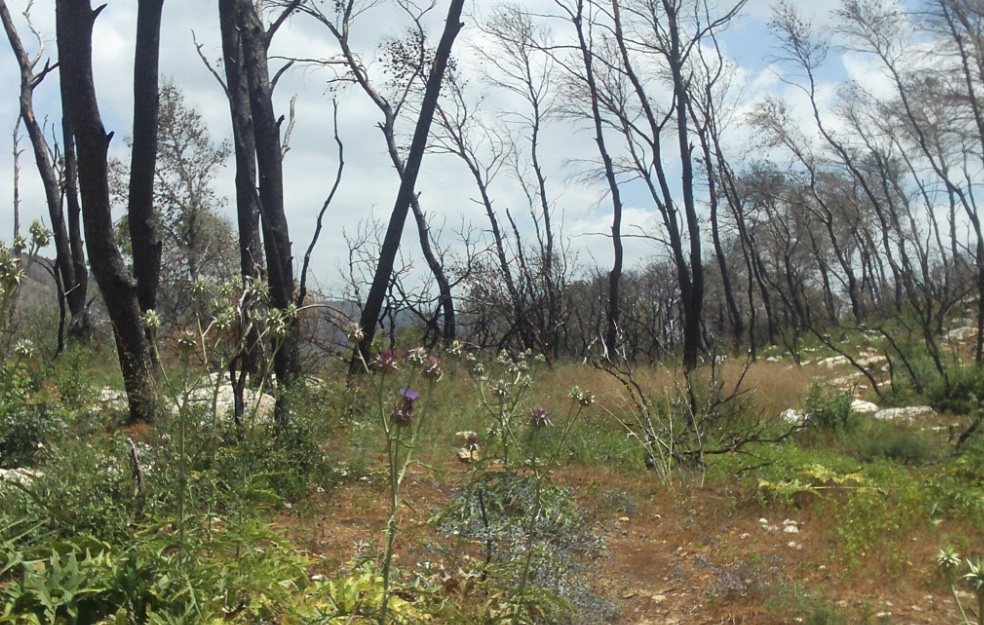
israel fire regrowthA year after the fire in Israel, Joshua finds new life at the ravaged Carmel Forest.

Israel experienced the largest wildfire in the country’s history nearly a year ago. The blaze broke out near Isifiya, in the Carmel region, on December 2, 2010.  Spreading over large swaths of land overnight, the fire quickly consumed 5,000 hectares before emergency crews extinguished it. Firefighters were able to gain the upper hand only after four days.  A large amount of fuel on the forest floor – dry material accumulated from a hot summer – hastened its progression.

It was a tragedy on both a geographic and human scale.  Fourty-four people perished. When the smoke cleared, a shocked country was left grieving and devastated.  After the funerals and memorials, Israelis considered their options.

The natural reaction for many was to begin replanting. The Zionist pioneers of Israel highly valued tree planting.  This act fulfilled a very basic tenet of Judaism.  Jews are obligated by the Torah to plant fruit trees to settle the land.  Additionally, planting trees provides agriculture, shade, a haven for wildlife, and aesthetic value.  So central are trees to Jewish life and philosophy that Jews refer to the Torah, their holiest book, as the “Tree of Life”.

But several ecologists warned that replanting too soon could be counterproductive as it may disturb nature’s own healing process.  The Jewish National Fund and the Society for Protection of Nature in Israel managed to convince the government not to replant immediately after the fire.  Their reasoning was that nature possesses far superior restorative abilities than man.

Researchers studying rehabilitation of the Sha’ar Ha-gai (just west of the Jerusalem Hills) Forest Fire in 1995 concluded that replanting is not necessarily successful in accelerating forest regeneration.  The Sha’ar Ha-gai study showed that areas which were replanted did not grow faster than areas left alone.

Thus, the government agreed to wait one year before making any decisions about rehabilitating the Carmel.  The advice of ecologists from the University of Haifa and elsewhere was very influential in the decision.

But as we approach the anniversary of the Carmel fire, there is mounting pressure on the government to begin a restoration campaign.  The forest, once a lush haven for hikers and nature enthusiasts, has become an eyesore.  Large swaths of blackened treetops can be seen from nearly every vantage point in the area.

The Israeli Cabinet authorized $15 million USD for the Carmel area this past summer, including an outlay for reforestation.  JNF crews have been active in the area recently, thinning brush and removing burned trees to ease the struggle of seedlings.  They have also surveyed the area to determine where to plant oak, cypress, pistachio, and pine trees.  The Carmel has the only population of Aleppo pine trees on the eastern Mediterranean coast.

And a month ago, Cyprus presented the State of Israel with 300 trees as a gift for the Jewish New Year.  After a ceremony honoring speedy Cyprian aid during the crisis, the attendees got to work planting the trees.

There is great momentum toward a full restoration effort.  But the rush to restore could be a mistake.   It could interfere with an important natural process.   Experts remark on the forest’s adaptation to fire regimes, which have existed throughout the region’s history.

Professor Ido Izhaki, Director of the Carmel Research Center at the University of Haifa, says we need not interfere too much.  “There are plant species [there] that have developed resilience to fire and those that have developed a dependency on fire, such as the Aleppo pine.”

The Aleppo pine cones actually require heat from fire to open.  This process releases their seeds to the ground.  “After this enormous fire, the Carmel will be covered with pine buds,” Izhaki says.

The once great Carmel Forest will return regardless of what we do.  But its return should be heralded by nature, not by the desperate acts of men.  What greater gesture of love for the forest than to leave it in peace?

Joshua Basofin
Joshua Basofinhttp://www.greenprophet.com
Joshua is an environmental attorney and writer living in Tel Aviv. He has worked for several conservation groups in his native United States, including The Nature Conservancy and Defenders of Wildlife. Joshua specializes in laws and policies aimed at protecting natural areas. He has a particular interest in freshwater and marine habitats. Growing up in the suburbs of Middle America, Joshua learned to escape into nature and leave the strip malls and parking lots behind. He has hiked and explored around the world, from South America to Australia to Thailand. Joshua is fascinated by the often polarizing worlds of tradition and modernity. He thrives on studying the intersection of environmental conservation, religion, and human culture. And he may have found his greatest challenge yet in Israel.

TRENDING

Eco organization offices destroyed by Iran missile

Tel Aviv's eco organization, the Heschel Center, was impacted by an Iranian missile.

What are AWG air-water generators, and why they aren’t a golden-bullet solution (yet)

Atmospheric water generators (AWGs) sound like magic: machines that can pull drinking water out of air. The idea is mentioned in the Bible, where the elders would pray for water collected as dew on plants and the catch on turning this into a machine is in the physics. To turn invisible vapor into liquid, you must remove heat, especially the latent heat of condensation.

Jordan’s $6 Billion Aqaba–Amman Desalination Project from the Red Sea Moves Forward

In 2025, the Jordanian government signed agreements with a consortium led by Meridiam and SUEZ, alongside VINCI Construction and Orascom Construction. Under a 30-year concession agreement, the consortium will design, build, finance, operate, and maintain the system before transferring it back to the Jordanian government. The total investment is estimated at approximately $6 billion USD.

The Saudi Startup Turning Desalination’s Toxic Waste Into Its Own Disinfectant

For millennia, the Middle East's water crisis seemed an immutable fact of geography — a region defined as much by what it lacked as by what lay beneath its sands. Today, a convergence of plummeting solar costs, advancing membrane technology, and hard-won engineering expertise is rewriting that story.

Earth building with Dead Sea salt bricks

Researchers develop a brick made largely from recycled Dead Sea salt—offering a potential alternative to carbon-intensive cement.

Should You Invest in the Private Market?

startustartup Unlike public stock exchanges, which offer daily trading, strict...

How to build a 100-year-company

Kongō Gumi is a Japanese construction company, purportedly founded in 578 A.D., making it the world's oldest documented company. What can we learn about building sustainable businesses from them?

From Pilot Plant to Global Stage: How Aduro Clean Technologies’ 2026 Expansion Signals a Turning Point for Chemical Recycling Investors Like Yazan Al Homsi

The company's Next Generation Process (NGP) Pilot Plant in London, Ontario, has officially moved into initial operating campaigns, generating the kind of structured, repeatable data that separates laboratory promise from commercial viability.

How AI Helps SaaS Companies Reduce Repetitive Customer Support Work

SaaS products are designed for large numbers of users with different levels of experience, and also in renewable energy.

Pulling Water from the Air

Faced with water shortage in Amman, Laurie digs up...

Turning Your Energy Consultancy into an LLC: 4 Legal Steps for Founders in Texas

If you are starting a renewable energy business in Texas, learn how to start an LLC by the books.

Tracking the Impacts of a Hydroelectric Dam Along the Tigris River

For the next two months, I'll be taking a break from my usual Green Prophet posts to report on a transnational environmental issue: the Ilısu Dam currently under construction in Turkey, and the ways it will transform life along the Tigris River.

6 Payment Processors With the Fastest Onboarding for SMBs

Get your SMB up and running fast with these 6 payment processors. Compare the quickest onboarding options to start accepting customer payments without delay.

Related Articles

Popular Categories