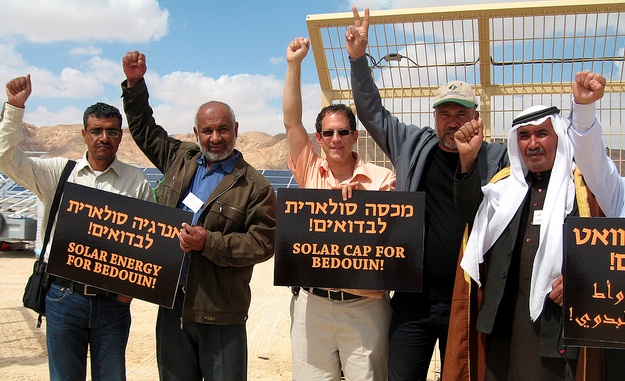
 Arava Power in Israel is fighting so Bedouin get a fair share of feed-in tariffs in Israel. Backed by Siemens Arava stands to benefit too.
“Sixty percent of the country happens to be desert, and 30 percent of the [desert] inhabitants happen to be Bedouin,” says Yosef Abramowitz, president of Arava Power Company in Israel. Abramowitz sees his solar energy company’s success of installing solar units in the desert as intertwined with the people who know Israel’s deserts best: the Israeli Bedouin.
He is fighting regulatory bodies on behalf of the Bedouin, to make sure they get their share of the sun. Attractive feed-in tariffs in Israel, with state guarantees on solar energy investments for new solar power plants, have created a small windfall of opportunities for local installers, as well as local and foreign investors. Arava seeks to lease Bedouin land to install solar power plants, with financial backing from companies like Siemens.
Step-by-step progress is being made: In the summer, the Southern Regional Planning and Building Committee of the Israeli Ministry of the Interior approved plans for a photovoltaic (PV) solar installation next to the Israeli Bedouin community of Tarabin. This $30 million joint project between the Tarabin tribe and Arava would be the first to be approved on Bedouin land.
Pushing through red tape
Arava Power recently installed a solar power plant of almost five megawatts at Kibbutz Ketura. A series of additional solar installations in the same area are planned as the company joins other industrious solar power plant entrepreneurs.
But getting the rubber stamp from the last regulatory body to go ahead with building the solar field at Tarabin is not proving easy. And in the meantime, feed-in tariffs, which cap at 300 megawatts, are getting used up.
Arava Power is appealing to the government to provide special caps to the Bedouin, a once entirely nomadic people now in transition. Abramowitz says Arava is ready to invest $3 billion in developing solar fields if this happens.
“Billions and billions of dollars will be invested in solar installations in the south of the country, and we have a moral obligation to ensure that the solar benefits of the state of Israel will be shared by all the citizens of the desert,” says Abramowitz, pointing out that allowing the Bedouin to derive a guaranteed income from an Arava-built plant would ease conditions caused by high unemployment.
The idea started with Lucy Michaels, a PhD student at the Arava Institute for Environmental Studies. She suggested that the solar energy business in Israel also benefit the Bedouin people, who tend to be socially, culturally, politically and economically marginalized from the Israeli majority.
“We didn’t start with a business model,” Abramowitz tells ISRAEL21c. “We started with a mission. We strove to maintain our mission focus. In the early years we expanded that mission to include economic justice.”
Tea, kisses and darned socks
However, complicated issues have emerged about the status of Bedouin on land that they claim without paperwork or formal deeds. According to Abramowitz, involving Bedouins in the solar industry can be a catalyst for resolving these land ownership claims, which is a government priority.
A Bedouin staff currently manages the planning stages for solar energy leasing agreements with Arava, signed at first over tea, handshakes and kisses — the Bedouin way. Every week when Abramowitz goes to visit the Bedouins he has to make sure his socks are clean with no holes, as it’s customary to remove your shoes while entering the host’s tent. “We choose families and tribes very carefully, and we are dealing with honorable people, people with influence,” he says. “A Bedouin word is their word.”
The first of five anticipated deals, the Tarabin project would be an eight-megawatt, 37-acre installation. The eventual full 30 megawatts from additional projects would go to the national grid, and in theory would be quickly used by the Bedouin people of Tarabin. Once a license is granted by the Public Utilities Authority, the first plant could be up and running in six months.
Community leader Haj Mousa Tarabin said: “I am glad there are people who are concerned and are helping the Bedouin improve their lifestyle on the economic level as well as with creating various sources of income.”
I wrote this story for ISRAEL21c – www.israel21c.org and it is reprinted here with permission.