A Side Of Sewage With Dinner In Morocco

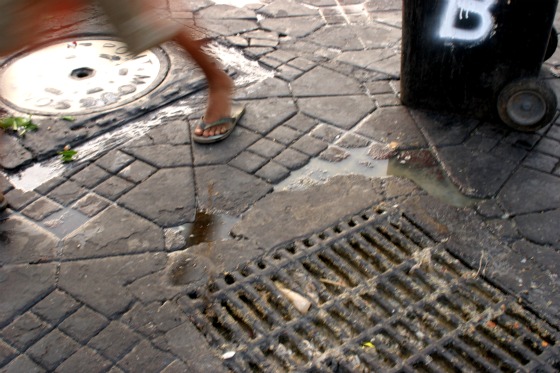
wastewater treatment, MoroccoRight in the middle of a crowded tourist destination, a sewage drain overflowed and no one rushed to the scene to clean it up!

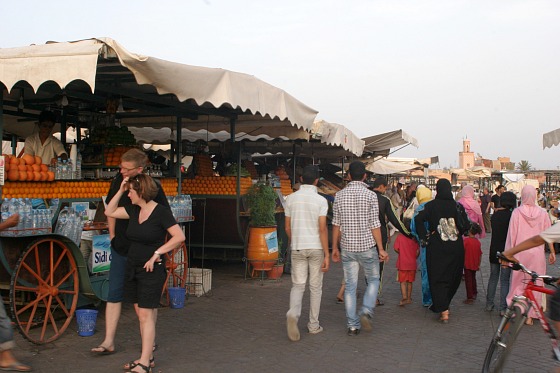
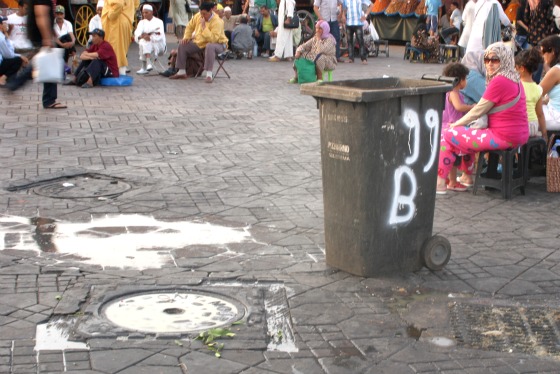
Last night, hundreds of tourists that descended upon the popular La place Jemâa el Fna in Marrakech were greeted with a stinking treat. Right next to the open air restaurant that later served me a small Moroccan salad, potato cakes, and delicious mint tea, (see a recipe for Moroccan Anise bread here) and where Henna painters, storytellers, and snake charmers spend their evenings luring tourists to their small patch of concrete, a blocked drain overflowed. And nobody rushed to the scene to clean it up.
wastewater treatment, MoroccoHouston, we have a sewage problem

Located in Africa’s Northwestern corner, Morocco has a sewage problem. This is no secret to anyone on the street or on high, and the issue is being addressed with a certain urgency. In the meantime, though, raw sewage continues to run amock not only in poor, rural areas, but also in urban areas that experience high tourist traffic.

The Régie Autonome de Distribution d’Eau et d’Electricité de Marrakech (RADEEMA) was established in 1971 to manage Marrakech’s water and electricity supply. Then in 1998, it was tasked with restructuring the city’s water sanitation facilities and closing injection  points that discharge untreated water into the surrounding environment.

According to Eco2Data, Marrakech produces approximately 90,720 m3 of wastewater every day. With limited infrastructure to cope with it, RADEEMA’s job of ensuring that the surrounding environment is not contaminated with untreated sewage is no easy task.

Poop in the sea

Roughly 60% of the country’s 546 million m3 of wastewater lands up in the Atlantic Ocean untreated, which is harmful to fish – an important domestic and export commodity. And the cost of cleaning up this and agricultural contamination amounts to at least $0.5 billion every year.

In Marrakech alone, it is estimated that 2,000 hectares of agricultural land, which produce cereals and fruit, are watered with raw sewage. Fresh water resources are quickly dwindling in Morocco, as elsewhere in the Middle East and North Africa region, particularly in the drier, southern parts of the country, so farmers are resorting to what resources they do have.
wastewater treatment, MoroccoSo, what’s the solution to this sh#tty problem?  Under the Horizon 2020 program spearheaded by the European Union, which has contributed 90 million euros towards Morocco’s national sanitation program, 34 high level wastewater managers and decision makers attended a training program in Rabat earlier this year. There they were exposed to best practices that are expected to be passed (and hopefully not flushed) down the management chain.

Plan and program

The country has a long way to go, but unlike Egypt, for example, where raw sewage flows freely into the Nile river, Morocco’s government has a plan.

According to Global Water Intel:

In 2005, Morocco only treated 10% of its municipal effluent, despite the fact that 70% of the population was connected to the sewerage network. Faced with mounting pollution problems, the country launched a national wastewater strategy, Plan National de l’Assainissement (PNA), with the longterm objectives of treating 60% of effluent and connecting 80% of the population to the sewerage network by 2020.

Tonight, I’m going back down to the square to see whether I can eat my dinner in a stench-free environment!

More on travel, nature, and the environment in Morocco:

Morocco: Arab World Star Has a Dark Side

Rocking the “Eco” Kasbah du Toubkal in Morocco

Making Cobras Swoon is not so Charming

images via Tafline Laylin

Tafline Laylin
Tafline Laylinhttp://www.greenprophet.com
As a tour leader who led “eco-friendly” camping trips throughout North America, Tafline soon realized that she was instead leaving behind a trail of gas fumes, plastic bottles and Pringles. In fact, wherever she traveled – whether it was Viet Nam or South Africa or England – it became clear how inefficiently the mandate to re-think our consumer culture is reaching the general public. Born in Iran, raised in South Africa and the United States, she currently splits her time between Africa and the Middle East. Tafline can be reached at tafline (at) greenprophet (dot) com.
4 COMMENTS

Comments are closed.

Hot this week

How Renewable Energy is Revolutionizing the Way We Power Our World

Solar has become the star of the transition thanks to modular hardware and straightforward installation. It fits dense cities and remote towns alike. Many companies are turning to rooftop arrays and carport systems - and exploring commercial solar installation as a practical way to lock in future savings.

How does one start prepping?

Faced with an extreme winter storm this year, Americans wonder how to be prepared for catastrophe. Miriam has lived through wars in the Middle East - so she's prepared on giving you a guide to prepping.

Fishermen sue tire manufacturers on behalf of the salmon

A federal trial in San Francisco has brought US tire manufacturers, fishing groups, and environmental scientists into court over a chemical most drivers have never heard of — but which scientists say may be silently reshaping aquatic ecosystems.

Listening to Water: Tarek Atoui’s Next Work for Tate Modern

Born in Beirut, Lebanon in 1980 and now living in Paris, Atoui has spent years building instruments that don’t sit comfortably in concert halls. Many of them involve water, glass, and ceramics — materials that react to sound instead of simply producing it.

Leading Through a Dual-Energy Transition: Balancing Decarbonisation with Energy Security

Experience in one area of the energy industry isn't enough to guarantee readiness across all the others. That's where a structured program like an MBA in energy can come in. Today's advanced curricula explore energy economics, finance, policy, and strategic management alongside the technical subjects. And when pursuing an energy MBA online, professionals can skill up and retrain without having to step out of the labor market -- an important perk at a time when skilled professionals are already in short supply.

Topics

How Renewable Energy is Revolutionizing the Way We Power Our World

Solar has become the star of the transition thanks to modular hardware and straightforward installation. It fits dense cities and remote towns alike. Many companies are turning to rooftop arrays and carport systems - and exploring commercial solar installation as a practical way to lock in future savings.

How does one start prepping?

Faced with an extreme winter storm this year, Americans wonder how to be prepared for catastrophe. Miriam has lived through wars in the Middle East - so she's prepared on giving you a guide to prepping.

Fishermen sue tire manufacturers on behalf of the salmon

A federal trial in San Francisco has brought US tire manufacturers, fishing groups, and environmental scientists into court over a chemical most drivers have never heard of — but which scientists say may be silently reshaping aquatic ecosystems.

Listening to Water: Tarek Atoui’s Next Work for Tate Modern

Born in Beirut, Lebanon in 1980 and now living in Paris, Atoui has spent years building instruments that don’t sit comfortably in concert halls. Many of them involve water, glass, and ceramics — materials that react to sound instead of simply producing it.

Leading Through a Dual-Energy Transition: Balancing Decarbonisation with Energy Security

Experience in one area of the energy industry isn't enough to guarantee readiness across all the others. That's where a structured program like an MBA in energy can come in. Today's advanced curricula explore energy economics, finance, policy, and strategic management alongside the technical subjects. And when pursuing an energy MBA online, professionals can skill up and retrain without having to step out of the labor market -- an important perk at a time when skilled professionals are already in short supply.

From Green Energy to Healthy Societies: Why old systems thinking is becoming relevant again

Across the Middle East and North Africa, large investments are being made in green hydrogen, renewable energy, water infrastructure and sustainability. Most of these efforts are discussed in the context of climate change, decarbonization and economic diversification. That framing is important, but it may not capture their full value.

We saw peace – an interreligious encounter deep in our eyes

They came from Israel, Palestine, Jordan, Iraq, Yemen, Morocco, Tunisia, Lebanon, Egypt… There are Sunni Muslims, Shiite Muslims, Jews (Orthodox and Reform), Orthodox Christians, Coptic Christians, Protestant Christians, Druze, Baha'is, a Scientologist.

Can biochar reduce ‘Forever Chemicals’ in food if it’s used in farms?

Biochar is produced by heating organic material in a low-oxygen environment so it does not burn. This process, known as pyrolysis, transforms plant matter into a stable, carbon-rich material.

Related Articles

Popular Categories