
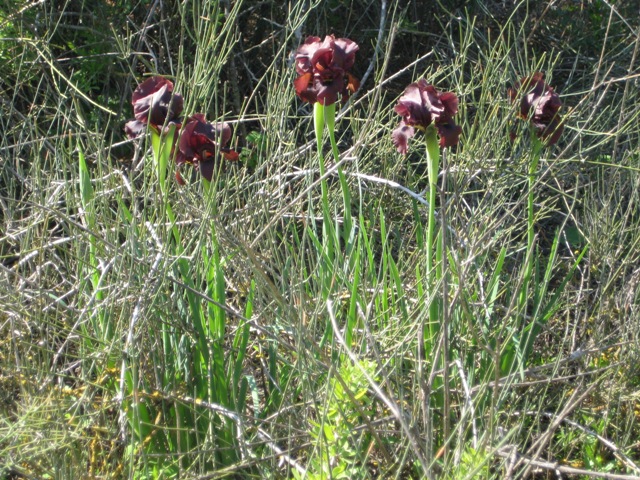
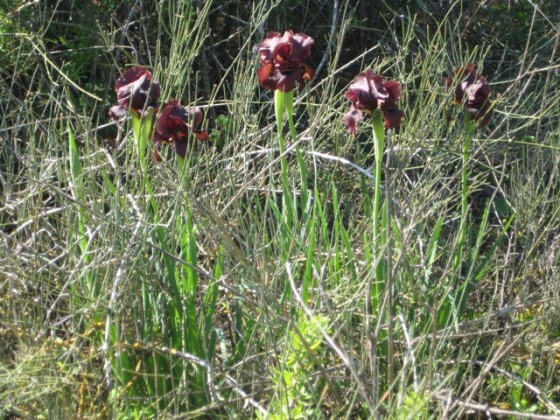
The Wild Winter Iris in Israel

The Argaman Iris in all its glory awaits you this winter

Further to my article in the Jerusalem Post about open places in Netanya being squeezed out by mega housing projects, this writer decided to pay a return visit to one of the nature reserves, the Argaman Iris Reserve, located in southern Netanya next to the ongoing Ir Yamim development project. The iris reserve contains a variety of indigenous wild flowers, most notably the wild purple or Argaman iris.

Found in only a few parts of Israel, including small areas in southern Netanya, this perennial plant blossoms only during a 2 to 3 week period from mid February to early March. The iris reserve is confined to a site of around 100 acres, and bordered on the east by the construction projects and on the west by what used to be the city’s garbage dump, until it was relocated elsewhere. 

“Neither the Argaman Iris site nor the Winter Pond (about 3/4 of a kilometer north of the iris reserve)  are protected nature sites,” says Alon Rothschild, in charge of Environmental Protection and Natural Sites in the Central Region for the Society for the Protection of Nature in Israel (SPNI).

Entrance to iris preserve: note construction in background

Rothschild, who was interviewed for the JPost article, says that a hotel project was originally planned  to be built on part of the area now allocated for the Argaman iris reserve, but it was moved elsewhere due to lobbying efforts from the SPNI and other “green” organizations.

The entrance to the reserve is off the main coastal road heading out of Netanya, and  parking lots are located on either side of the reserve. Signs at the reserve’s entrance tells visitors the various kinds of plant and animal life located in the reserve, much of which covered the entire area now being developed by the Ir Yamim project, which also will include a galleria-type shopping mall.

Trails with rope barriers are designed to allow visitors to the reserve to observe the irises and other plant life without causing any damage to fragile flowers like the irises. This doesn’t always work out according to plan however, as people often want to touch or be photographed by these lovely flowers.

Another problem is “invading” plant life that competes with the irises and other native species for space. “We have to remove these invasive plants from the site so the natural species can thrive,” says Rothschild. Fortunately, on my visit to the site on a particularly lovely Friday morning in mid February, the irises were “cooperating” and were starting to bloom. Other native flowers and flowering plants were blooming too, and the buzzing of pollen gathering bees could be heard everywhere.
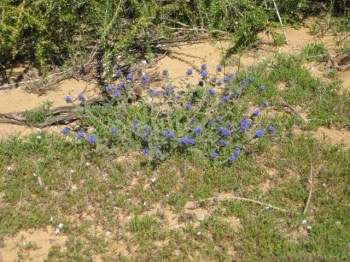
Not just irises, but other beauty too

There may be hope yet for the iris reserve and other nature sites in this city of 208,000, as the Netanya Municipality is becoming more aware of the need to preserve these “green spaces” for future generations.

According to Sara Gazit, Parks and Infrastructure Architect for the Municipality, and who was also interviewed for the Jpost article: “Until 10 years ago, we at the municipality did not have ecologists to advise us on what needs to be done to maintain these natural sites. Since then, we have conducted surveys and made a lot of changes to area building plans in order to take the ecological situation into consideration in these natural sites.”

Read more on environmental issues affecting nature sites in Israel:

Is Jerusalem Stone Under Threat?

Ancient Ceasarea Needs Every Grain of Sand

Maurice Picow
Maurice Picowhttps://www.greenprophet.com/
Maurice Picow grew up in Oklahoma City, U.S.A., where he received a B.S. Degree in Business Administration. Following graduation, Maurice embarked on a career as a real estate broker before making the decision to move to Israel. After arriving in Israel, he came involved in the insurance agency business and later in the moving and international relocation fields. Maurice became interested in writing news and commentary articles in the late 1990’s, and now writes feature articles for the The Jerusalem Post as well as being a regular contributor to Green Prophet. He has also written a non-fiction study on Islam, a two volume adventure novel, and is completing a romance novel about a forbidden love affair. Writing topics of particular interest for Green Prophet are those dealing with global warming and climate change, as well as clean technology - particularly electric cars.

TRENDING

Eco organization offices destroyed by Iran missile

Tel Aviv's eco organization, the Heschel Center, was impacted by an Iranian missile.

What are AWG air-water generators, and why they aren’t a golden-bullet solution (yet)

Atmospheric water generators (AWGs) sound like magic: machines that can pull drinking water out of air. The idea is mentioned in the Bible, where the elders would pray for water collected as dew on plants and the catch on turning this into a machine is in the physics. To turn invisible vapor into liquid, you must remove heat, especially the latent heat of condensation.

Jordan’s $6 Billion Aqaba–Amman Desalination Project from the Red Sea Moves Forward

In 2025, the Jordanian government signed agreements with a consortium led by Meridiam and SUEZ, alongside VINCI Construction and Orascom Construction. Under a 30-year concession agreement, the consortium will design, build, finance, operate, and maintain the system before transferring it back to the Jordanian government. The total investment is estimated at approximately $6 billion USD.

The Saudi Startup Turning Desalination’s Toxic Waste Into Its Own Disinfectant

For millennia, the Middle East's water crisis seemed an immutable fact of geography — a region defined as much by what it lacked as by what lay beneath its sands. Today, a convergence of plummeting solar costs, advancing membrane technology, and hard-won engineering expertise is rewriting that story.

Earth building with Dead Sea salt bricks

Researchers develop a brick made largely from recycled Dead Sea salt—offering a potential alternative to carbon-intensive cement.

Should You Invest in the Private Market?

startustartup Unlike public stock exchanges, which offer daily trading, strict...

How to build a 100-year-company

Kongō Gumi is a Japanese construction company, purportedly founded in 578 A.D., making it the world's oldest documented company. What can we learn about building sustainable businesses from them?

From Pilot Plant to Global Stage: How Aduro Clean Technologies’ 2026 Expansion Signals a Turning Point for Chemical Recycling Investors Like Yazan Al Homsi

The company's Next Generation Process (NGP) Pilot Plant in London, Ontario, has officially moved into initial operating campaigns, generating the kind of structured, repeatable data that separates laboratory promise from commercial viability.

How AI Helps SaaS Companies Reduce Repetitive Customer Support Work

SaaS products are designed for large numbers of users with different levels of experience, and also in renewable energy.

Pulling Water from the Air

Faced with water shortage in Amman, Laurie digs up...

Turning Your Energy Consultancy into an LLC: 4 Legal Steps for Founders in Texas

If you are starting a renewable energy business in Texas, learn how to start an LLC by the books.

Tracking the Impacts of a Hydroelectric Dam Along the Tigris River

For the next two months, I'll be taking a break from my usual Green Prophet posts to report on a transnational environmental issue: the Ilısu Dam currently under construction in Turkey, and the ways it will transform life along the Tigris River.

6 Payment Processors With the Fastest Onboarding for SMBs

Get your SMB up and running fast with these 6 payment processors. Compare the quickest onboarding options to start accepting customer payments without delay.

Related Articles

Popular Categories