


 MENA has enough sun to make everyone smile, so why aren’t we using it?
Until 2008, not one of the six Gulf Cooperation Council countries produced a single kilowatt of renewable energy, so reliant are they on oil and natural gas. And yet three of the six are on Al Masah Capital’s list of the Middle East North African region’s best locations for solar energy generation. That seems like a waste of untapped potential. According to a recent Al Masah report, however, rising renewable energy generation in the region might be the clue to keeping revenue-generating oil exports steady. Egypt, Oman, Saudi Arabia, Jordan, and the UAE have a combined 47 hours of sunshine each day, and satisfy other top specifications including Direct Normal Irradiance (DNI) measured in KWh/m2/y (for CSP), Global Horizontal Irradiance (KWh/m2/y), and percentage of non-arable land.
The following data depicts the amount of solar energy potential in each country:
Country DNI GHI % Non-AL Hrs of Sunshine
Egypt 2,800 2,450 96.6% 9.3
Oman 2,200 2,050 99.7% 9.6
Saudi Arabia 2,500 2,130 98.2% 9.3
Jordan 2,700 2,310 95.5% 9.3
UAE 2,200 2,120 97.0% 9.5
Source: UNEP, CIA World Factbook, weather2travel.com, Al Masah research
Egypt has a number of PV and Concentrated Solar Power installations developed by the New and Renewable Energy Authority (NREA) as well as several other government, non-government, and private entities. These projects generate electricity in part for water pumps, desalination, and rural electrification.
Jordan also uses solar energy for water heating. About 25% of the country’s water is heated this way, except according to Al Masah Capital, this is mostly true in rural Jordan. Even so, the National Energy Research Center claims that the country is well on its way to having 10MW of solar Photovoltaic capacity by 2020.
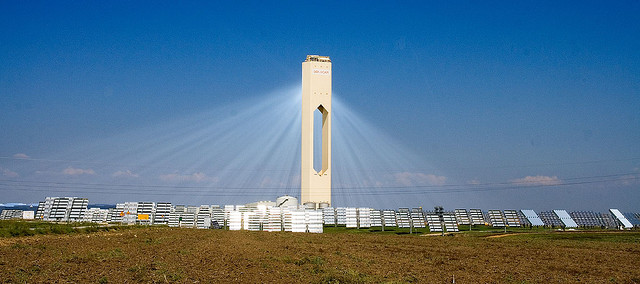
But Oman, Saudi Arabia, and the United Arab Emirates are lagging behind. Despite Masdar City’s 10MW PV plant which provides energy to the city’s ongoing construction,the Masdar company’s plans to build a 100 MW CSP plant in western Abu Dhabi, and small, almost boutique solar projects scattered throughout Abu Dhabi and Dubai (including this new solar-powered ATM!), and millions of crude oil equivalent lies fallow.
Al Masrah reports that every square kilometer of land in the MENA region has the equivalent of 1.5 million barrels of crude oil. More significantly, though we have known this for a while, MENA has enough solar energy potential to satisfy the entire planet’s energy needs.
Although Oman and Saudi have been slow to exploit this resource, dwindling oil reserves – which account for up to 50% of the GCC gross domestic product – will need to be rationed in order to maintain its export value.
As prices for alternative energy technology falls, we will see more MENA countries, including the oil-rich Gulf states, using solar energy to offset their burgeoning energy requirements.
More on Solar Energy in the Middle East:
21st Century Egypt Powers Two Villages Entirely On Solar Energy
It Must Be Peak Oil Driving Saudis To Solar
500 Solar-Powered Recycling Units Promote UAE Conservation
image via barockschloss


Qatar has 1.5MW under construction or installed, it is researching solar desalination, it developed a solar cooling test stadium run by concentrated solar, it is undertaking a research project with the Freinhoffer Institute to use solar in the hydrocarbon distillation process & it’s building a US$500Mn solar grade polysilicon & yet it does not even get a mention in your report.
I appears that this report is not accurately portraying solar in the MENA region at all.
Perhaps because Israel doesn’t fall within the top five countries? This isn’t about who has developed the most technology, but who has made the most out of their available sun. PS: you never did email me regarding that project you wanted me to review: [email protected]
why ISRAEL is not included in this U.N. research?israel is the main reason,to my knowledge, of jordan’s and palestinian authority’s leadership in solar hot water heating in the middle east after israel(more than 70% of its houses have solar water heaters by law!)