

 Meet Yoav Banin, CEO of Solergy, a solar power company in California and Italy.
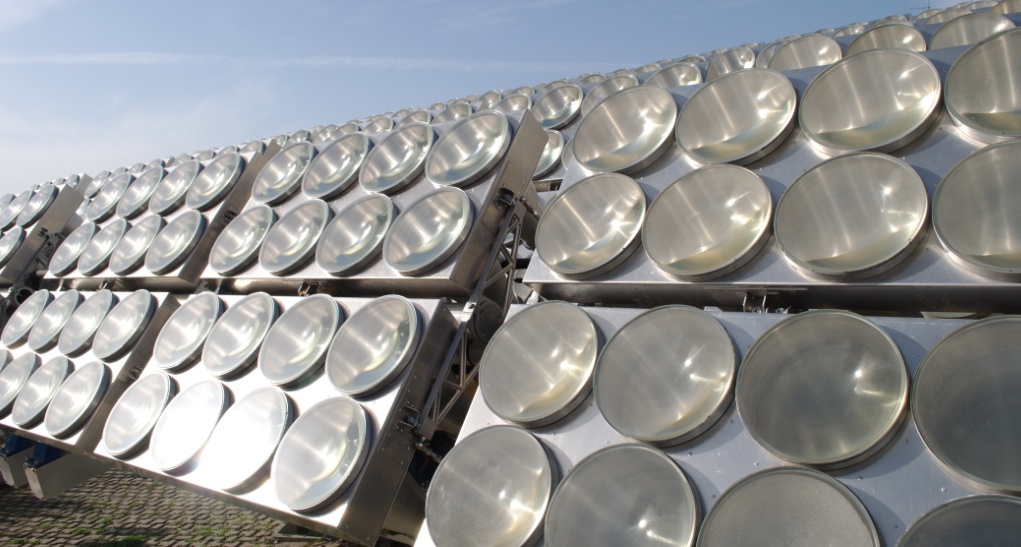
Reared in California by Israeli parents, and married to an Italian wife, Yoav Banin speaks to his two young sons in Hebrew while raising them in Rome. This 38-year-old trilingual Silicon Valley veteran is co-founder and chief executive officer of Solergy, founded in 2007 to create and manufacture advanced concentrated photovoltaic (CPV) technology. Using optics to focus sunlight over 500 times onto special photovoltaic cells, CPV increases solar energy conversion efficiency while reducing the amount of expensive materials that often hamper the practicality of this field.
Solergy is headquartered in California, but Banin is stationed at the company’s research-and-development facility in Rome. His partner Giovanni Lanzara, an engineering professor and entrepreneur from Italy, previously founded Invision, the company best known for its airport luggage scanners. Banin had met Lanzara in California and intrigued the academic entrepreneur with his solar energy business ideas.
“I was excited to have the opportunity to collaborate with someone who has a proven track record in building successful companies based on highly sophisticated technology,” Banin says. Lanzara suggested setting up their R&D center in Italy to take advantage of its technical expertise and rapidly growing solar energy market.
Though he resided in Israel for only six years – from the time he joined the paratroop brigade at 21 to the time he returned to Silicon Valley – Banin spent childhood summers in Israel and was active as a youth in the San Francisco Bay Area chapter of Israel Scouts. After completing his university studies, he fulfilled a longstanding desire to live in Israel.
After the military, he stayed to work for a few years. “Those years in Israel were fantastic,” he said. “I enjoyed being immersed in a young, vibrant place where I had friends and family nearby, together with a dynamic, innovative high-tech industry.” Toward the end of 1999, he explored South America before seeking his fortune in Silicon Valley.
Whereas his father first earned a master’s degree in physics and then left Israel to get a doctorate in computer science at the University of California at Berkeley, the younger Banin earned his undergraduate degree in applied mathematics at Berkeley and later switched to material science. “I went in the opposite direction,” he said with a laugh.
Banin was behind the first monitoring and troubleshooting products for the emerging voice-over-Internet protocol (VoIP) telephony market at Radcom. As director of products at Mercury Interactive (later sold to Hewlett Packard for $4.5 billion), he invented and launched enterprise software products that generated over $50 million in revenue within three years.
At that point, he was ready to move on. “I had always had a tendency to stay at the forefront of initiatives,” he said. “I noticed that in software the pace of innovation was slowing down. Infected by the ‘Silicon Valley entrepreneurial bug,’ I was determined to start my own company, and renewable energy seemed like the next big thing.”
Needing relevant technical background, he left the security of Mercury in 2004 to earn a master’s degree in material science at Stanford University. Around the same time, he married a native Italian physics professor at UC Berkeley. Two years later, he met Lanzara while investigating business opportunities.
To harvest sunlight and convert it into electricity and heat in a cutting-edge fashion, Solergy’s founders paired the strengths of the United States and Italy in the multidisciplinary CPV field: semiconductor materials, software and electronics from the North American side and sophisticated mechanics, structural design, thermodynamics and optics from the European side. There’s a third continent involved too, in the form of principal investor Videocon in India.
A consumer electronics and energy giant, Videocon gave Solergy access to facilities that once manufactured conventional television sets. These factories, appropriately renovated, are optimal for achieving high-volume, low-cost production of CPV systems at a price point competitive with fossil fuels.
The partnership with Videocon also provides Solergy with a direct channel to the Indian market, which is heavily investing in solar energy infrastructure.
Solergy had its formal worldwide debut in mid-November at the EnerSolar+ trade show in Milan, and reported “tremendous interest.” The company’s launch kicked off simultaneously with a press conference in Milan, an unveiling of its website, and an international media campaign.
Nurturing a new business and two active preschoolers doesn’t leave Banin much time for playing his jazz trumpet, an interest he developed at Berkeley. But living in Rome suits him fine. “There is a lot of similarity between Israelis and Italians in attitude and mentality,” he said. He expressed his hope that someday he will be successful in taking his CPV technology to Israel, and help the country achieve energy independence based on clean, renewable sources.
(This post is written by Abigail Klein)




Best regards to you and all those working with you
Dear …
If you have the desire erect plant with accessories run on solar energy to generate 5 megawatts
Please answer quickly, provided that the cells and batteries for storing energy and accessories from the origin of Uribe
If you have prepared for this work … Will provide you with full details
Thank you I wish you a progress
Civil Engineer
Mahmoud H Shehab
Iraq – Anbar
009647807461630
The world is flattening to a point that this is really less of an interesting story. Especially with the technologically fast moving green industry the top of the class is a post-national bunch. Through and through.