AIA Names Saudi's KAUST In 2010 Top Green Projects

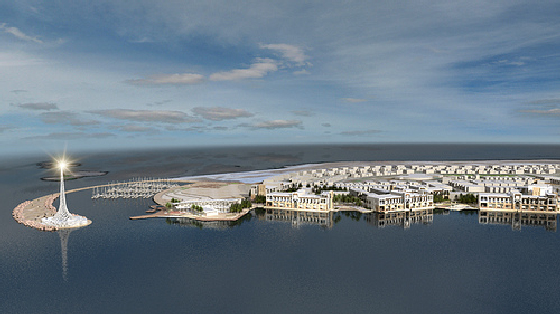
aerial view saudi KAUST photoThe king willed it – so it was built…Michael Arndt questions the ‘greenliness’ of KAUST, granted the US Green Building Council’s highest LEED certification possible.

The American Institute of Architecture recently hailed The King Abdullah University of Science and Technology (KAUST) as one of its top ten most environmentally responsible building designs.   This follows other “green” developments in Saudi Arabia, including the largest environmental tourism park, and a solar-powered desalination plant.  KAUST has bagged a few firsts:  it is the country’s first co-ed university as well as its first LEED certified building, and at 6.5 million sq feet, with 26 buildings built on 9,000 acres of land near Jeddah, on the Red Sea, it is also the largest Platinum certified building in the world.
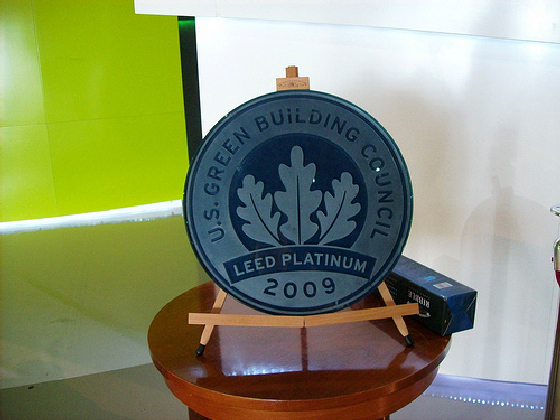
KAUST LEE USGBC

It achieved this rating by meeting some of the most stringent USGBC’s LEED rating requirements.  Under transportation:  100 shared electric cars along with recharging stations, segway and bike shares, and 3 shuttle bus lines on campus.  Under renewable energy:  2 solar towers, along with solar thermal and photovoltaic panels, amounting to a total production of 4MW renewable energy.

A permanent plan will protect the local coral reef and mangrove habitat under habitat preservation.  Under materials, 37.8% was manufactured from within 500 miles of the site, 99.2% of wood was certified by Forest Stewardship Council (FSC), and 79% of construction waste was recycled or diverted from landfill.  100% of the campus water will be treated on site and there is a comprehensive recycling plan in place for glass, aluminum, plastic, metal, and cardboard.  Finally, the total power demand was reduced by approximately 24.5%.

KAUST Saudi

The percentages are impressive, but Arndt raises this crucial point: “nearly two-thirds of the tens of thousands of tons of materials needed to construct this desert campus—paint, carpeting, furnishings, wood—had to be shipped in from more than 500 miles away. I don’t know how much greenhouse gas those vessels produced, but I do know that … they produced more carbon dioxide than 10 of the 39 industrialized nations originally included in the Kyoto Protocol. ”

There is no question that through competition and marketing, LEED promotes better building practices, and provides incentive – where otherwise there would be little – to produce more efficient buildings.  But thousands of tons of material?  Shipped to and constructed in the desert? This is sustainable?
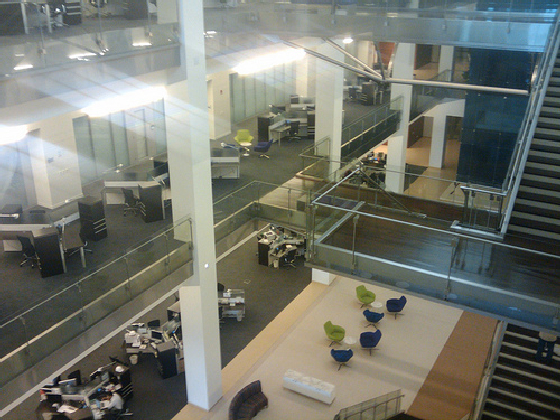
KAUST-Saudi-interior

Arndt quotes Colin Rohlfing, one of the HOK Designers on the KAUST project,  “It’s always a dilemma,” he said, concluding that the building was inevitable, that the king was going to build there in any case, and that they “had to make the best of it.”  We agree that if they must build, build better.   But all the Saudi money will not bring back Mother Nature’s diminishing resources again.

:: Via Business Week

More on so-called sustainable projects in the Middle East:
Re-Assessing Masdar City
What’s Sustainable about Masdar’s Foster+Partners?
Is Urjuan a Wise Expenditure of Qatar’s Oil and Gas Wealth?
Tafline Laylin
Tafline Laylinhttp://www.greenprophet.com
As a tour leader who led “eco-friendly” camping trips throughout North America, Tafline soon realized that she was instead leaving behind a trail of gas fumes, plastic bottles and Pringles. In fact, wherever she traveled – whether it was Viet Nam or South Africa or England – it became clear how inefficiently the mandate to re-think our consumer culture is reaching the general public. Born in Iran, raised in South Africa and the United States, she currently splits her time between Africa and the Middle East. Tafline can be reached at tafline (at) greenprophet (dot) com.
2 COMMENTS
  1. Another problem is that only the research area was built “green.” The residential homes are incredibly wasteful. Not only were they not built to LEED standard, but there are many three story apartments for a single person, requiring three air conditioning units, or sliding doors on the apartment complexes that are left open most of the day, refrigerating the outdoors. There is still a mindset of waste here that will take a lot more work to get rid of. After sitting in on presentations of the architects, the effort just to get LEED on the main campus in this country took monumental efforts. There just isn't the infrastructure for building green like you might find in developed countries.

Comments are closed.

TRENDING

What are AWG air-water generators, and why they aren’t a golden-bullet solution (yet)

Atmospheric water generators (AWGs) sound like magic: machines that can pull drinking water out of air. The idea is mentioned in the Bible, where the elders would pray for water collected as dew on plants and the catch on turning this into a machine is in the physics. To turn invisible vapor into liquid, you must remove heat, especially the latent heat of condensation.

Jordan’s $6 Billion Aqaba–Amman Desalination Project from the Red Sea Moves Forward

In 2025, the Jordanian government signed agreements with a consortium led by Meridiam and SUEZ, alongside VINCI Construction and Orascom Construction. Under a 30-year concession agreement, the consortium will design, build, finance, operate, and maintain the system before transferring it back to the Jordanian government. The total investment is estimated at approximately $6 billion USD.

Saudi Arabia cancels the Asian games at Neom’s Trojena

Neom, a bombastic collection of futuristic cities and resorts, has flopped as Saudi oil prices roll back reality. The Saudi plan of hosting the 2029 Asian games to be held at Trojena, a ski report in the desert, has been cancelled. 

Xcimer is the Denver-based startup that could put Saudi Arabia out of business

An American company can collapse OPEC if they can prove their approach to unlimited energy works.

The Saudi Startup Turning Desalination’s Toxic Waste Into Its Own Disinfectant

For millennia, the Middle East's water crisis seemed an immutable fact of geography — a region defined as much by what it lacked as by what lay beneath its sands. Today, a convergence of plummeting solar costs, advancing membrane technology, and hard-won engineering expertise is rewriting that story.

Should You Invest in the Private Market?

startustartup Unlike public stock exchanges, which offer daily trading, strict...

How to build a 100-year-company

Kongō Gumi is a Japanese construction company, purportedly founded in 578 A.D., making it the world's oldest documented company. What can we learn about building sustainable businesses from them?

From Pilot Plant to Global Stage: How Aduro Clean Technologies’ 2026 Expansion Signals a Turning Point for Chemical Recycling Investors Like Yazan Al Homsi

The company's Next Generation Process (NGP) Pilot Plant in London, Ontario, has officially moved into initial operating campaigns, generating the kind of structured, repeatable data that separates laboratory promise from commercial viability.

How AI Helps SaaS Companies Reduce Repetitive Customer Support Work

SaaS products are designed for large numbers of users with different levels of experience, and also in renewable energy.

Pulling Water from the Air

Faced with water shortage in Amman, Laurie digs up...

Turning Your Energy Consultancy into an LLC: 4 Legal Steps for Founders in Texas

If you are starting a renewable energy business in Texas, learn how to start an LLC by the books.

Tracking the Impacts of a Hydroelectric Dam Along the Tigris River

For the next two months, I'll be taking a break from my usual Green Prophet posts to report on a transnational environmental issue: the Ilısu Dam currently under construction in Turkey, and the ways it will transform life along the Tigris River.

6 Payment Processors With the Fastest Onboarding for SMBs

Get your SMB up and running fast with these 6 payment processors. Compare the quickest onboarding options to start accepting customer payments without delay.

Related Articles

Popular Categories