

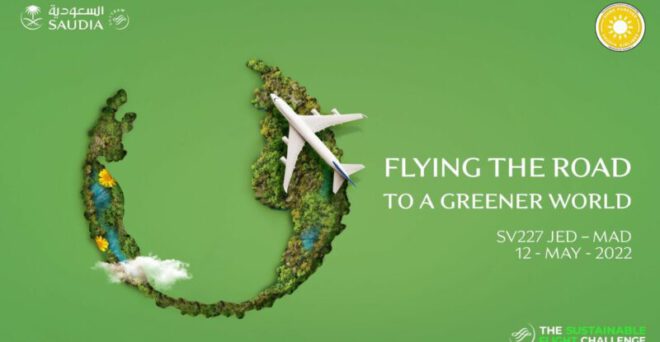
Emirates might be the world’s sexiest airline (though we don’t suggest joining the Mile High club on a journey to Dubai) but Saudia but be the most eco-sexiest so far. The airline we have never heard of, the national flag carrier of the Kingdom of Saudi Arabia, has operated the world’s longest net positive flight in May this year.
On its maiden net-positive voyage in from Jeddah to Madrid, Saudia claims it offset a total of 346 tonnes of carbon emissions for commercial passenger flight SV227, making the flight flight net-positive. This means that the passengers of this flight help offset more greenhouse gases than their travel created.
Operating with a Boeing 787-9 Dreamliner, the flight time was 5 hours and 55 minutes. It departed from King Abdulaziz International airport in Saudi Arabia at 1030 hrs and arrived at Adolfo Suárez Madrid–Barajas airport at 1535 local time.
The most “eco” way to fly is not flying at all, and the next step is creating greener fuels, more direct flights, but we should still praise airlines looking to go the extra mile despite so many challenges Covid has thrown at the airline industry.
How do you make a flight next positive?
The most creative way would be an airplane that sucks greenhouse gases from the atmosphere as it flies. As that’s not a realistic solution, Saudi turned to CarbonClick and aviation consultancy SimpliFlying.
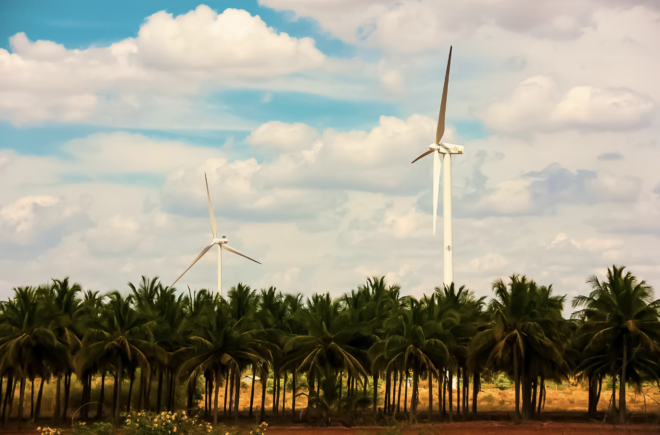
CarbonClick will use proceeds from the flight to generate clean wind electricity for communities in India. From the offsets bought, wind turbines can be powered for 26 days, generating clean energy for the local population.
The project is building wind power in India, displacing an equivalent amount of carbon-intense electricity which would otherwise rely on dirty fossil fuels for cooking, like coal. The contribution by Saudi to this project will supply clean energy to the grid, providing sustainable electricity to families living in Bhuj, in the western Indian state of Gujarat.
CarbonClick has also provided a landing page for guests on all Saudi flights allowing them to voluntarily offset the carbon emission of their travel. Guests who visit this page will be able to calculate the CO2 impact of their flight and make a contribution towards climate-friendly travel, receiving a verified receipt to fully-traceable carbon offsets.
American college students going to Colorado College, however, don’t appreciate the easy-fix idea of buying carbon credits to achieve carbon neutrality. Read this story we covered on the student body demanding more from their campus, including solar power on campus to offset their studies.
But we can’t discount the efforts: This flight is SAUDIA’s entry into The Sustainable Flight Challenge, an initiative by SkyTeam, one of the world’s three major airline alliances. All SkyTeam airlines are being challenged to go above and beyond by finding the most sustainable way to operate one single flight in their existing networks.
SkyTeam is one of the world’s three major airline alliances. Founded in June 2000, SkyTeam was the last of the three alliances to be formed, the first two being Star Alliance and Oneworld, respectively. Its annual passenger count is 630 million, the second largest of the three major alliances.
The 20 airlines that are members of SkyTeam include Aeroflot, KLM, Korean Air, Vietnam Airlines, and XiamenAir.
Carbon demands now from the millennial generation make it complicated for any business to face a world where they can do better. But in Saudi Arabia’s case future flights may end in the use of novel clean technolgies such as cleanly-produced hydrogen fuel.
Let me explain: Despite Saudi Arabia’s often misinterpreted ideas of how modernity and sustainability should go together (see Neom on the Red Sea) which is paid for by big oil money thanks to Saudi Aramco (the wealthiest company in the world); and Saudi’s undiplomatic response to journalists they don’t like; and the lavish spending habits of its ruling family and Prince, Saudi Arabia is also taking on risks where other companies and countries wouldn’t dare. Its investment into solar desalination early on, and commitment to unproven hydrogen fuel are just a couple of many examples.
“The Kingdom’s Vision 2030 will see 100 million visits to Saudi Arabia by the end of the decade,” said Saudi CEO Ibrahim Koshy. “A cornerstone of that vision is for the Kingdom to be a leader in sustainable and even regenerative tourism.
Regenerative is usually applied to agriculture, an approach that includes permaculture, animal systems and human needs into the picture. Since women in Saudi Arabia are not yet to travel aboard without a man’s permission we leave the level of Saudi’s “regenerative tourism” concept to your imagination. Saudi Arabia does have an ambitious plan to plant a million mangroves. (See: In Saudi, it looks like behind every thriving mangrove, there’s a strong woman.)

The flight will also see the world’s first in-flight sustainability lab, where passengers contribute ideas on how air travel can become ‘greener’, led by SimpliFlying.
“Aviation is a difficult sector to decarbonize. New, more sustainable technologies are emerging, but those advances can be easily outpaced by industry growth,” says Michelle Noordermeer, Chief Operating Officer at CarbonClick. “SAUDIA is setting a huge example by showing what can be done now, carbon offsetting, and using quality carbon credits as a powerful way to remove carbon and neutralize the impacts of radiative forcing.”