
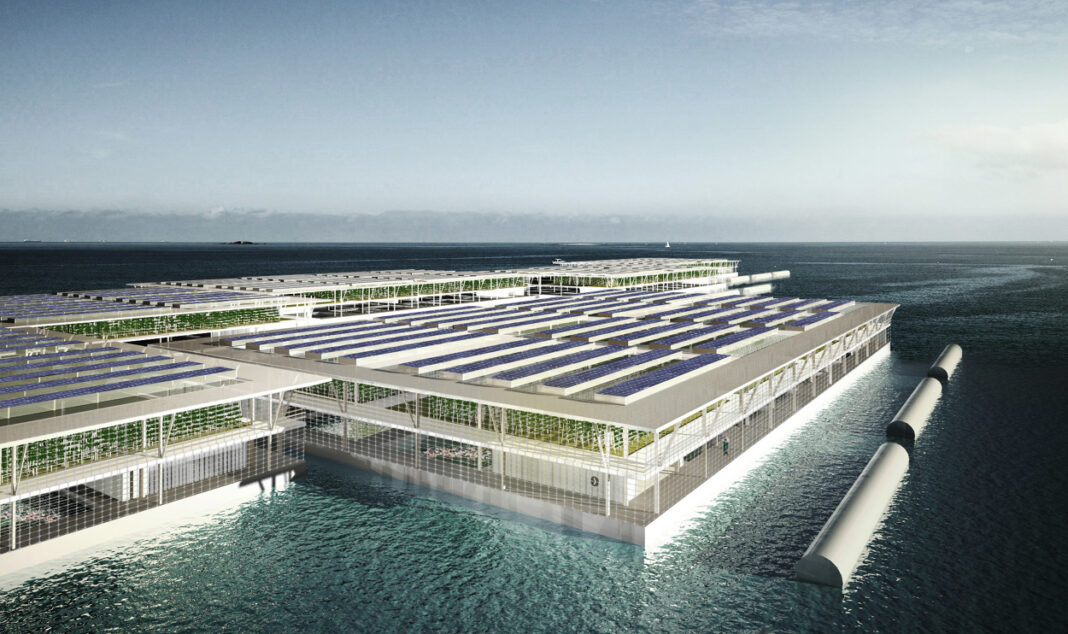

 World population will balloon from 7 billion today to more than 9 billion in 2050, with associated food demand predicted to increase by 70% in that same time-frame. How will the agricultural sector meet that demand without stressing natural resources and further accelerating climate change? Take a look at SFFs, a food production solution based on floating farms.
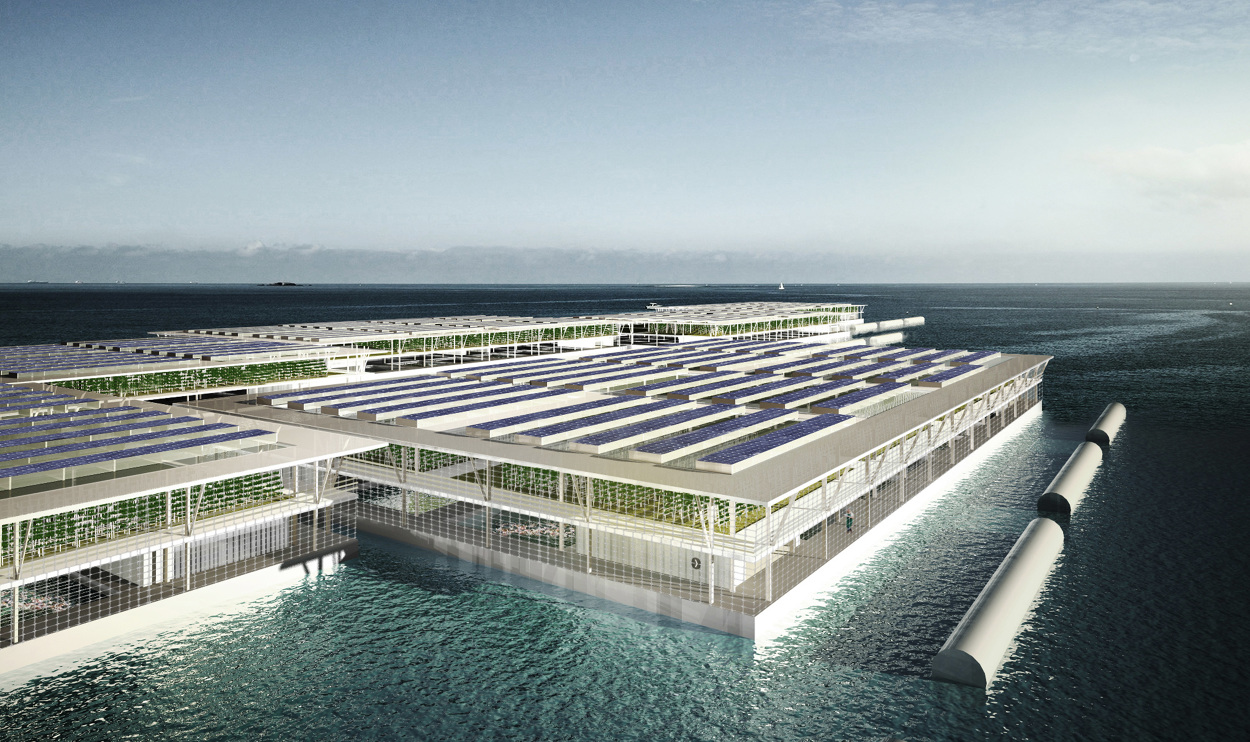
Barcelona-based company, Forward Thinking Architecture, has developed a commercially viable automated offshore floating farm system (or SFF) which could ease many of the world’s food security related problems while increasing food production everywhere in proximity to a coastline.

The designers point out that 71% of Earth’s surface is water with many of the densest areas located close to a coast. A modular floating farm system – self-powered by solar and wave energy and easily expandable – not only sidesteps the need for upland agricultural development in areas where land is unsuitable or scarce, but also reduces dependency on food imports.
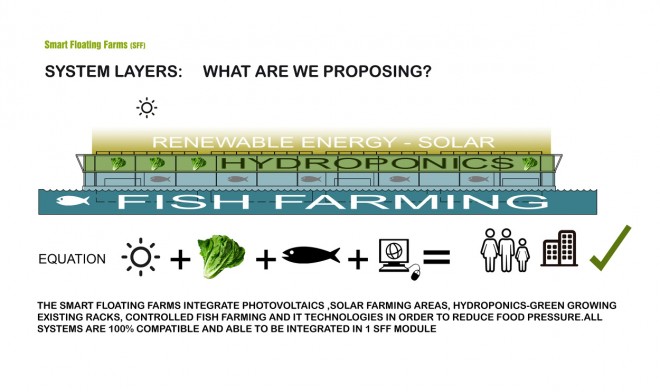
Each SFF is a largely automated, multilevel floating food factory built using innovative, yet mature and well-tested materials, technologies, and systems already in use around the globe. The SFF can support both green farming (hydroponics) and sustainable fisheries (aquaculture).
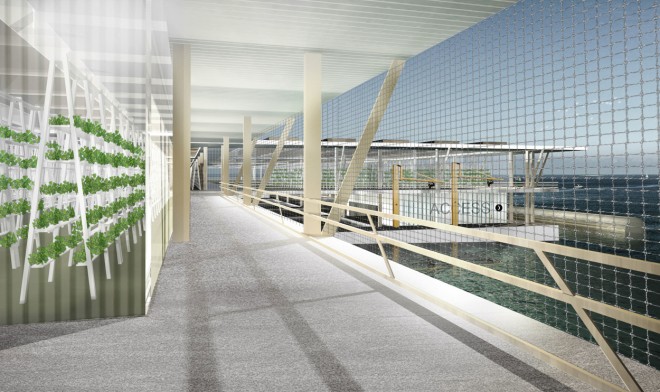
The tri-level modules float on pontoons and boasts a total area of 209.610 square meters that include growing areas, offices, circulation and support space. Level 0 contains offshore aquaculture fish farms, external perimeter wave barriers and protection, water access points, storage, slaughterhouse, desalination plant and a packaging facility. Level 1 houses a hydroponic greenhouse, irrigation control system, and microclimate controls for crop cultivation (adjusting temperature, humidity, carbon dioxide, lighting, etc.). Rooftop Level 2 holds a photovoltaic field, skylight openings to provide natural light for the plants, and rainwater collectors.
 Its 200 meter x 350 meter rectangular footprint was inspired by traditional Asian grid-shape fish floating farms, an efficient configuration which allows for maximum production estimated at 8.152 tons of produce per year, and 1.703 tons of fish per year.
The designers are aiming for a fully automated system, centrally controlled by software that can integrate operation and production data from several SFFs via Cloud technology. Data analysis will be able to make comparisons on food needs and consumption for specific cities which can be used for continual SFF improvement. Prototypes will also be tested using a human workforce and traditional practices now used in fish farming and crop production.
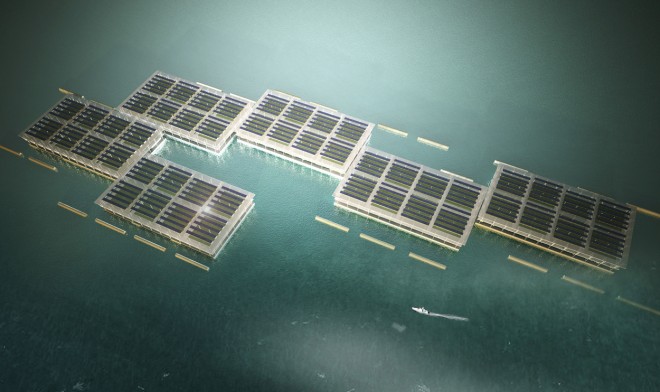
The farms will use sustainable water management practices; a bio-digester will convert all organic wastes to high quality and safe fertilizer. Hydroponic greenhouses will grow food year-round and lower the effects of natural disaster.
SFF value depends on development of critical supply chain, specifically inbound logistics, operations, outbound logistics, marketing and sales. These will be specific to each site, working within established governmental regulations and commercial structures.
Preliminary cost-benefit and feasibility studies shown that the SFF project first investment is recovered in less than 10 years.
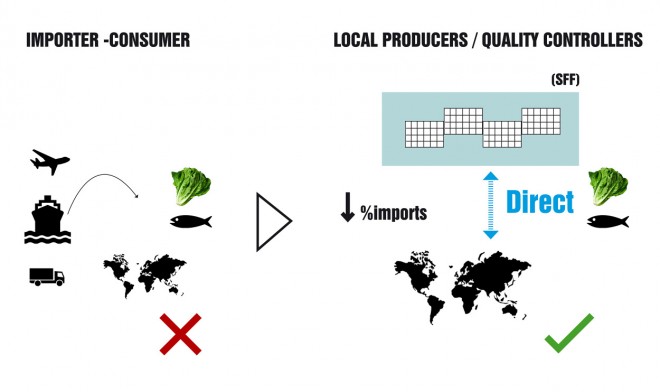
In summary, SFFs allow for year-round growing of a diverse range of organic food without pesticides. They use less area for growing due to higher yield per square meter of the hydroponic systems, freeing land for non-agricultural use. They consume less water compared to traditional farming and all organic wastes are digested on site.
The socio-economic benefits are as tasty as the food it will produce. SFFs return farming to centers of consumption, and dramatically reduces fossil fuel usage (no tractors, plows, shipping) and logistic costs. More proximity to centers of consumption means less CO2 emissions. They also cut the need for food storage. They employ local people and create new employment opportunities. Most importantly, in the naturally-water-starved Middle East where most food depends on unstable importation, SFFs increase local production and lower dependence on imports, thus raising national food security and creating a steady food supply.
Read more about the tech behind this project at the Forward Thinking Architecture website, link here.
All images from Forward Thinking Architecture




This is a very well written website. I am glad to see that Qatar has such forward thinking society.