

Norway: 2019 the highest Amazon deforestation rates in over ten years

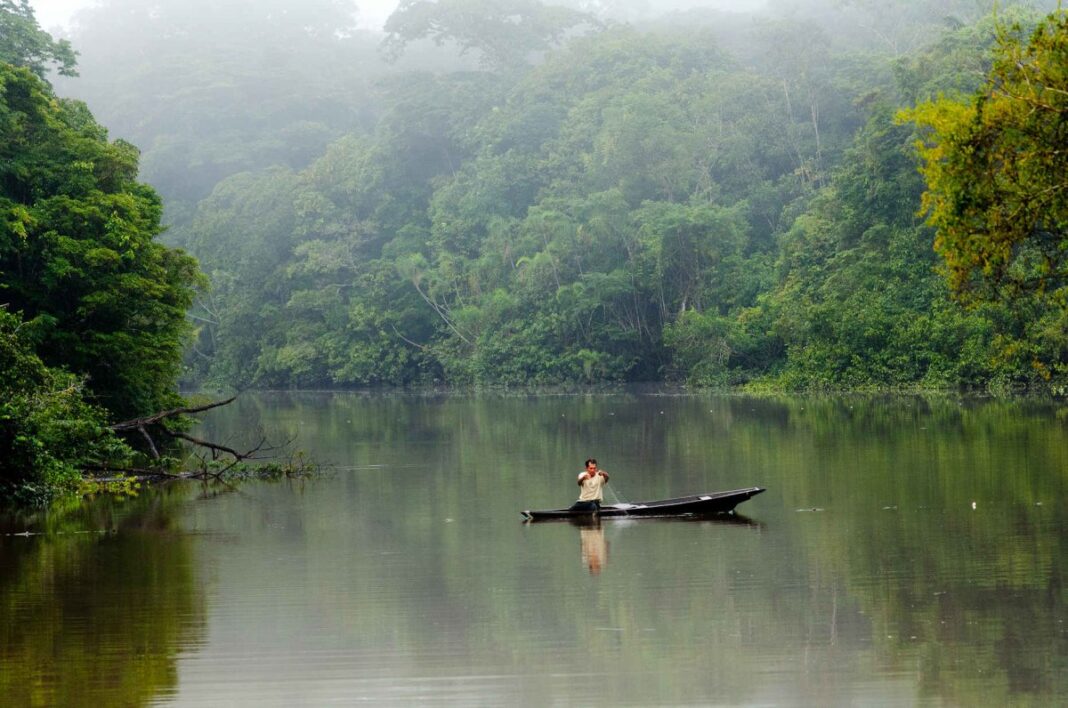
fishing man peru in amazon
We heard the news, now here are some facts to bring to the dinner table this weekend.

The take home message is don’t buy wood from Brazil. Nine thousand seven hundred (9,700) square kilometers of rainforest were lost in Brazil in 2019.

These are very alarming numbers, says Rainforest Foundation Norway.

Brazilian authorities today announced the official deforestation figures for the 2019 forest year (August 1, 2018, to July 31, 2019).

Data from the PRODES satellite monitoring system confirms that the deforestation rate is the worst in more than a decade: 9700 km² were lost.

These figures confirm what we feared, namely that 2019 has been a dark year for the rainforest in Brazil. The numbers are alarmingly high.

“We must remember that the Amazon has been undergoing deforestation for decades. We are approaching a potential tipping point, where large parts of the forest will be so damaged that it collapses. A loss the size of what we’ve seen this year is terrible news,” says Secretary-General Øyvind Eggen of Rainforest Foundation Norway (RFN).

In the wake of the fires that ravaged the Amazon in August and September, it was emphasized that these fires did not represent a normal year. RFN’s Secretary-General Øyvind Eggen is clear that neither are the deforestation figures that were just published.

He continues: “This is a result of political decisions and actions in Brazil. The Brazilian government has, through its words and deeds, shown that it is not interested in prosecuting illegal logging, including by placing restrictions on the environmental police, IBAMA. That has led to a widespread belief that it is acceptable to take liberties with the remaining rainforest. We now see the results: a disaster for the Amazon.”

Eggen laments that there is no sign of any change in the policies for the Amazon.

Just last week, Brazilian minister of agriculture Teresa Cristina attacked the long-standing soy moratorium, calling it “absurd”.

The soy moratorium is the soy industry’s self-imposed ban on selling soy grown in recently deforested areas.

The soy moratorium was introduced because the soy industry was about to destroy the Amazon, and the ban has been useful.

Eggen believes Norway and other countries must react immediately to the deforestation figures presented now.

A clear message must be sent to Brazil to change its policy. For instance, no country should ratify any trade agreement with Brazil until the deforestation trend is reversed and the level approaches the goals Brazil has set for itself through national climate legislation and the Paris Agreement.

Also, foreign investors and businesses trading with Brazil must set precise requirements and demand documentation that their business counterparts’ activities do not contribute to deforestation.

Read More

TRENDING

90% of Americans worry about microplastics

Microplastics are showing up everywhere—from dollar store toys and synthetic clothing to bottled water, toothbrushes and even human sperm. A new Ocean Conservancy survey finds that nearly 9 in 10 Americans are concerned about the health impacts of microplastics, while support is growing for tougher regulations. As scientists uncover plastic particles in the heart, placenta and reproductive organs, the question is no longer whether microplastics are affecting our lives, but how much damage they are already doing.

Understanding Food Production: Karl Studer on the Urban-Rural Knowledge Gap

Karl Studer occupies an unusual position in American business. As President of Quanta Services, he oversees electrical infrastructure operations across the United States, Canada, and Australia, managing thousands of employees and multibillion-dollar projects.

Tigris River oil spill highlights Iraq’s environmental oversight and our addiction to oil

A fresh oil spill in the Tigris River, filmed by an Iraqi university student, has reignited concern over Iraq's polluted waterways. From ancient Mesopotamia to modern Basra, the country's dependence on oil has come at a steep environmental and human cost, with activists warning that unchecked contamination is putting ecosystems and public health at risk.

Doctor-Led Direct Hair Transplant: What Surgeon Involvement Means for Outcomes

Hair restoration technology continues to evolve, but the surgeon behind the procedure remains the most important factor. Doctor-led hair transplants emphasize careful diagnosis, conservative donor management, natural hairline design, and long-term planning rather than simply maximizing graft counts. By treating donor hair as a limited resource and tailoring each procedure to the patient's future hair loss, experienced surgeons can reduce the need for corrective surgery while delivering more natural, sustainable results.

Data centers in Space? Sophia Space and Apex plan on busing them in

Can data centers really be built in space? Pasadena-based Sophia Space is partnering with Apex to test the idea by launching modular AI computing systems into low Earth orbit in 2027. Using radiation-hardened compute TILEs cooled by passive radiative systems and mounted on scalable satellite buses, the companies aim to prove that edge computing can operate reliably in space. While challenges remain, the project represents an important step toward distributed orbital computing networks that could support everything from climate monitoring and pollution tracking to autonomous spacecraft navigation in an increasingly crowded orbital environment.

Yerukim Forms a New Green Economy Where the Money is Really Green

The Yerukim members who pick up the recyclables get to keep the monetary reward, the public earns "green" bills that can be used in shops, and business owners get to be associated with environmentalism.

Choosing Riyadh over Dubai? What Investors Should Know

Saudi Arabia is deploying capital at unmatched scale to catalyze tourism and advanced industry while rewiring its power-and-water backbone. The investable frontier is widening—especially in renewables, grid storage, water efficiency/desal retrofits, and hospitality operating platforms. Prudent investors will insist on phased delivery, enforceable KPIs (energy, water, biodiversity), and RHQ/zone compliance—while pricing political-economy and reputational risks alongside growth upside.

Sell your cooking oil for biodiesel money

Want to make money on old french fry oil? Sell it.

Qatar Alternative Energy Summit Pairs Investors And Innovators

Alternative energy investors and innovators can meet n' greet in Doha, Qatar March 16 and 17.

Here’s How To Implement The Four Pillars Of Employee Engagement

If you throw a party for your work team and they are vegans, don't make it a barbecue. Know the sustainability values of your team to boost moral and retain good people.

Locals From Rishon Fight IKEA

Big Box stores are a pretty new concept in Israel, and thank God that not every Israeli city wants them in their backyard. A word from someone who has see the beautiful farmland around her hometown Newmarket, Ontario stripped and converted into vulgar strip malls of big box shops: they have no place in a healthy and sustainable town or city.

The Jewish National Fund Meets An Inconvenient Truth

According to the JNF, it has transformed thousands of acres of barren land into green forests in Israel. They state that each person emits about 23 tons of carbon per year, estimating that each tree planted can absorb one ton of carbon in its lifetime. That's a whole lot of trees you'd need to be planting. Could so many fit in Israel?

How to quiet noise from construction in your office

Streets need to be resurfaced in New York but the humming and grinding noise is unsettling. Noise is environmental pollution. 

Popular Categories