
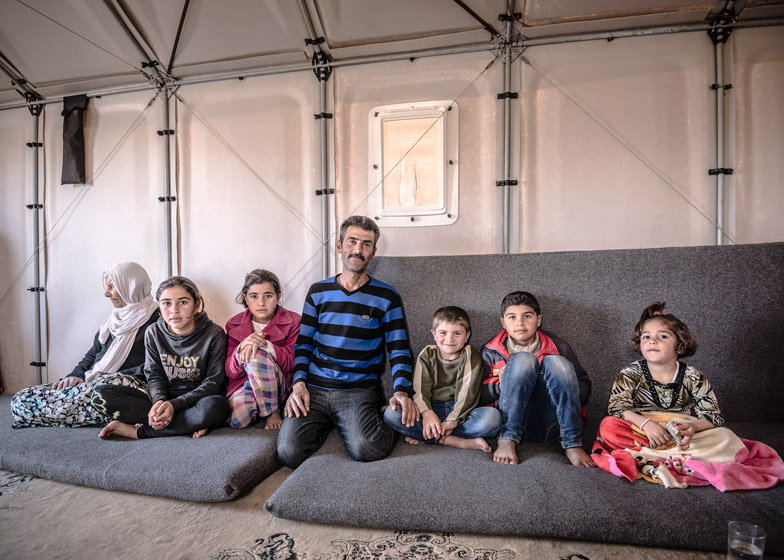

 IKEA and UNHCR (the United Nations High Commission for Refugees) emerged from two years of research with a prototype shelter suitable for refugee families anywhere. It features an innovative roof that reflects 70% of the sun’s rays during the day yet retains heat during the night, and it’s fitted with solar panels that power an interior light fixture and a USB outlet both built into the structure. They’ve begun producing 10,000 of these temporary homes, and as you’d expect from the Swedish home goods giant, they arrive via flat-pack shipping.
“Better Shelter will ship 10,000 units to UNHCR in 2015 for use by UNHCR operations globally – and that is just the beginning. We will continue to develop the Better Shelter and also provide other solutions to benefit the many displaced people. Innovation is our strongest driving force,” Johan Karlsson, Better Shelter Head of Business Development, stated on the IKEA Foundation website. Better Shelter is supported the IKEA Foundation.
Forty refugee families in Iraq and Ethiopia tested and improved the prototype. It encloses an 88 square foot area (twice the size of the UNHCR regulation tent) and sleeps five adults. Rhulite, an insulated polymer sheeting similar to that used in mobile toilets, sheathes the steel-skeleton shelters and allows diffused daylight to penetrate the interiors. It arrives on site in four flat-pack boxes weighing just 100 kilograms. Assembly takes four hours using basic tools.
The design team aims to equip next-generation shelters with enough solar generating ability to support cooking and water purification. Prototypes cost $10,000 to produce, but mass production will cut that to $1,000 per unit or less. This is twice the cost of the fabric tents, but the shelters will last for three years – six times the lifespan of the standard UN-supplied fabric tents.

The mission of the IKEA Foundation is to improve opportunities for children in developing countries. Their partnership with UNHCR began in 2009 with the goal of designing a new emergency shelter for global refugees, half of whom are children.
Their collaboration demonstrates how corporations can help offer solutions that succeed on levels beyond initial remit, in this case – to give shelter. IKEA brought extensive flat packing, supply chain and logistics ability to the table, expertise that is critical to UNHCR’s ability to cut costs and increase efficiency.
The project demonstrates that knowledge sharing is as important as monetary donations, especially in a the void left by architectural open-source and humanitarian organizations such as Architecture for Humanity. Corporate and social collaboration can advance humanitarian achievement in step with powerful economic and environmental wins.
“The realization that the people who need design ingenuity the most, the poorest 90% of the global population, have historically been deprived of it, and the determination to address that, have been one of the most important design developments of the past decade,” design critic Alice Rawsthorn said in a press release.
You can see ten other contemporary design solutions for emergency housing – link here.
Images from The IKEA Foundation website


Here’s a view on the IKEA better shelter: http://thenosemilk.com/news/world/ikea-cashes-in/