Earth. Energy. Everything next.

Olive Season is Here: Buy Local or DIY

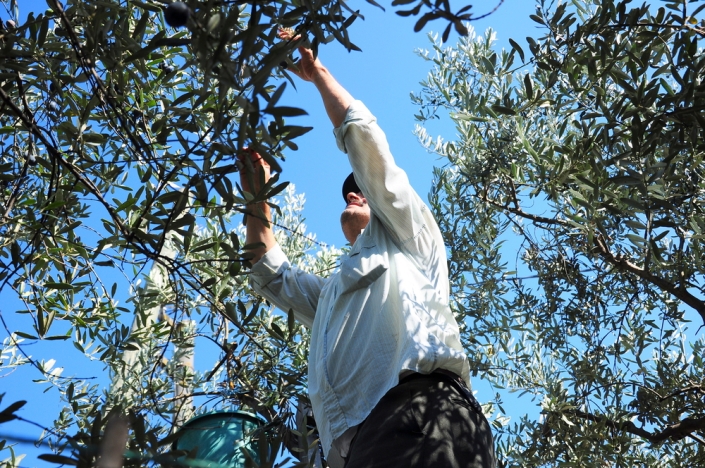
traditional olive pickingPicking olives the traditional way is less damaging to the fruit

The annual olive harvest is here in the Middle East again. For people living in Mediterranean and Middle East olive producing countries, they can enjoy pickling their own olives due to the proliferation of olive trees in these locations. Here in Israel where I love, many private and public gardens and parks have olive trees growing in them; making olives available to anyone taking the time to pick them during the annual autumn olive season.

In a previous Green Prophet article about preserving olives, I explored how easy home picked olives are easy to pickle and are usually ready to eat after being stored in pickling brine for at least two to three months. After doing this for several years, I have found that one can experiment using various spices in their pickling ingredients that include rosemary, thyme, black peppercorns, cayenne peppers (to give the olives a “kick”) and bay leaves.

ripe-olives

The most common types of olives available in my neighborhood are the narrow and pointed Syrian olives and the larger, egg shaped Mazanillo olives. These are some of the best olive groves are in the Galilee Region of Israel and on the West Bank; although there are a lot of political issues over Palestinian olive groves getting damaged and even cut off by the separation barrier erected by Israel.

Although it is possible to mix these two olive species when pickling, it is not recommended to do so as each species has a different flavor with the Syrian ones being more bitter. With the Syrian olives, unless you like their bitter taste, it is recommended to “crack” them by opening them with a wooden mallet which allows the pickling brine to remove the bitter taste. With both olive species, soaking them daily in fresh water for at least two weeks prior to pickling is a must as well.

In previous Green Prophet articles it was reported about threats to Mid East olive growers and suppliers due to falling olive oil prices ; partially due to heavy subsidizing by several European Union countries.

While I haven’t yet tried to make my own olive oil, there are recipes for doing this on the internet. But with olive oil prices being so low, as previously mentioned, excellent varieties of locally produced virgin olive oils are readily available at attractive prices.

My recommendation is not to be tempted to purchase olive oils from countries like Italy and Spain, which are “dumping” their products in many countries, including the Middle East. It’s obviously better to support local growers and producers and not those elsewhere.

Read more on olives and olive related issues in the Middle East:
Israel’s Separation Barrier Could Disrupt Ancient Way of Farming Since Roman Times
Cheap Olive Oil Threatens to Destroy Mid East Growers and Suppliers
Preserving Olives the Green Prophet Way
Picking Olives for Pickling


Maurice Picow
Maurice Picowhttps://www.greenprophet.com/
Maurice Picow grew up in Oklahoma City, U.S.A., where he received a B.S. Degree in Business Administration. Following graduation, Maurice embarked on a career as a real estate broker before making the decision to move to Israel. After arriving in Israel, he came involved in the insurance agency business and later in the moving and international relocation fields. Maurice became interested in writing news and commentary articles in the late 1990’s, and now writes feature articles for the The Jerusalem Post as well as being a regular contributor to Green Prophet. He has also written a non-fiction study on Islam, a two volume adventure novel, and is completing a romance novel about a forbidden love affair. Writing topics of particular interest for Green Prophet are those dealing with global warming and climate change, as well as clean technology - particularly electric cars.

Read More

TRENDING

Oil tankers are spilling and burning in the Middle East – where is the environmental outrage?

From the Red Sea to the Strait of Hormuz, ships have burned, tankers have leaked oil and cargo vessels have sunk since October 2023. A timeline of maritime disasters, environmental damage and cleanup efforts.

PeaceTech is the next CleanTech. And we’ve been building it for decades.

From the forests of Ontario to sea turtle conservation in Lebanon and water cooperation across the Middle East, Green Prophet founder Karin Kloosterman argues that CleanTech, EnviroTech and AgTech are already building the foundations of PeaceTech.

The ancient factory that never sat idle: what Tel Shiqmona can teach modern architects

A 2,700-year-old industrial site on Israel’s Carmel coast shows how ancient craftsmen reused the same spaces for different seasonal jobs — a lesson in flexible architecture that still matters today.

Was the Flydubai cockpit emergency an attempted terror attack — or a pilot in crisis?

What happened inside the cockpit of flydubai Flight FZ1073 on Wednesday morning is still under investigation, but the story has become considerably more disturbing since the first reports of a “fight between pilots.”

Mona Khalil, Orange House Project founder, sea turtle protector killed in Lebanon

Mona Khalil spent decades protecting Lebanon's sea turtles and coastal ecosystems. Her death in the ongoing conflict between Israel and Hezbollah shines a light on a broader environmental tragedy unfolding across northern Israel and southern Lebanon. From damaged wetlands and disrupted bird migrations to threatened seed banks and endangered wildlife, the region's ecosystems are becoming casualties of a war with no clear end in sight.

Why Bronwyn Finnegan Chose the Nonprofit Sector Over Politics or Corporate Life

Bronwyn Finnegan could have pursued a career in politics or corporate leadership. Instead, she chose the nonprofit sector, where she focuses on financial sustainability, governance and helping mission-driven organizations build the capacity to survive and grow.

Scientists make lead-free perovskite solar cells that can weather the elements

Scientists have developed a “raincoat” for lead-free tin perovskite solar cells, helping them withstand air, moisture and heat while maintaining high efficiency.

The Essential Guide To Sustainability in Project Management

Sustainability is an approach where businesses and individuals balance the environmental, social, and economic aspects of a project such that current and future stakeholders are not overburdened with the impacts of the project in future.

Yerukim Forms a New Green Economy Where the Money is Really Green

The Yerukim members who pick up the recyclables get to keep the monetary reward, the public earns "green" bills that can be used in shops, and business owners get to be associated with environmentalism.

Choosing Riyadh over Dubai? What Investors Should Know

Saudi Arabia is deploying capital at unmatched scale to catalyze tourism and advanced industry while rewiring its power-and-water backbone. The investable frontier is widening—especially in renewables, grid storage, water efficiency/desal retrofits, and hospitality operating platforms. Prudent investors will insist on phased delivery, enforceable KPIs (energy, water, biodiversity), and RHQ/zone compliance—while pricing political-economy and reputational risks alongside growth upside.

Sell your cooking oil for biodiesel money

Want to make money on old french fry oil? Sell it.

Qatar Alternative Energy Summit Pairs Investors And Innovators

Alternative energy investors and innovators can meet n' greet in Doha, Qatar March 16 and 17.

Here’s How To Implement The Four Pillars Of Employee Engagement

If you throw a party for your work team and they are vegans, don't make it a barbecue. Know the sustainability values of your team to boost moral and retain good people.

Popular Categories