
Turkish Cabinet Invokes Wartime Law To Seize Property For Hydro Projects

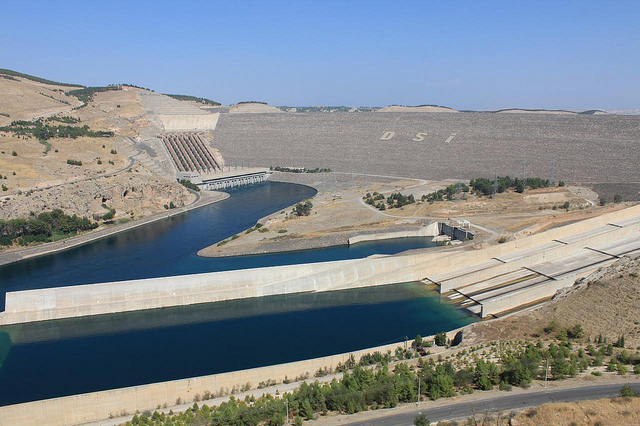
ataturk dam turkey seizes land maritime lawThe more than 20 hydroelectric projects that Turkey has built on the Tigris and Euphrates Rivers have been sharply criticized for displacing populations and harming the local environment.

Now it’s even easier for hydro companies to build destructive dams in Turkey. Real estate for 13 different hydroelectric projects in 12 provinces can now be seized at any time by Turkey’s Energy Market Regulatory Agency (EPDK) and State Waterworks Authority (DSİ), thanks to a recent decision by the prime minister’s cabinet, as reported in Bianet, Turkey’s independent media agency.

Hydroelectric projects: A matter of national defense?

The cabinet invoked Turkey’s “Nationalization Law” to pass the ruling, even though the law is only supposed to apply in extraordinary circumstances, when homeland security is on the line.

“In times of war, [authorities] used to nationalize properties, but there really was a war in those times. Now, the only war is for investment,” said Cömert Uygar Erdem, an environmental lawyer.

Countless people may be pushed off their land to make way for a hydroelectric project in their area thanks to the ruling. The projects for which property seizure has been authorized are spread all over the country, from Black Sea provinces Zonguldak and Ordu to the southern province of Adana to Erzurum in the northwest.

The use of the homeland defense law to authorize land grabs in these areas is even more absurd when one considers recent remarks by Energy Secretary Taner Yıldız (in Turkish) that Turkey “has no problem producing more energy than it consumes at this time.”

Hydro’s checkered legal history in Turkey

Turkey’s highest administrative court had already prevented the cabinet from giving the EPDK the power to nationalize property in 2004, because it would constitute a “transfer of authority”, according to Erdem.

More than 100 of the approximately 120 suits that have been filed against property seizure for hydro development have won, suggesting that legally, hydroelectric companies are often on the wrong side of the law when they try to seize land.

But this time, the cabinet issued separate rulings for each of the  13 projects it wanted to accelerate, directly authorizing the land grab rather than delegating it to the EPDK.

“People will be forced to emigrate and deprived of their properties when [authorities] confiscate their real estates. There were already similar measures in force until [now…] The process is going to accelerate due to this decision, and the destruction of nature will [gather speed,]” said Erdem.

A record of damage to humans and the environment

Last year, the United Nations released a report condemning Turkey’s hydroelectric development plans because of the harm they would cause human communities and ecosystems.

The planned projects have become a major source of contention between Turkey and Iraq, whose inhabitants would directly suffer as a result of changes in the water flow from the Tigris and Euphrates. Earlier this year, Georgia’s Green Party warned that a planned dam in northeastern Turkey could similarly impact Georgia and Azerbaijan by diverting the flow of the biggest water artery in the Southern Caucasus.

Turkey’s hydroelectric habit has already tainted its relations with neighbors. If the cabinet’s ruling stands, the government will be faced with a new population of landless citizens, driven off their property by the greed of hydroelectricity companies. Is that really a situation they want to create?

:: Bianet

Read more about hydroelectricity in Turkey:

Turkey’s Early Hydroelectric Dams Featured in Exhibit
Hydroelectric Dam In Turkey May Cause Environmental Catastrophe In Georgia
Turkish Water Projects Stirring Resentment Around The Region
Turkey’s Dams Are Violating Human Rights, UN Report Says

Image via 10b travelling

Julia Harte
Julia Hartehttp://www.greenprophet.com
Julia spent her childhood summers in a remote research station in the Rocky Mountains of Colorado, helping her father with a 25-year-old experiment in which he simulated global warming over a patch of alpine meadow. When not measuring plant species diversity or carbon flux in the soil, she could be found scampering around the forests and finding snowbanks to slide down. Now she is a freelance journalist living in Istanbul, where her passion for the environment intersects with her interest in Turkish politics and grassroots culture. She also writes about Turkish climate and energy policy for Solve Climate News.

Read More

1 COMMENT
  1. 40.000 people were killed in an war with the Maoist-Stalinist PKK. Some dams are a vital defence for the country, more will come and build in such a way the caves where the PKK hide coming form iraq will be put under water.
    Like the wall in Israel, since they have it hudres of lives in suicide attacks were prevented.
    Most people in Turkey care more about their lives then about problems people have outside Turkey.
    Why should Turkey care about countries who support the PKK and cry for water. The hole world was changed with an attack in New York: 4000 innocent people died?. So go for a walk and talk about your own problems before judging others.
    How many animals or nature was destroyed because of the war (mines, bombs).

TRENDING

Abortion Pills, Plan B and Mifepristone and what the new US mail ban means

Abortion pills, often confused with Plan B (the morning-after pill), and historically referred to as RU486 (mifepristone), are part of a broader category of reproductive health medications that women have been using for decades. But they are not the same thing.

Sink holes from over-watering farmers’ fields

Sinkholes are rapidly appearing in Turkey’s central Anatolian farming region, particularly around Konya and Karapınar. These giant gaping holes in the ground in areas of farmland, known locally as obruk, are not random geological events. They are linked to prolonged drought, climate-driven heat stress, and heavy groundwater extraction for agriculture in one of the country’s most important breadbaskets.

Iran’s holiest city about to run dry as terror chosen over water management

Iran’s second-largest city, Mashhad, is facing an acute water emergency after dam reservoirs feeding the city fell below three percent capacity, according to Iranian state and local media. Officials warn that without rainfall or improved inflows from neighboring Afghanistan, the city’s supply could soon collapse.

Arap Koftesi burgul balls in a garlicky yogurt sauce

This bit of Turkish home cuisine is called Arap Koftesi, and I discovered it in Özlem's Turkish Table. We can call them burgul balls.

Americans probe the alleged biblical ark on Mount Ararat in new study

The Durupınar formation's dimensions strikingly mirror the biblical description of Noah's Ark, as detailed in Genesis 6:15. Ground-penetrating radar (GPR) surveys have revealed internal features, including rectangular shapes and what appears to be a central chamber, located approximately 22 feet beneath the surface. These findings suggest the possibility of man-made structures within the formation.

Yerukim Forms a New Green Economy Where the Money is Really Green

The Yerukim members who pick up the recyclables get to keep the monetary reward, the public earns "green" bills that can be used in shops, and business owners get to be associated with environmentalism.

Choosing Riyadh over Dubai? What Investors Should Know

Saudi Arabia is deploying capital at unmatched scale to catalyze tourism and advanced industry while rewiring its power-and-water backbone. The investable frontier is widening—especially in renewables, grid storage, water efficiency/desal retrofits, and hospitality operating platforms. Prudent investors will insist on phased delivery, enforceable KPIs (energy, water, biodiversity), and RHQ/zone compliance—while pricing political-economy and reputational risks alongside growth upside.

Sell your cooking oil for biodiesel money

Want to make money on old french fry oil? Sell it.

Qatar Alternative Energy Summit Pairs Investors And Innovators

Alternative energy investors and innovators can meet n' greet in Doha, Qatar March 16 and 17.

Here’s How To Implement The Four Pillars Of Employee Engagement

If you throw a party for your work team and they are vegans, don't make it a barbecue. Know the sustainability values of your team to boost moral and retain good people.

Locals From Rishon Fight IKEA

Big Box stores are a pretty new concept in Israel, and thank God that not every Israeli city wants them in their backyard. A word from someone who has see the beautiful farmland around her hometown Newmarket, Ontario stripped and converted into vulgar strip malls of big box shops: they have no place in a healthy and sustainable town or city.

The Jewish National Fund Meets An Inconvenient Truth

According to the JNF, it has transformed thousands of acres of barren land into green forests in Israel. They state that each person emits about 23 tons of carbon per year, estimating that each tree planted can absorb one ton of carbon in its lifetime. That's a whole lot of trees you'd need to be planting. Could so many fit in Israel?

How to quiet noise from construction in your office

Streets need to be resurfaced in New York but the humming and grinding noise is unsettling. Noise is environmental pollution. 

Popular Categories