
Peak Everything? Save Your Junk.

Camden Asay, Peak Everything, Peak Oil, Infographic, Recycled Materials, Natural Materials, ewasteDon’t throw out your e-waste and other junk; in a few decades, you could be sitting on a gold mine.  

Last year we posted a funky little video that detailed what goes into making just one cell phone. “Eric-Sun” – a personified cellular phone facing the end of its life – is comprised in part of  South African gold and Russian platinum, of silver from Mexico, and nickel from Australia, and so many other components it would take all day to list them. Eventually, this and the other 99% of the world’s cell phones are tossed in a landfill when the next iPhone comes out.

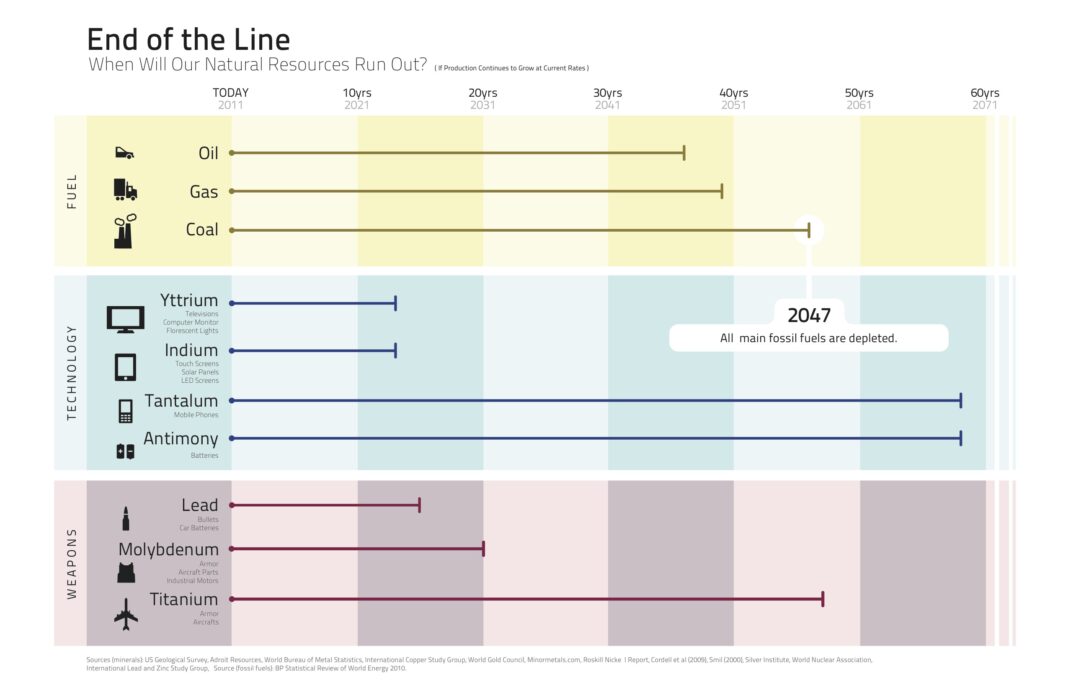
This eye-opening video raised a lot of questions about how feasibly we can continue on our so called developmental path full of fancy gadgets and cloud-hugging towers when we live on a planet of finite resources. But convincing people to think about this is tricky – until you see a nifty infographic like the one put together by American designer Camden Asay and posted on FastCo Design. Finally, thanks to one succint (but no doubt fallible) chart, we have a pretty good idea of just how quickly we are depleting … a lot.

FastCo warns that although Asay derived his data from reputable sources such as the U.S. Geological Survey, this chart might be a little bit too easy to grasp since it’s difficult to predict how our rate of consumption will compare to our increasing ability to do more with less. The site’s founder Cliff Kuang cites Jevons Paradox, which describes how (paradoxically) increased efficiency also increases our rate of consumption. Jevons Paradox + Rapid Population Growth = something worth sitting down for in order to properly digest it.

So think twice before you throw out your e-waste and other “junk,” which Egyptian fixers put to good use; one day it could be worth its weight in gold.

Tafline Laylin
Tafline Laylinhttp://www.greenprophet.com
As a tour leader who led “eco-friendly” camping trips throughout North America, Tafline soon realized that she was instead leaving behind a trail of gas fumes, plastic bottles and Pringles. In fact, wherever she traveled – whether it was Viet Nam or South Africa or England – it became clear how inefficiently the mandate to re-think our consumer culture is reaching the general public. Born in Iran, raised in South Africa and the United States, she currently splits her time between Africa and the Middle East. Tafline can be reached at tafline (at) greenprophet (dot) com.

Read More

TRENDING

Self-repairing contact lenses and desalination membranes that fix themselves?

Could the humble contact lens become a sustainability breakthrough? Researchers in Korea have developed a self-healing hydrogel lens that repairs scratches with just one hour of UV light exposure. Beyond reducing waste from disposable contacts, the technology could one day help extend the life of solar panels, water filtration systems, and other plastic-based products.

From Pilot Plant to Global Stage: How Aduro Clean Technologies’ 2026 Expansion Signals a Turning Point for Chemical Recycling Investors Like Yazan Al Homsi

The company's Next Generation Process (NGP) Pilot Plant in London, Ontario, has officially moved into initial operating campaigns, generating the kind of structured, repeatable data that separates laboratory promise from commercial viability.

Urban miner Sortera raises $45 million USD to pull aluminum from the scrap pile

Sortera Technologies, founded in 2020 by Nalin Kumar and Manuel Garcia, is emerging as a major U.S. circular-industry player. Led by CEO Michael Siemer, the company uses AI and advanced sensors to turn scrap metal into high-value aluminum alloys. Its new ~$45 million funding round signals investor appetite for industrial decarbonisation—where emissions cuts come not from PR-friendly solar installs, but from upgrading the materials that power EVs, solar frames, and construction.

Waste Reform from the Ground Up: How Trash Balers Are Helping Cities Rethink Sustainability

If you’ve ever watched a recycling truck weaving through city streets, you’ve seen the problem firsthand. Most of what we call “recycling” still depends on long-distance transportation and centralized sorting facilities. Those systems are energy-intensive and prone to contamination — the dreaded mix of wet food, plastic wrap, and paper that renders recyclables useless.

Scientists Crack the Code for Low-Cost, Low-Carbon Plastic Recycling

While enzymatic recycling offers hope for managing existing plastic waste, scientists and environmental advocates agree it must be paired with the development of bio-based plastics—materials made from renewable biological sources like corn starch, sugarcane, or algae. Unlike conventional plastics derived from fossil fuels, bio-based alternatives can dramatically reduce carbon emissions at the production stage and are often compatible with closed-loop recycling.

Yerukim Forms a New Green Economy Where the Money is Really Green

The Yerukim members who pick up the recyclables get to keep the monetary reward, the public earns "green" bills that can be used in shops, and business owners get to be associated with environmentalism.

Choosing Riyadh over Dubai? What Investors Should Know

Saudi Arabia is deploying capital at unmatched scale to catalyze tourism and advanced industry while rewiring its power-and-water backbone. The investable frontier is widening—especially in renewables, grid storage, water efficiency/desal retrofits, and hospitality operating platforms. Prudent investors will insist on phased delivery, enforceable KPIs (energy, water, biodiversity), and RHQ/zone compliance—while pricing political-economy and reputational risks alongside growth upside.

Sell your cooking oil for biodiesel money

Want to make money on old french fry oil? Sell it.

Qatar Alternative Energy Summit Pairs Investors And Innovators

Alternative energy investors and innovators can meet n' greet in Doha, Qatar March 16 and 17.

Here’s How To Implement The Four Pillars Of Employee Engagement

If you throw a party for your work team and they are vegans, don't make it a barbecue. Know the sustainability values of your team to boost moral and retain good people.

Locals From Rishon Fight IKEA

Big Box stores are a pretty new concept in Israel, and thank God that not every Israeli city wants them in their backyard. A word from someone who has see the beautiful farmland around her hometown Newmarket, Ontario stripped and converted into vulgar strip malls of big box shops: they have no place in a healthy and sustainable town or city.

The Jewish National Fund Meets An Inconvenient Truth

According to the JNF, it has transformed thousands of acres of barren land into green forests in Israel. They state that each person emits about 23 tons of carbon per year, estimating that each tree planted can absorb one ton of carbon in its lifetime. That's a whole lot of trees you'd need to be planting. Could so many fit in Israel?

How to quiet noise from construction in your office

Streets need to be resurfaced in New York but the humming and grinding noise is unsettling. Noise is environmental pollution. 

Popular Categories