

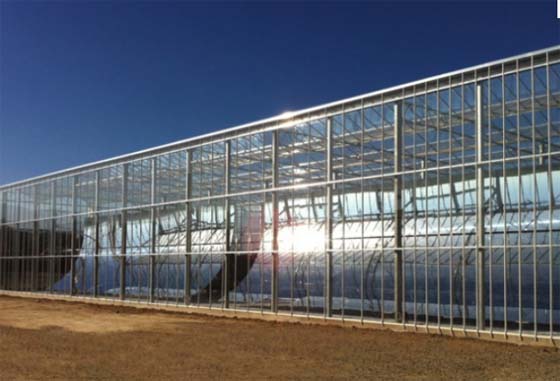
In the deserts with the best solar insolation in the world, dust and drought are also the greatest enemy. GlassPoint is pioneering the solution – put the solar in a Glass House – only after an attempted sale in Middle Eastern oil fields. Instead of merely being just another solar CSP company, GlassPoint is now the very first solar company in the world that will make solar power in a greenhouse. The GlassPoint Glass house solar project will make its debut in a depleted oil field in California.
But, as we covered in November…
(Middle Eastern Oil Companies to Try Solar CSP to Boost Oil Production) GlassPoint originally approached oil drillers in the Middle East about using their solar CSP technology to help extract the last few drops of oil from oil fields, rather than use gas. Where the sun shines brightly ten hours a day, Middle Eastern oil giants need electricity in the field. I expected to hear of a deal. But no deals were announced. But back then, there was no mention of encasing the solar CSP in a glass house.
CEO Rod MacGregor has always been focused on some of the industrial potential of solar CSP. Initially he focused on the industrial applications of the heat production rather than electric power. “You’ll find that most solar companies talk about process heat, but if you look at their real focus, it’s all in electricity,” he says.
So he initially approached industries that need heat. Steel smelters, food processors, sustainable gypsum board manufacturers like Serious Materials. And then oil drillers. They all need heat to burn gas to make steam to drive a turbine to make electricity.
In the same way as gas uses steam to drive a turbine to make electricity to power the pumps on drilling sites, solar mirror technology like GlassPoint’s also makes steam to power a turbine to make electricity to power the pumps on drilling sites to help extract oil in depleting oil fields.
But gas prices can increase. What happens then? MacGregor says that you can’t stop “steaming” an oil field. “If you do, the ground cools and the oil gets trapped.” So what if you could make steam for free? Once built, solar is fuel-free.
Although no deals were announced, I think he had a brainwave in the vast and dusty deserts of Saudi oilfields. Before he visited the Middle East, his was just another solar CSP company, as you see in the history of press stories on the GlassPoint website. When he returned: the solar glasshouse idea.
MacGregor has proved to be an inventive and enterprising innovator, willing to take a couple of runs at an idea. Some times it takes an entrepreneur several shots at getting something right. This time, I think he has it. Solar in a greenhouse solves solar’s biggest problem.
With the mirrors behind glass, now there is no dirt or dust to affect the moving parts as they track the sun all day. They are not subject to hot and dusty desert winds, they don’t have to be built strong – and thus heavy – costing more power to move. The mirrors themselves can be lightweight and cheaper to build.
With the much lower costs, his glasshouse solar can now undercut gas in price.
More on MENA solar CSP:
Middle East/Med Region Could Solar Power World 3 Times Over
MENA Cleantech Sees ‘Existential Need’ for CSP in Middle East and North Africa
Iran Inaugurates Its First CSP Solar Power Plant




Hi Susan,
I like your articles and musings about GlassPoint as I’ve been following the company from its early days. It’s all good stuff.
While you’re spot-on about the glasshouses being great protective environments for the STT mirrors in harsh oilfield climates, your hunch that Mr. MacGregor got his idea of enclosing the troughs in glass was maybe inspired by a visit to the dusty regions in the Middle East is slightly late in the time-line of the technology’s development.
Mr. MacGregor actually had the glasshouse idea from incept. He just didn’t talk about the glasshouse portion of the technology early on for sound business reasons. And GlassPoint’s contract award for the PDO project stemmed from those initial visits to the Middle East. Contracts with government owned oil companies are a rather long and paper-filled process.
Cheers and keep up the great coverage!