When Abu Dhabi Art Meets Sand, Sun, and Sky

s-flow-art-installationGlass art installation in Abu Dhabi generates inspiration and energy in one fell swoop

Studied Impact in Abu Dhabi came to our attention when they publicized a power plant they designed that doubles as a residence. The firm comprises a dynamic couple, architect and artist, who merge their environmental concern with creativity in very interesting ways.

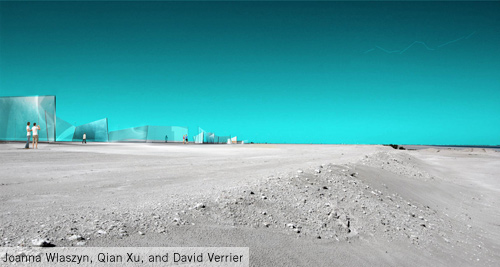
They are also the energy behind the Land Art Generator Initiative (LAGI), which is staging a unique interdisciplinary design competition. LAGI brought us the solar thermal music projects inspired by Egyptian history, and encouraged solar vs. nuclear power for the UAE. Now we’d like to introduce one competition submission, an art-meets-nature-meets-clean-energy installation designed by Joanna Wlaszyn, Qian Xu, and David Verrier.

Light play

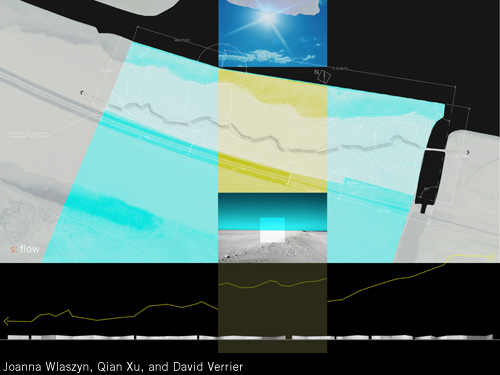
If you can imagine walking along a pale shore, and if you can imagine that shore intersecting with the sea, then perhaps you might also be able to envision a curved line of glass following that ecotone, or intersection. If you can, then you have become a part of the s: flow design, in a sense, because your role as viewer is crucial to the project’s success.

S is for sun, sunlight, solar, sunshade, see, sky, and for sand; this land art installation nudges the viewer to question “the visual dimension of distance and length perception,” according to the designers.

In addition, s: flow draws attention to the ever-cyclical nature of light’s play, to the notion that the only constant in life is change.

While moving along the installation, the sun reflections on the glass continuously change and create the flow of sunlight motion. Each time of the day the installation takes a whole new appearance in a permanent dialogue between light and shadow, nature and technology, and especially between man and his environment.

This visual interaction, say the project’s designers, is enhanced by the stark contrast between the sky and the reflective sand.

Function as art

While art is a meaningful end in itself, since good art encourages spectators to re-think an ordinary object, or turn a concept on itself in order to see it in a different light, LAGI and s: flow are compelling because that artistic twist is applied both to nature and clean energy production.

The standing glass, which transparency is maintained with “light supporting metal load-bearing structure,” is composed of reflective glass that provides a large feeding grounds for solar energy. This is harnessed with Spherlar Micro Solar Cells that absorb both direct and indirect sunlight, on both sides, and provide 80% high transparency.
s-flow-art-design Art energy

This captured energy is then converted to electricity; the designers say how:

“Actuating cables placed in the metal structure transmit the energy to be transformed into electrical power through the grid connection cables placed in the ground.”

And to delineate between private and public space, an invisible alarm placed on the ground triggers sound to alert hapless intruders.

The winner (s) would have be informed on August 9th, but the public will not be informed until the award ceremony in January. The winning team will be awarded the prize at the 2011 World Future Energy Summit in Abu Dhabi as part of the Land Art Generator exhibition at Masdar stand at WFES. The winning prize is sponsored by Masdar.

Although the competition is closed, each of the submitted pieces continues to distribute energy to the power grid, adding a brilliant punch to an already groundbreaking project.

The UAE has taken a lot of heat, but it’s impossible to ignore the ingenuity that the region generates. All puns intended.

:: Land Art Generator Initiative

Related posts:
Will Foster & Partners Achieve Carbon Neutrality In Hong Kong?

Dye Solar Cell “3G Solar” Moves On-Grid

Public Transportation Takes Flight In Dubai

Tafline Laylin
Tafline Laylinhttp://www.greenprophet.com
As a tour leader who led “eco-friendly” camping trips throughout North America, Tafline soon realized that she was instead leaving behind a trail of gas fumes, plastic bottles and Pringles. In fact, wherever she traveled – whether it was Viet Nam or South Africa or England – it became clear how inefficiently the mandate to re-think our consumer culture is reaching the general public. Born in Iran, raised in South Africa and the United States, she currently splits her time between Africa and the Middle East. Tafline can be reached at tafline (at) greenprophet (dot) com.

Read More

TRENDING

Self-repairing contact lenses and desalination membranes that fix themselves?

Could the humble contact lens become a sustainability breakthrough? Researchers in Korea have developed a self-healing hydrogel lens that repairs scratches with just one hour of UV light exposure. Beyond reducing waste from disposable contacts, the technology could one day help extend the life of solar panels, water filtration systems, and other plastic-based products.

Wave wind energy for Nvidia’s next AI energy boom?

As AI factories consume unprecedented amounts of electricity, NVIDIA is looking beyond chips and data centers to the ocean. The company recently spotlighted Israel's Eco Wave Power and its wave energy projects in Jaffa and Los Angeles, highlighting how AI, digital twins and renewable energy can work together to meet future power demands. The collaboration reflects a growing realization that the future of artificial intelligence may depend as much on clean energy infrastructure as it does on computing power.

Collecting kinetic energy from roads; REPS turns traffic into a power plant

REPS announced a $23.6M equity financing round to scale...

Baby teeth read like tree rings paint a picture of toxins in early life

A new study from the Icahn School of Medicine at Mount Sinai in New York offers a striking insight into how the environments we are born into can quietly shape our brains years later. By analyzing naturally shed baby teeth, the ones tucked under pillows for the tooth fairy, researchers have reconstructed a detailed timeline of exposure to environmental metals during pregnancy and early infancy.

Art from Oman at the Venice Biennale

Oman is returning to the Venice Biennale with Zīnah, an immersive installation by artist and curator Haitham Al Busafi that transforms a traditional form of horse adornment into a large-scale sensory experience.

Yerukim Forms a New Green Economy Where the Money is Really Green

The Yerukim members who pick up the recyclables get to keep the monetary reward, the public earns "green" bills that can be used in shops, and business owners get to be associated with environmentalism.

Choosing Riyadh over Dubai? What Investors Should Know

Saudi Arabia is deploying capital at unmatched scale to catalyze tourism and advanced industry while rewiring its power-and-water backbone. The investable frontier is widening—especially in renewables, grid storage, water efficiency/desal retrofits, and hospitality operating platforms. Prudent investors will insist on phased delivery, enforceable KPIs (energy, water, biodiversity), and RHQ/zone compliance—while pricing political-economy and reputational risks alongside growth upside.

Sell your cooking oil for biodiesel money

Want to make money on old french fry oil? Sell it.

Qatar Alternative Energy Summit Pairs Investors And Innovators

Alternative energy investors and innovators can meet n' greet in Doha, Qatar March 16 and 17.

Here’s How To Implement The Four Pillars Of Employee Engagement

If you throw a party for your work team and they are vegans, don't make it a barbecue. Know the sustainability values of your team to boost moral and retain good people.

Locals From Rishon Fight IKEA

Big Box stores are a pretty new concept in Israel, and thank God that not every Israeli city wants them in their backyard. A word from someone who has see the beautiful farmland around her hometown Newmarket, Ontario stripped and converted into vulgar strip malls of big box shops: they have no place in a healthy and sustainable town or city.

The Jewish National Fund Meets An Inconvenient Truth

According to the JNF, it has transformed thousands of acres of barren land into green forests in Israel. They state that each person emits about 23 tons of carbon per year, estimating that each tree planted can absorb one ton of carbon in its lifetime. That's a whole lot of trees you'd need to be planting. Could so many fit in Israel?

How to quiet noise from construction in your office

Streets need to be resurfaced in New York but the humming and grinding noise is unsettling. Noise is environmental pollution. 

Popular Categories