

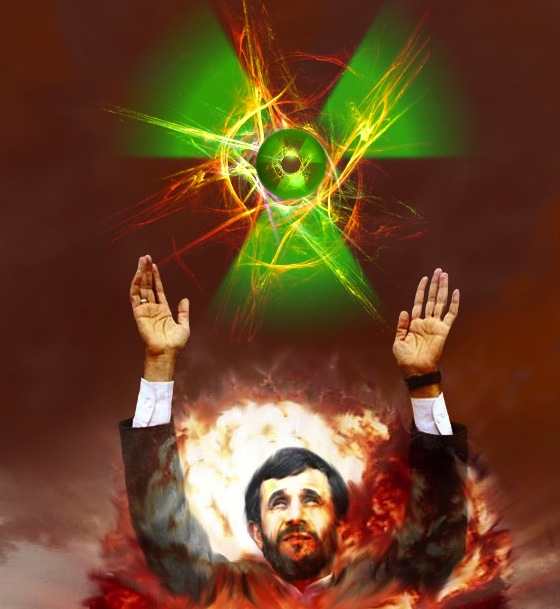
 As major oil companies pull out of Iran, analysts differ over the import of new economic sanctions.
By all objective standards, this week Iran is facing some version of a moment of truth. Responding to the impending imposition of beefed-up United Nations economic sanctions, French oil company Total announced publicly that it was suspending oil shipments to Iran and the Spanish oil giant Repsol withdrew from a contract to develop part of a large Iranian oil field. Even Iran’s neighbor, the United Arab Emirates, announced a series of moves to comply with the strengthened sanctions regime.
But analysts disagree over the import of the sanctions, and the degree to which the new approach will influence the Iranian government.
“These new sanctions will target Iran’s financial sector, Iran’s ability to trade, Iran’s ability to communicate with the external world and travel, which begins to target the energy sector, and squeeze a number of companies connected to the revolutionary guard,” Dr Emanuele Ottolenghi, a Senior Fellow at the Foundation for the Defense of Democracies and author of Under a Mushroom Cloud – Europe, Iran and the Bomb, told The Media Line. “All of these things combined will have a significant effect.”
“Obviously, it could have been much tougher, but there are some aspects of the resolution which if implemented honestly, conscientiously and resolutely can do a great deal of damage at a time when the Iranian economy is particularly fragile due to the vast incompetence of the current government. And the internal political situation makes the government more vulnerable,” he continued. “If you look at sanctions as a way to slow down and damage the efforts of the regime then these efforts are valuable.”
“Those who think that sanctions will solve the problem are wrong: sanctions are not going to convince President Ahmadinejad or the Supreme Leader Khamenei to reconsider their approach to nuclear power, nor are sanctions going to bring down the regime,” Dr Ottolenghi said.
“I don’t think that sanctions will have a major effect on Iran, especially since the Iranians had been preparing for the sanctions for quite awhile now,” he told The Media Line. “Iran is trading less and less with Europe and North America; and has been finding alternative partners in Asia, Latin America and Africa.
“Beyond diversifying its trade, Iran has also become more independent, for example in its consumption of oil, with heavy investment in oil refineries,” Dr Marandi said. “So Iran is much more independent than it was a few years ago.”
“There will be a minor effect,” he continued. “For example hospitals will have difficulty importing equipment from Europe. But at the end of the day it’s not going to have a major effect on the Iranian economy, and the irony is that the more sanctions that the west places on Iran, the greater the gap between them and the less leverage Western countries have over Iran.”
Dr Mehrdad Khonsari, a former Iranian diplomat and Senior Research Consultant at the Centre for Arab and Iranian Studies, argued that the sanctions would delay, but not solve, the principal conflict between Iran and the West.
“The sanctions will obviously have some kind of an effect on the Iranian economy by making conditions worse for all Iranians,” he told The Media Line. “But it will not be of sufficient strength or magnitude to force the Iranian government to change its stance or go a different way.”
“Life will become harder, Iran’s flexibility within the international community will be marginalized, but it doesn’t mean that the sanctions will achieve the behavior which they are aimed at achieving,” Dr Khonsari continued. “The oil companies are not pulling out, and those who are buying Iran’s oil are still buying the oil. What they are doing is essentially making sure that there is no new investment or technology and that production levels don’t increase.”
“If the international community were serious about containing Iran’s development towards nuclear weapons, they would recognize reality: we are moving towards a military confrontation, which is exactly what Ahmadinejad wants,” he said. “Sanctions are not working; diplomacy is not working; so what else is left? The choice is very clear.”
More on oil, green news and not-so green, from the Middle East:
Saudi Arabia to Replace Oil With Solar Power
Jordan Activists Worry About Oil Spill in Red Sea
Red Sea Oil Spill Cover Up Worse Than Expected
(This story is reproduced from the Middle East News Source – The Media Line)
Above image via azrainman

The person using the name “Cyrus Safdari” posting on this site is misrepresenting his name and is not the real Cyrus Safdari
you do realize that the bootlicking fascist you’re quoting here — Mohammad Marandi — is a paid toadie for the regime? How can you take anything that guy says seriously?