“In the midst of uncertain time, renewable energy remains consistent and steadfast in its expansion,” said Francesco La Camera, IRENA’s Director-General. “A more decentralised energy system, with a growing share of renewables and more market players, is structurally more resilient.”
Health insurance is a regulated financial product. Insurers operate under binding contracts, overseen by state insurance commissioners, that legally obligate them to pay claims meeting policy terms. Policyholders who believe a covered claim was wrongfully denied have legal recourse through state regulatory channels.
The New Zealand Merino Company, now rebranded as Zentera, has quietly removed the phrase “world’s leading ethical wool brand” from its website, a notable change that comes after a disturbing investigation by PETA Asia-Pacific into the company’s ZQ-certified wool supply chain, PETA reports to Green Prophet.
Somehow vegetables with short seasons excite the imagination and appetite more sharply than produce that’s available all year around. Good Middle Eastern cooks have many recipes for delicate fava beans, and this turmeric-fragrant soup is one.
“In the midst of uncertain time, renewable energy remains consistent and steadfast in its expansion,” said Francesco La Camera, IRENA’s Director-General. “A more decentralised energy system, with a growing share of renewables and more market players, is structurally more resilient.”
Health insurance is a regulated financial product. Insurers operate under binding contracts, overseen by state insurance commissioners, that legally obligate them to pay claims meeting policy terms. Policyholders who believe a covered claim was wrongfully denied have legal recourse through state regulatory channels.
The New Zealand Merino Company, now rebranded as Zentera, has quietly removed the phrase “world’s leading ethical wool brand” from its website, a notable change that comes after a disturbing investigation by PETA Asia-Pacific into the company’s ZQ-certified wool supply chain, PETA reports to Green Prophet.
Somehow vegetables with short seasons excite the imagination and appetite more sharply than produce that’s available all year around. Good Middle Eastern cooks have many recipes for delicate fava beans, and this turmeric-fragrant soup is one.
“In the midst of uncertain time, renewable energy remains consistent and steadfast in its expansion,” said Francesco La Camera, IRENA’s Director-General. “A more decentralised energy system, with a growing share of renewables and more market players, is structurally more resilient.”
Health insurance is a regulated financial product. Insurers operate under binding contracts, overseen by state insurance commissioners, that legally obligate them to pay claims meeting policy terms. Policyholders who believe a covered claim was wrongfully denied have legal recourse through state regulatory channels.
The New Zealand Merino Company, now rebranded as Zentera, has quietly removed the phrase “world’s leading ethical wool brand” from its website, a notable change that comes after a disturbing investigation by PETA Asia-Pacific into the company’s ZQ-certified wool supply chain, PETA reports to Green Prophet.
Somehow vegetables with short seasons excite the imagination and appetite more sharply than produce that’s available all year around. Good Middle Eastern cooks have many recipes for delicate fava beans, and this turmeric-fragrant soup is one.
“In the midst of uncertain time, renewable energy remains consistent and steadfast in its expansion,” said Francesco La Camera, IRENA’s Director-General. “A more decentralised energy system, with a growing share of renewables and more market players, is structurally more resilient.”
Health insurance is a regulated financial product. Insurers operate under binding contracts, overseen by state insurance commissioners, that legally obligate them to pay claims meeting policy terms. Policyholders who believe a covered claim was wrongfully denied have legal recourse through state regulatory channels.
The New Zealand Merino Company, now rebranded as Zentera, has quietly removed the phrase “world’s leading ethical wool brand” from its website, a notable change that comes after a disturbing investigation by PETA Asia-Pacific into the company’s ZQ-certified wool supply chain, PETA reports to Green Prophet.
Somehow vegetables with short seasons excite the imagination and appetite more sharply than produce that’s available all year around. Good Middle Eastern cooks have many recipes for delicate fava beans, and this turmeric-fragrant soup is one.
“In the midst of uncertain time, renewable energy remains consistent and steadfast in its expansion,” said Francesco La Camera, IRENA’s Director-General. “A more decentralised energy system, with a growing share of renewables and more market players, is structurally more resilient.”
Health insurance is a regulated financial product. Insurers operate under binding contracts, overseen by state insurance commissioners, that legally obligate them to pay claims meeting policy terms. Policyholders who believe a covered claim was wrongfully denied have legal recourse through state regulatory channels.
The New Zealand Merino Company, now rebranded as Zentera, has quietly removed the phrase “world’s leading ethical wool brand” from its website, a notable change that comes after a disturbing investigation by PETA Asia-Pacific into the company’s ZQ-certified wool supply chain, PETA reports to Green Prophet.
Somehow vegetables with short seasons excite the imagination and appetite more sharply than produce that’s available all year around. Good Middle Eastern cooks have many recipes for delicate fava beans, and this turmeric-fragrant soup is one.
“In the midst of uncertain time, renewable energy remains consistent and steadfast in its expansion,” said Francesco La Camera, IRENA’s Director-General. “A more decentralised energy system, with a growing share of renewables and more market players, is structurally more resilient.”
Health insurance is a regulated financial product. Insurers operate under binding contracts, overseen by state insurance commissioners, that legally obligate them to pay claims meeting policy terms. Policyholders who believe a covered claim was wrongfully denied have legal recourse through state regulatory channels.
The New Zealand Merino Company, now rebranded as Zentera, has quietly removed the phrase “world’s leading ethical wool brand” from its website, a notable change that comes after a disturbing investigation by PETA Asia-Pacific into the company’s ZQ-certified wool supply chain, PETA reports to Green Prophet.
Somehow vegetables with short seasons excite the imagination and appetite more sharply than produce that’s available all year around. Good Middle Eastern cooks have many recipes for delicate fava beans, and this turmeric-fragrant soup is one.
“In the midst of uncertain time, renewable energy remains consistent and steadfast in its expansion,” said Francesco La Camera, IRENA’s Director-General. “A more decentralised energy system, with a growing share of renewables and more market players, is structurally more resilient.”
Health insurance is a regulated financial product. Insurers operate under binding contracts, overseen by state insurance commissioners, that legally obligate them to pay claims meeting policy terms. Policyholders who believe a covered claim was wrongfully denied have legal recourse through state regulatory channels.
The New Zealand Merino Company, now rebranded as Zentera, has quietly removed the phrase “world’s leading ethical wool brand” from its website, a notable change that comes after a disturbing investigation by PETA Asia-Pacific into the company’s ZQ-certified wool supply chain, PETA reports to Green Prophet.
Somehow vegetables with short seasons excite the imagination and appetite more sharply than produce that’s available all year around. Good Middle Eastern cooks have many recipes for delicate fava beans, and this turmeric-fragrant soup is one.
“In the midst of uncertain time, renewable energy remains consistent and steadfast in its expansion,” said Francesco La Camera, IRENA’s Director-General. “A more decentralised energy system, with a growing share of renewables and more market players, is structurally more resilient.”
Health insurance is a regulated financial product. Insurers operate under binding contracts, overseen by state insurance commissioners, that legally obligate them to pay claims meeting policy terms. Policyholders who believe a covered claim was wrongfully denied have legal recourse through state regulatory channels.
The New Zealand Merino Company, now rebranded as Zentera, has quietly removed the phrase “world’s leading ethical wool brand” from its website, a notable change that comes after a disturbing investigation by PETA Asia-Pacific into the company’s ZQ-certified wool supply chain, PETA reports to Green Prophet.
Somehow vegetables with short seasons excite the imagination and appetite more sharply than produce that’s available all year around. Good Middle Eastern cooks have many recipes for delicate fava beans, and this turmeric-fragrant soup is one.
Food is never something lacking at Jewish celebrations, but, like most things in life, their environmental footprint keeps expanding, whether the factory-farmed chicken that ends up in the soup pan, or the throwaway plastic cutlery destined to spend the next few centuries in a landfill site.
Our friends at Jewish eco-NGO, Hazon, have devised a guide for a healthy, sustainable Purim that brings together traditional Jewish faith with modern concerns about unsustainable consumption. Purim is also an occasion when booze flows freely, so their tips come well in advance of the festival itself, which starts on Thursday 20 March.
One way of greening is economizing space and where better place to economize than than in your own home… Here are a few tips for making your home bigger:A flat screen mounted on the wall eliminates the need for a TV stand or armoire, it also looks sleek and great!Paint the walls and ceiling in a continuous color to make the room seem taller. Paint moldings, doors and the like in the same color as the walls. Strongly contrasting elements chop up the space.Miltitaskers: A daybed that converts into a comfy guest bed, for instance, is a great space saver that precludes the need for another piece of furniture.Use furniture that is scaled appropriately to the room. For example, an oversize sofa will eat up too much space in a small room.Provide good illumination, which will enhance the sense of space.
Rothschild Boulevard has always been lined with trees, but anyone walking on Rothschild Boulevard between Bezalel Yafe Street and Yavne Street during the past couple of weeks may have noticed a special influx of greenery.
Lined in the center of the boulevard, this collection of trees is a special site-specific installation by Israeli environmental sculptor, Dani Karavan.
The installation, titled Orchard, was created by Karavan to accompany his recent retrospective at the Tel Aviv Museum of Art, and was displayed outside of the museum throughout the duration of his exhibition. Orchard is now part of an initiative called Well Houses: Disappearing Palaces of Jaffa which attempts to preserve the historical and cultural importance of the city’s wells.
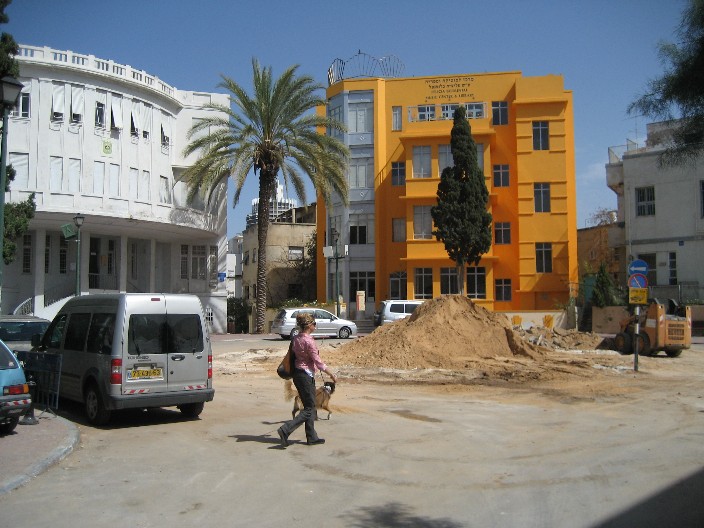
The colorful sculpture that once graced Bialik Square in the center of Tel Aviv is no more. The sculpture, designed for the square by artist Nahum Gutman in the 1970’s, rose out of a circular fountain and recounted 4000 years of Tel Aviv-Jaffa history in tiled mosaics. Today, a pile of dirt sits in the middle of the square, and Gutman’s piece sits, disassembled, in storage. Later this year, the city plans to reassemble the sculpture and move it to Rothschild Boulevard.
City authorities told Ynet (Hebrew link) that the decision to remove the sculpture was made a year ago, in coordination with the Gutman family, which supports the move. The reason for moving the sculpture is the fact that it partially blocked the facade of the old city hall building, which is slated for renovation and will house the Museum of the History of Tel Aviv-Jaffa. In place of Gutman’s mosaics, a “biological pond,” similar to the pond that existed pre-Gutman, will become the square’s new centerpiece.
Hebrew University, sent Green Prophet this press announcement today. Water seems to be the talk of the town these days:
Possessing only 6.2% of global freshwater resources to supply 21% of the world’s population, China’s severe water shortage has become one of the most pressing dangers the country faces, threatening its fast-growing economy.
Despite its vast water reserves, China is quickly running out of its most vital natural resources due to rampant industrial pollution and inefficient use. Today, 70 percent of running water in China’s cities is unfit for drinking or fishing and around 300 million rural Chinese currently drink polluted water.
We’re accustomed to the doom-and-gloom prophecies of Israel’s chronic water shortage and how the thirst of the growing population of a country that is over 50% desert is going to crash and burn one day in the future. So it came as a shock to the system to hear Machiavellian German hydrogeologist, Clemens Messerschmid insist that, “Israel has plenty of water for everyone.”
Apparently Jerusalem has more rainfall each year than Berlin and the Palestinian city of Ramallah, 20 minutes drive north of Jerusalem, is wetter than Paris.
Tel Aviv is offering organic food not only in form of vegetable boxes, or new organic grocery stores, but also in form of a brand new vegetarian restaurant.
Sarahle Organi is a cute place in Nachalat Benjamin that opened a few weeks ago.
The whole restaurant is very light and friendly and completely redesigned by it’s owner Schmulik, who is also the cook of this fabulous place. The restaurant is divided to a front part, with a bar and coffee tables and a back part, where you can sit on bigger tables.
The back door leads you to a small garden that offers you the opportunity to enjoy the dishes or your coffee in the sun.
In the summer the backyard will also host different events. Yoga lessons and movie nights are two happenings that are planned for the summer.
But now let’s finally talk about the food:
The menu offers you, next to several breakfast options and deserts, a special variety of vegetarian main dishes. I am sure that all of them are worth a try, but I want to recommend you two dishes, that are yummy, yummy, yummy!
Tel Aviv’s Naomi from Abu Yoyo has found an ingenious way to recycle city banner adverts. She makes bags, wallets and book covers and sells them back to media companies. Ingenious, no?
Thinking back to picnics as a kid I can still hear my parents’ voices telling me to leave the place cleaner than how we found it.
Until this day this thought is what goes through my mind whenever I sit down to eat. Can you imagine how wonderful our world would be if everyone could implement this? Give it a try. All it takes is one more piece of garbage than what you brought with you.
Brits amongst us might well be familiar with the concept of ‘green’ or ‘ethical banking’ through publicity surrounding the Cooperative Bank and Triodos, or other UK high street banks that are falling over themselves to offer this new, trendy financial facility, which is also spreading rapidly through the American banking system; but what about Israel?
How is Israel, this vibrant economy, and environmental-technology pioneer of the Middle-East, adapting to this concept of ethical, environmental and social investing? Are we putting our hard earned shekels where our environmental mouths are? Green Prophet talked to Daniel Schwab, founder and CEO of Kayema, a boutique financial services company, and one of the very few championing ethical investing here, to find out.
Marty has just arrived back from 1955, we hear a sonic boom. Marty turns around and sees Doc Brown’s Dolorean drive up behind him. Doc impresses on Marty that he must return with him to the future to fix a mishap of his son. In order to fuel the time machine Doc rummages through Marty’s trash and pulls out a banana peel. a can of beer and some egg shells, pops them into “Mr. Fusion” and walla! No need for a bolt of lightning to power this trip…
Wouldn’t it be nice to be able to harness the power of trash?
Shai Pinczewski, founder and CEO of waste disposal company REN Waste explains: “The whole idea is to have a self-sustaining solution that eliminates 100% of the waste steam, doesn’t damage the environment, and can produce efficient clean energy. We brought in every different technology we need to achieve a complete breakdown in waste”
Pinczewski’s plant offers a complete alternative to traditional methods including incineration or landfills and eliminates the need for complimentary waste disposal treatments. Garbage and sewage are bought to the plant, shredded, run through magnetic sorters, separated, and tipped into a bio-chemical oxidation chamber for seven days for aerobic digestion.
After fermentation, a pyrolysis plant breaks down waste rubber, plastics and unfermentable organic matter. By the end of the process the waste has been separated and segregated into component materials and concentrated to a high degree of purity. Byproducts of this process including electricity, ethanol, metal, potable water, glass and gas that can be resold turning a huge financial burden into a cash cow.
Municipal waste is an environmental hazard that pollutes air, land and groundwater resources. It causes health hazards ranging from skin and eye infections to lethal diseases. It also costs world consumers billions of dollars a year in disposal costs. In the US alone, waste production has tripled from 88 million tons in 1960 to close to 250 million tons today and in New York, the cost of garbage disposal ranges from $80 to $150 a ton. In Europe it costs about 110 to 115 Euros.
“On some things we won’t make a lot of money, but the idea is that it won’t cost anything and we will be able to get rid of the waste completely,” says Pinczewski. “It’s good for the environment, good for us, and good for the world.”
We hope that every city around the world implements Pinczewski’s plant. Perhaps one day Doc Brown’s rummaging to create electricity will not see so futuristic.
Leaking electricity from electronics costs Americans millions annually. In fact about $750 million a year from leaky TVs and about $600 million a year from VCRs. To avoid the leaking of electricity, either unplug electronics when not in use, or plug them into a power strip that can be switched off.
There’s no more satisfying way of enjoying what you eat than growing it yourself, but if you simply don’t have the time or know-how than the next best thing is to get to know the person who grows it for you.
That’s the idea behind Community Supported Agriculture (CSA), a small but growing movement of farms who deliver direct to their customers. Although most of Israel’s organic produce is exported overseas, some farmers have imported the CSA concept, (for example, the Tuv Ha’aretz program from Jewish eco-NGO Hazon) to help close the widening gap between farm and fork.
Many farms adopting the CSA model are also organic, so you not only get to know who grows your food, but also how they grow it.
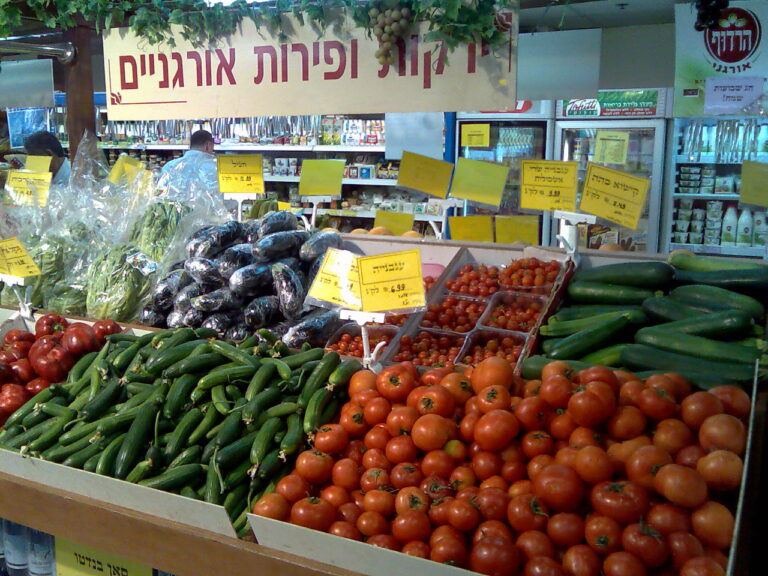
One important aspect of a greener life is what you eat. Try various substitutes for your less healthy foods.
Use brown sugar instead of white, or mix in whole wheat with your regular flour. These little changes don’t always make a big difference taste-wise and DO make a difference health-wise.
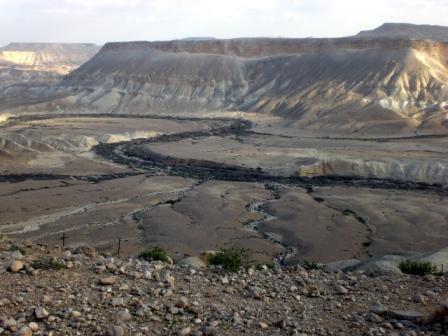
I’ve been researching Bedouin issues in the Negev Desert Israel for about 5 years, and one of the first individuals I met was Nuri El-Ukbi. Nuri and the El-Ukbi tribe have claims to the land named in Arabic El-Araquib, which is roughly situated between Rahat and Beersheva.
It is a vast area of land, roughly 19,000 dunams, and Nuri has documents showing ancestral tithes to this piece of land that stretch back to Mandate and Turkish rule.
In 1951 the El-Ukbi tribe were transferred to land around Hura.
Nuri, on behalf of his father and grandfather, both sheiks (deceased) of the El-Ukbi tribe, has lived in a protest tent on the land for several years now, conducting virtually a one-man non-violent protest against the powers-that-be who will not allow the tribe to live on or farm this piece of land.
Some of it has been given over to a gated settlement, Givaot Bar, and another chunk has been given to members of the Tarabin tribe. Attempts to plant trees and sow crops there by the El-Ukbi tribe and their many Jewish and International supporters meet with the Police and Green Patrol intervening and destroying trees and crops.
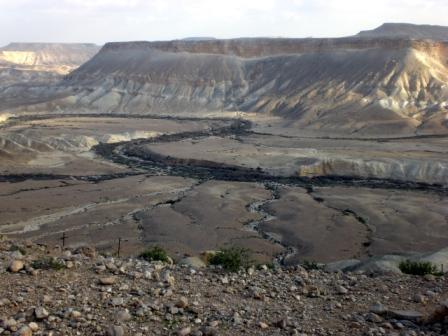
It is a visually stunning landscape. I was there yesterday with Nuri, and together we watched birds of prey circle overhead. Here is a short piece of film I made recently about Nuri….
Sadly, he told me the tree has now completely died. The new growth could not flourish. Nuri however, remains in El-Araquib, defiant and quietly optimistic. He is a great example of non-violent protest. He is, like the title of a book he has written about his life, ‘waiting for justice’.


 Food is never something lacking at Jewish celebrations, but, like most things in life, their environmental footprint keeps expanding, whether the factory-farmed chicken that ends up in the soup pan, or the throwaway plastic cutlery destined to spend the next few centuries in a landfill site.
 One way of greening is economizing space and where better place to economize than than in your own home… Here are a few tips for making your home bigger:A flat screen mounted on the wall eliminates the need for a TV stand or armoire, it also looks sleek and great!Paint the walls and ceiling in a continuous color to make the room seem taller. Paint moldings, doors and the like in the same color as the walls. Strongly contrasting elements chop up the space.Miltitaskers: A daybed that converts into a comfy guest bed, for instance, is a great space saver that precludes the need for another piece of furniture.Use furniture that is scaled appropriately to the room. For example, an oversize sofa will eat up too much space in a small room.Provide good illumination, which will enhance the sense of space.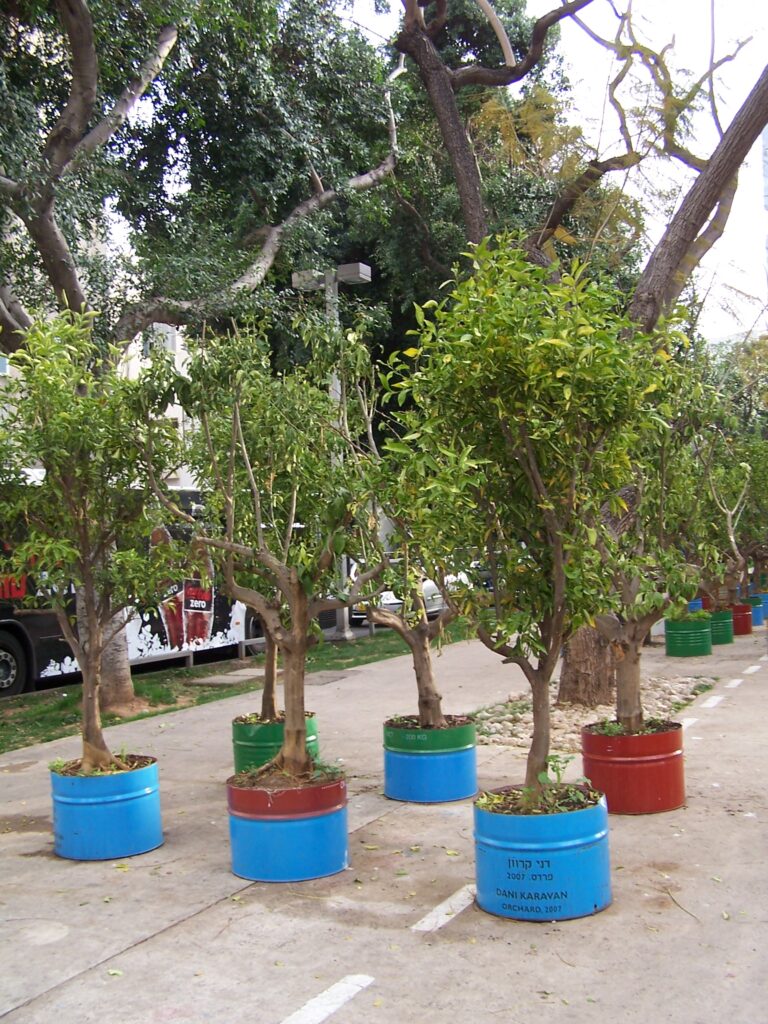





 Thinking back to picnics as a kid I can still hear my parents’ voices telling me to leave the place cleaner than how we found it.




 One important aspect of a greener life is what you eat. Try various substitutes for your less healthy foods.