Two thousand years ago, someone scratched a web of lines into stone in a Roman settlement on the empire’s northern edge. Soldiers, traders, or locals passing time in Coriovallum—now Heerlen in the Netherlands, moved small counters across those lines in a tactical duel of blockade and entrapment.
Unlike most recordings from this era, which were lost as early media deteriorated, the audograph discs survived and appear to have been uniquely used for underwater sound — making them a rare, possibly singular example of early ocean listening preserved from the dawn of marine acoustics.
Two thousand years ago, someone scratched a web of lines into stone in a Roman settlement on the empire’s northern edge. Soldiers, traders, or locals passing time in Coriovallum—now Heerlen in the Netherlands, moved small counters across those lines in a tactical duel of blockade and entrapment.
Unlike most recordings from this era, which were lost as early media deteriorated, the audograph discs survived and appear to have been uniquely used for underwater sound — making them a rare, possibly singular example of early ocean listening preserved from the dawn of marine acoustics.
Two thousand years ago, someone scratched a web of lines into stone in a Roman settlement on the empire’s northern edge. Soldiers, traders, or locals passing time in Coriovallum—now Heerlen in the Netherlands, moved small counters across those lines in a tactical duel of blockade and entrapment.
Unlike most recordings from this era, which were lost as early media deteriorated, the audograph discs survived and appear to have been uniquely used for underwater sound — making them a rare, possibly singular example of early ocean listening preserved from the dawn of marine acoustics.
Two thousand years ago, someone scratched a web of lines into stone in a Roman settlement on the empire’s northern edge. Soldiers, traders, or locals passing time in Coriovallum—now Heerlen in the Netherlands, moved small counters across those lines in a tactical duel of blockade and entrapment.
Unlike most recordings from this era, which were lost as early media deteriorated, the audograph discs survived and appear to have been uniquely used for underwater sound — making them a rare, possibly singular example of early ocean listening preserved from the dawn of marine acoustics.
Two thousand years ago, someone scratched a web of lines into stone in a Roman settlement on the empire’s northern edge. Soldiers, traders, or locals passing time in Coriovallum—now Heerlen in the Netherlands, moved small counters across those lines in a tactical duel of blockade and entrapment.
Unlike most recordings from this era, which were lost as early media deteriorated, the audograph discs survived and appear to have been uniquely used for underwater sound — making them a rare, possibly singular example of early ocean listening preserved from the dawn of marine acoustics.
Two thousand years ago, someone scratched a web of lines into stone in a Roman settlement on the empire’s northern edge. Soldiers, traders, or locals passing time in Coriovallum—now Heerlen in the Netherlands, moved small counters across those lines in a tactical duel of blockade and entrapment.
Unlike most recordings from this era, which were lost as early media deteriorated, the audograph discs survived and appear to have been uniquely used for underwater sound — making them a rare, possibly singular example of early ocean listening preserved from the dawn of marine acoustics.
Two thousand years ago, someone scratched a web of lines into stone in a Roman settlement on the empire’s northern edge. Soldiers, traders, or locals passing time in Coriovallum—now Heerlen in the Netherlands, moved small counters across those lines in a tactical duel of blockade and entrapment.
Unlike most recordings from this era, which were lost as early media deteriorated, the audograph discs survived and appear to have been uniquely used for underwater sound — making them a rare, possibly singular example of early ocean listening preserved from the dawn of marine acoustics.
Two thousand years ago, someone scratched a web of lines into stone in a Roman settlement on the empire’s northern edge. Soldiers, traders, or locals passing time in Coriovallum—now Heerlen in the Netherlands, moved small counters across those lines in a tactical duel of blockade and entrapment.
Unlike most recordings from this era, which were lost as early media deteriorated, the audograph discs survived and appear to have been uniquely used for underwater sound — making them a rare, possibly singular example of early ocean listening preserved from the dawn of marine acoustics.
These are no ordinary pyramids. When built, eight orbiting solar-paneled pyramids surrounding one larger “earth” will generate enough energy to power 250 Abu Dhabi homes.
For months we’ve been teetering at the edge of our seats waiting to learn who will win the Land Art Generator Initiative (LAGI) design competition. Finally, our waiting is over.
This morning, at the ongoing World Future Energy Summit (WFES) in Abu Dhabi, Masdar’s Associate Director of Sustainability, Dr. Nawal Al Hosany, awarded the first place prize to the design team responsible for the Lunar Cubit. Second Place Mention went to the Windstalk, and Third to Solaris.
Violators of the new recreational fishing ban in Southern Sinai will be tracked and prosecuted.
At the end of last year, a spate of shark attacks left three tourists injured and one elderly woman dead. What caused the sharks to act so contrary to their nature is still under investigation, though the situation appears to be under control.
The well-publicized incident took a toll on the region’s tourism industry, which recovered following the government’s decision to lift the snorkeling ban. South Sinai’s governor has now announced that all sport fishing – by locals and tourists alike – will be henceforth banned.
Environmental Studies in Israel, Enlight Renewable Energy’s recent surge, Leviathan Energy, and more headlines related to Israeli cleantech and the environment.
With the aid of a 700,000 euro grant from Europe Aid, the Local Energy Center launched this past week and will help local authorities reduce stress on the power grid and become more energy efficient. A Tel Aviv University professor is challenging current theories on thin-film solar panels and construction began in central Israel on the world’s largest reverse osmosis desalination plant. For these stories and the rest of this week’s headlines, see below.
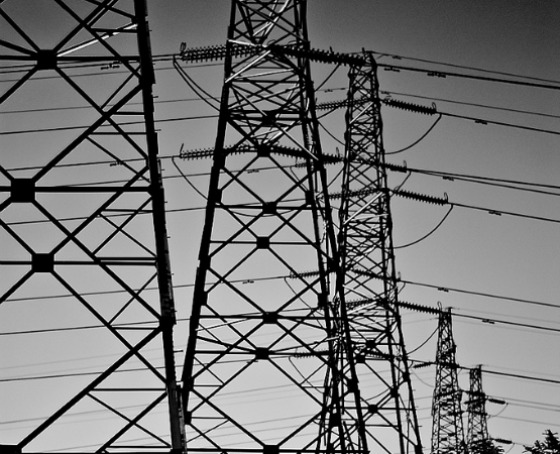
The Fourth World Future Energy Summit hosted by Masdar opened this week bringing out many of the world’s foremost influencers and thought leaders on renewable energy, including heads of state, policy makers, government officials, business leaders, technologists, financiers and academics. All have travelled from corners of the world to Abu Dhabi to debate, discuss and promote the challenges and solutions relating to the world’s energy needs.
Iceland’s President Olafur Grimsson at Masdar conference:”Renewable Energy is the way of the future”
Iceland is a small country which recently came into “prominence” when one of its volcanoes caused a huge volcanic ash cloud to ground commercial airline flights for nearly a month last spring. But all this potential energy is also resulting in Iceland being almost completely energy independent, due to the use of geothermal energy, as well as other forms of renewable energy to create electricity and heat homes and businesses in this island nation.
Carob is an easy and sustainable chocolate replacement
Ancient food of the Middle East, carob’s sweet flavor makes this vegan dessert naturally good.
The sweetly named carob tree produces a fruit that can be used as a chocolate substitute. Its cultivation is less harmful to the environment and it can made into syrups, desserts, spreads, toffees, drinks or used as a sweetener.
When I was a little girl living in New York, Israel was just a faraway hot, sandy country to me. Tu B’Shvat is a Jewish holiday that meant planting a tree by mail, although today you can plant a tree in Israel online.
It was when Dad would bring home carobs. “Boxer,” he’d say. Yiddish for carob. A taste of the Holy Land, something to bring the New Year of the Trees closer. We kids would chew away earnestly on the long black pods, fascinated with the sweet taste with a cheese flavor. The shiny black seeds, hard enough to split a tooth, we carefully collected for our own arcane purposes in a box under my bed.
You can live off carobs if you are in the Middle East
Having lived in Israel for over three decades and now a grandmother, I still delight in carob, although as a powder, for cooking. These just-sweet-enough carob balls are so right for a Tu B’Shvat celebration. or a dessert at a vegan meal. The recipe includes other native Israeli foods: honey, almonds, wheat and nuts.
Vegan Carob Nut Balls
Ingredients:
3/4 cup almond butter
1/2 cup carob powder
1/2 tsp. cinnamon
1/2 cup honey
1 tsp. vanilla
1 cup puffed wheat
1/2 cup chopped walnuts or pecans
For coating:
1. 1/4 cup Dried, powdered coconut
2. 4 Tblsp. cocoa powder mixed with 4 Tblsp. carob powder and 1/4 tsp. cinnamon
3. Blend 3 Tblsp. carob powder and 1/4 cup sugar. Melt 2 Tblsp. margarine or coco butter/oil, remove from heat and mix in carob powder/sugar. If needed, thin the coating with a little warm milk (soy, almond, coconut milks are fine). If too thin, add a little more carob powder.
Vigorously mix the almond butter, carob powder, cinnamon, honey and vanilla. The dough will be stiff.
Add the nuts and cereal. Wet your hands to form the dough into balls. The surface of the balls should be moist in order to help the coating stick.
Roll each ball in one of the coating mixes. Refrigerate till firm.
Dubai has hardly been noted for its energy-saving green buildings. But new regulations are about to change that.
Dubai’s Energy Council has just announced the passage of new green building regulations that were initially proposed a year ago. These tough new building codes could reduce energy consumption by almost a fifth, according to Amal Koshak, senior manager for demand management at Dubai’s Electricity and Water Authority (DEWA).
“It was approved a month ago by the executive council, and there is a 3 years grace period, and the expected savings are 20 percent for electricity, and 15 percent for water,” Koshak told Middle East Utilities on Monday.
New buildings will have to comply with a range of conservation measures, from energy efficient lighting, in the building itself, to participating in the creation of thermal storage in district cooling plants, similar to Sweden’s district heating (in reverse) that is a big part of that nation’s nearly 100% fossil-energy independence.
Planning out your vacations for the new year ahead? Beirut, Tel Aviv and Abu Dhabi make the cut.
A few months ago, world-renowned travel guide company Lonely Planet made a list of its top 10 cities for 2011. Tel Aviv made the prized 3rd place spot (after New York and Tangier, but before Valencia, Delhi, and Chiang Mai). Tel Aviv tops a Green Prophet list as well: the list of Middle Eastern eco-cities to visit in 2011 (or as soon as you possibly can).
Besides Tel Aviv, our list includes Beirut and Abu Dhabi.
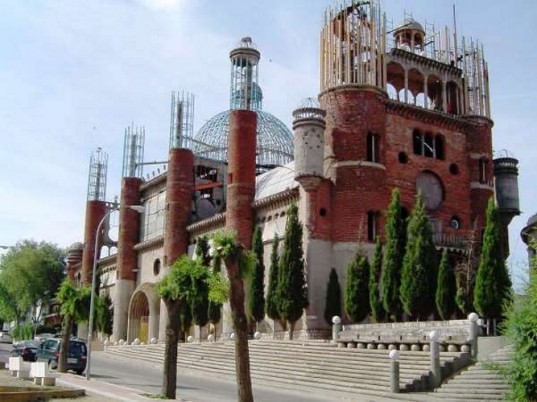
Remarkable “junk” cathedral is built by one man with a ton of faith.
Have you ever got down on your knees and promised your creator that if you got that groovy green job, or if these natural stimulants improved your libido, or if that horrible bout of encephalitis went away, you would do something amazing? Quit smoking, start eating better, or maybe even give up cars and take up biking instead?
And then, did you forget all about your promise when the thing you wanted came about?
After recovering from tuberculosis, which forced him out of the Benedictine order of monks, Justo Martinez (known fondly as Don Justo) promised to build a massive cathedral for the Lady of the Pillar, who helped him through his ordeal. And that is what he has been doing for the last 50 years.
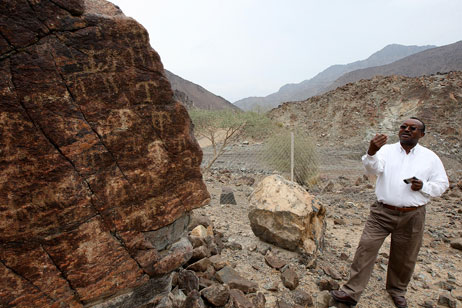
Archaeologists in Fujairah at working against the clock to save the UAE’s precious rock art.
Without an historical record, our future would seem shallow. A future sans identity. A future that lacks the benefit of hindsight to inform important decisions. Because ancient relics – fossils, petroglyphs, and architecture – shed light on our origin, they also help us to put the future into perspective.
Otherwise, we would think of ourselves as mostly urban people with no tool-making or agricultural history, without a rich menu of mythology and culture. Which is why archaeologists in the United Arab Emirates are fighting so hard to protect the few remaining petroglyphs from encroaching industrial development.
From luxury architecture in Mecca to the blinged-out buildings of Dubai, it seems that Islamic architecture is all about opulence and grandeur. The bigger and the more lavish- the better but it hasn’t always been like this. In the past, Islamic architecture relied on natural materials and some of the most iconic Islamic buildings were ones of simplicity and modesty– think the Kaaba in Mecca. Mud was something that was heartily used and architecture sought to reflect the environment rather than to outshine it. Today, the renowned architect Ibrahim Mohammed Jaidah states that the fading green credentials of Islamic architecture are in need of revival.
In December, The United Nations’ Food and Agricultural Organization noted that food prices have exceeded the high prices of 2008, when the Gulf region was hit particularly hard. The IMF found that inflation skyrocketed almost 16% in the Gulf as a result, mostly driven by high food prices – driven by high oil prices. The Gulf states are reliant on food imports.
This time, the Arab states, led by Saudi Arabia and UAE, have decided to take matters into their own hands, according to Arabian Business. They are using their vast oil wealth to buy up tracts of land the size of small countries in Africa, intending to turn them into agricultural hotbeds to feed their multitudes.
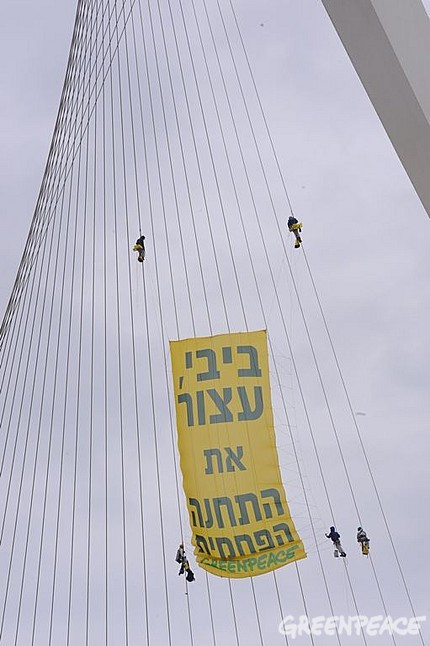
No it’s not Spiderman and friends, just green activists trying to call attention to the environmental impact of coal-burning power plants.
Greenpeace went to great heights yesterday to express opposition to plans for a new coal-burning power plant in Israel. Five Greenpeace activists scaled the cables of the Chords Bridge at the entrance to Jerusalem and hung a huge banner (44 square meters) imploring Prime Minister Benjamin Netanyahu: Stop the coal plant.
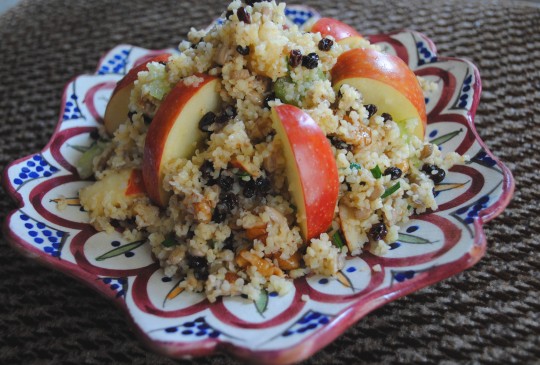
Rabbi Judah, a sage who lived in the 2nd century, said that wheat – not an apple – was the fruit of the Tree of Knowledge. The stalks of wheat in the Garden of Eden were thought to have been “as tall as the cedars of Lebanon.” As Hannah described in her post on Tu B’Shvat, foods traditionally eaten on this holiday come from the seven species of Israel and since wheat is one, it’s fun to eat something delicious made from wheat.
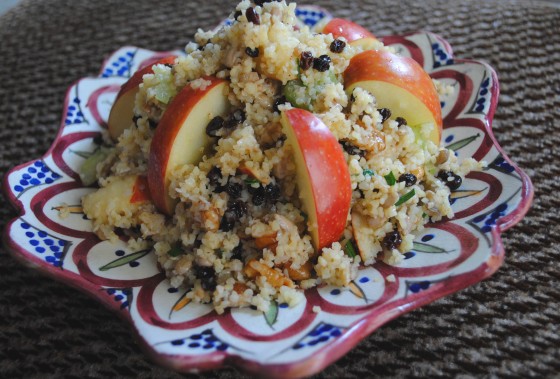
Of course, today’s celebrations include all kinds of fruit that the Sages never dreamed of. Try this bulgur salad made savory and lightly sweet with dried and fresh fruit, seeds, and nuts. After all, not only tabbouleh does cracked wheat make.
Designer Eungi Kim created a sort of clip-on accessory that looks like the silhouette of a horse for the Seoul Cycle Design Competition 2010. While the jury is out on whether the resources needed to create the spirit spoils the fun, our eco-minded friends at the Guardian and Treehugger vote not-guilty.
In the title, I used the term “ecotard.” The person who used it to disparage an environmentally aware festival-goer in Israel who accidentally started a fire in the Golan meant for it to mean “retarded” hippie. But in our internal dialogue, we Green Prophet writers (actually, Karen Chernick made the suggestion) decided that we liked the frilly variety of that invented word.
Riding such a personalized bike can lighten up the sometimes stressful world of climate change and rising temperatures, according to Treehugger, who quotes The Guardian’s Peter Walker:
Who wouldn’t feel better pedalling around with the wooden silhouette of a horse’s head, body and tail clamped to the frame of your bike? Well, maybe quite a lot of people. However impractical and whimsical it might be, I love the way the designer, Eungi Kim, has captured the essential thrill of riding a bike. If driving a car around a city can feel like being trapped in your own personal, (slowly) mobile prison cell, then on a good day cycling is more like cantering along a prairie.
The only thing I would add to this breathless vision is an ecotard. A glowing green lacy thing that frees the inner ecollect as the cyclist tears across the urban landscape on a shadowy steed.
More fun design stories that will free your inner ecollect:

 These are no ordinary pyramids. When built, eight orbiting solar-paneled pyramids surrounding one larger “earth” will generate enough energy to power 250 Abu Dhabi homes.
 Masdar energy conference started this week.