
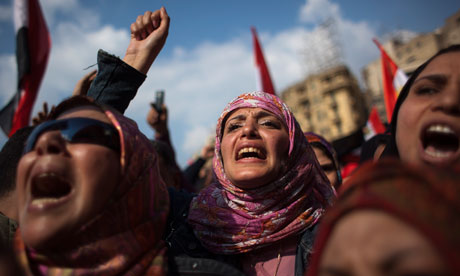
Unstable and unsustainable societies threaten our health, and that of the environment. The latest: virginity tests in Egypt.
Despite their massive involvement in the protests and overthrow of their government, Egyptian women are being denied a voice in the formation of a new government, World Pulse and other watchdog organizations report. Amnesty International has called on the Egyptian authorities to investigate serious allegations of torture, including forced ‘virginity tests’, inflicted by the army on women protesters (we’ve written about in Egypt) arrested in Tahrir Square earlier this month.
After army officers violently cleared the square of protesters on 9 March, at least 18 women were held in military detention. Amnesty International has been told by women protesters that they were beaten, given electric shocks, subjected to strip searches while being photographed by male soldiers, then forced to submit to ‘virginity checks’ and threatened with prostitution charges.
A 2020 documentary on virginity tests in Egypt
‘Virginity tests’ are a form of torture when they are forced or coerced. An Amnesty International spokesperson said:”Forcing women to have ‘virginity tests’ is utterly unacceptable. Its purpose is to degrade women because they are women. All members of the medical profession must refuse to take part in such so-called ‘tests’.”
Twenty-year-old Salwa Hosseini told Amnesty International that she was arrested and taken to a military prison in Heikstep where she was made, with the other women, to take off all her clothes and searched by a female prison guard, in a room with two open doors and a window. During the strip search, Salwa Hosseini said male soldiers were looking into the room and taking pictures of the naked women.
The women were then subjected to ‘virginity tests’ in a different room by a man in a white coat. They were threatened that “those not found to be virgins” would be charged with prostitution.
According to information received by Amnesty International, one woman who said she was a virgin but whose test supposedly proved otherwise was beaten and given electric shocks.
An Amnesty International spokesperson said: “Women and girls must be able to express their views on the future of Egypt and protest against the government without being detained, tortured, or subjected to profoundly degrading and discriminatory treatment.
“The army officers tried to further humiliate the women by allowing men to watch and photograph what was happening, with the implicit threat that the women could be at further risk of harm if the photographs were made public.”
Journalist Rasha Azeb was also detained in Tahrir Square and told Amnesty International that she was handcuffed, beaten and insulted.
Following their arrest, the 18 women were initially taken to a Cairo Museum annex where they were reportedly handcuffed, beaten with sticks and hoses, given electric shocks in the chest and legs, and called “prostitutes”.
Rasha Azeb could see and hear the other detained women being tortured by being given electric shocks throughout their detention at the museum. She was released several hours later with four other men who were also journalists, but 17 other women were transferred to the military prison in Heikstep.
Testimonies of other women detained at the same time collected by the El Nadeem Center for Rehabilitation of Victims of Violence are consistent with Rasha Azeb and Salwa Hosseini’s accounts of beatings, electrocution and ‘virginity tests’.
An Amnesty International spokesperson said:
“The Egyptian authorities must halt the shocking and degrading treatment of women protesters. Women fully participated in bringing change in Egypt and should not be punished for their activism.
“All security and army forces must be clearly instructed that torture and other ill-treatment, including forced ‘virginity tests’, will no longer be tolerated, and will be fully investigated. Those found responsible for such acts must be brought to justice and the courageous women who denounced such abuses be protected from reprisals.”
All 17 women detained in the military prison were brought before a military court on 11 March and released on 13 March. Several received one-year suspended prison sentences.
Salwa Hosseini was convicted of disorderly conduct, destroying private and public property, obstructing traffic and carrying weapons.
Amnesty International opposes the trial of civilians before military courts in Egypt, which have a track record of unfair trials and where the right to appeal is severely restricted.
Related reports on what creates an unsustainable Middle East :
Egypt’s Conflagation is an Advanced Warning for an Unsustainable World
Tunisia, Egypt: What Fuels Middle East Repression









 We speak to Ibrahim Al Zu’bi from the Emirates Divers Association about why the ban on shark finning in the UAE hasn’t worked and what ordinary people can do to stop the horrific trade







 Vegan-friendly lip enhancers? CollPlant makes an animal-free collagen, using tobacco plants.
 The 100-MW photovoltaic power station would be the first to harness Turkey’s remarkable solar resource.