Home Blog Page 525

Cool Kuwaiti Home Foils Peeping Toms

0

sustainable architecture, kuwaitThis beautiful home has loads of secret hiding spots and stays cool in the desert heat.

Traditionally, Arabic homes huddle together in order to create shade. This is a great technique to keep desert buildings nice and cool, but it’s not so great for foiling peeping Toms and Tamis.

AGi Architects struck the perfect balance by creating a space that is both well-shaded and private. Albeit somewhat high-budget, this striking addition to Kuwait’s Shuwaikh B skyline has a relatively small environmental footprint and spectacular views of the surrounding urban setting.

Egypt Could Be On The Brink Of Famine

0

desertification, agriculture, egyptEgypt’s fertile lands fed the Pharoahs, but a new report throws into doubt whether it can feed today’s 85 million strong population.

It is no secret to Professor Mohamed Kassas that desertification is one of Egypt’s greatest environmental threats. But the United Nations recently removed all doubt on World Day to Combat Desertification and Drought by announcing that no other country in the world is losing its fertile land as quickly as Egypt.

Combined with urban sprawl, desertification usurps the land traditionally used to grow food, creating serious consequences for the country’s ability to feed its people. So serious that if swift measures are not taken, leading experts believe that Egypt could experience a devastating famine.

Stray Pups Cooked Alive in China

11

pupyy cooked chinaHot dog! Puppy gets cooked alive. Animal cruelty at its worst!

Examples of cruelty towards animals are easy to find these days where in the Middle East stray dogs getting shot on sight in Beirut Lebanon, and there is abuse towards animals imported for circus performances. The most cruelty to animals, to man’s best friend, was picked up by Treehugger environmental news website, where  stray puppies are being cooked alive and eaten by people in eastern China.

Palestinian Environmentalist Talks About Water, Dams & Finding Peace

1

The Palestinian environmentalist Taleb Al Harithi was born in a small town near Hebron called Idna in 1955. After gaining his PhD in 1986, he became a professor for Earth and Environmental Sciences and now works as a consultant for environmental health in the Palestinian Ministry of Health in Hebron alongside his post as a part-time professor for Geology and Hydrology in Birzeit University.

A passionate advocate for better water policies, he was part of the team which recently constructed a dam near Jericho to harvest rain run-off in the winter months. With a capacity of approx 700,000m³, it is hoped that the new dam constructed at Al-Ouja Wadi (around 13kms north of Jericho) will help alleviate the worst of the water problems facing the city. For example, the dam aims to dilute the increasing salinity of the underground water wells which makes the water undrinkable.

Syrian Tomato Salad Recipe for Summer or Anytime!

syria summer salad

Hot weather meals call for lots of cool salads. Here’s an easy and attractive one featuring summer’s tomatoes.

Sometimes all I want for lunch is about six kinds of salad. I can get my protein from one like our  luscious quinoa salad, fill up on a satisfying potato/fava bean salad, go on the sweet side with our bulgur and fruit salad and even go wild with edible weeds and seasonal veggies.

But summertimes’s prime salad ingredient is red, juicy tomatoes. To bring out the best of their sweet-tart flavor, I like to add a Middle-Eastern touch to them with herbs and spices.

Syrian Tomato Salad with Spiced Lemon Dressing

Recipe adapted from “Aromas of Aleppo,” by  Dweck and Cohen

Serves 4-6

Ingredients:

4-6 tomatoes

½ small red onion

Juice of 1 lemon

2 tablespoons olive oil

½ teaspoon ground allspice

1 teaspoon salt

1/8 teaspoon cayenne pepper flakes

A handful of parsley or cilantro leaves, chopped

HOW

Chop tomatoes into rough chunks.

Slice onion thinly. Gently mix into the tomato pieces.

Mix lemon juice, oil and spices and pour into the tomatoes and onions, gently stirring.

Scatter the chopped green leaves over the salad, and serve.

Both recipes may be halved or doubled.

More summery tomato recipes on Green Prophet:

Iran Plans To Launch Monkey Into Space

2

animals, space travel, iranMonkeys and other mammals have long been sacrificed to enable humans to explore space.

Iran is going to send a monkey into space to prepare for the country’s plan to send a man on a similar journey by 2020. After successfully launching its Rassad-1 satellite 162 miles into space this past week, the head of Iran’s Space Organization Hamid Fazeli announced that in July, it will launch the monkey in a Kavoshgar-5 rocket.

Who Needs 11 Nuclear Plants?

1

nuclear energy, egypt, solar energy, wind energyEgyptian environmentalists urge officials to reconsider their plans to acquire 11 nuclear power plants.

Egypt’s military intends to acquire 11 nuclear power plants. This comes soon after press reported that government officials expressed concern about a potential radiation leak at the Anshas nuclear power plant just outside Cairo.

Though the Egyptian Atomic Energy Authority (EAEA) dismissed those reports, the ruined Fukushima nuclear reactors in Japan has inspired certain countries to drop their nuclear ambitions. Egyptian environmentalists are working to get Egypt to do the same by diverting authorities’ attention to the country’s vast solar and wind resources.

Grow a beard – save a million gallons of water

1

beard transplant

The beard that saves. Judaism, Christianity and Islam encourage faithful believers to grow an environmentally friendly beard. Now with added eco-value.

Beards are timeless. Eons ago, a beard was an integral part of manhood for religious reasons and in the 21st century it still carries a sign of religiosity. We have seen the most iconic faces sport a stylish beard and the trend is still being passed down from father to son, generation to generation. Now that we know in Islam, the beard is in pursuit of a prophetic tradition, the question you’ll no doubt ask is, “Well, how is that connected to saving the environment?”

Growing a beard protects the earth’s resources by firstly cutting back on excessive water usage, currently a dwindling source of life in the Emirates. Although society promotes a clean-shaven look, growing a beard eliminates a need for not as eco-friendly grooming products. Ask yourself, is my bathroom eco-conscious? A properly maintained beard is also conducive to increased hygiene (in most men).

beard grow one

To encourage bearded living, Budweiser’s ‘Grow One. Save A Million’ campaign was an annual celebration of World Environment Day, 5th June, focusing on water management.

By asking adult men across America to not shave, the ‘Grow One. Save A Million’ program enabled consumers to save 5 gallons of water for each shave they skip.

“Every gallon of water that we save makes a difference to our communities, so when thousands of people get together for one common cause, great things can happen,” said Chad Pregracke, founder of Living Lands & Waters and the face of the program on Budweiser’s Facebook page.

“By pledging to skip shaving and ‘grow one,’ guys can literally wear their commitment to conserving our most valuable natural resource.”

Such environmentalism has a core place in the Islamic worldview of aesthetic harmony. A Muslim’s personal hygiene is easily incorporated in his daily routine of ‘Zuhd’ – an Arabic term loosely translated as ‘living lightly on the earth’, which defines how our low ecological footprint secures a healthy planet. Even ‘greywater’, the waste water after a shave, is recycled.

So, how is growing a beard eco-friendly?

  • The average home uses nearly 11 gallons of water a day from running taps alone (faucets) and the average shave can use more than 3 gallons of water. Cutting out a morning shave significantly reduces this amount.
  • Replacing brand named grooming products for environmentally friendly cleaners such as natural beard care shampoos means a beard produces ‘healthier’ waste into our water systems.
  • Not only does a beard reduce product quantity and water used, it will reduce you annual bill, meaning it’s more affordable to maintain. FTW!

And to my sisters – recruit your men to save one, grow one!

Take more enviro-action:
Knit Your Own Sustainable ‘Sunnah’ Beard
How To Live A Car-Free Existence
6 Tips for Conserving Water in Israel and the Middle East
How To Wash Your Car In A Water-Parched Desert
Go Green This Ramadan – 6 Steps

Now Even Big Oil is Getting in on the Geothermal Boom in Indonesia

1

Chevron is about to join Israeli geothermal pioneer Ormat in drilling for geothermal energy in what clean-energy investor Al Gore has described as the world’s first potential “geothermal superpower” – Indonesia.

Ormat is building a 330 MW geothermal plant in Indonesia’s North Sumatra, and has invested in other Pacific Rim nations too. It just landed a deal in New Zealand and invested in Alaska and Chile last year. Now Chevron plans to try its luck in Indonesia too. It has just drilled 84 wells two miles down beneath the Indonesian rainforest, to tap not oil, but steam that’s trapped in the world’s richest store of volcanic energy.

Ecological Conference in Istanbul Questions Wisdom of Rapid Economic Growth

0

Turkey is rapidly traveling down the same development path as many European countries. But will Turks be happier at the end of it?

Today is the last day of the 9th International Conference of the European Society for Ecological Economics, which was held in Istanbul this year. A recurring theme at the conference was the true cost of economic growth. Per capita, Turks consume approximately two-thirds as many resources as the average European, yet the standard of living in Turkey compares favorably with some European societies that are more economically developed.

Which begs the question: Should Turkey be modeling its economic development on Europe so closely?

Egypt Starts Over With Two New Cairos

2

Cairo, sustainable development, green architecture, eco-city

Two city extensions East and West of Cairo are each expected to accommodate 2.5 million people  within the next 10 years.

Cairo feels and looks like an apocalypse zone. When I last traveled through the city, small children huddled in dirty doorways, a bloody-faced man groveled on the ground looking for money, and trash piled up at the foot of every half-built red brick building. Though the desert and Luxor still maintain some of Egypt’s magical allure, it seems that Cairo’s glory days are over. But a joint SODIC and Solidere International venture that is well underway may restore some sense of sanity to the areas east and west of one of Africa’s most densely-populated cities.

Honk Heard Around the World: Saudi Spring for Women Drivers Begins Now!

saudi arabia facebook driverOn June 17th, she started to drive the car, not pose in front of it.

In a defiant move against the repressive treatment of females in Saudi Arabia, women across the Kingdom will do something commonplace around the world but forbidden in their country: they’ll start driving. Consider it the shot across the hood (much like the protest against virginity checks in Egypt) and a wake-up call that the Arab Spring will only flourish when women’s rights are on the forefront of democratic changes. Many international organizations point out that when it comes to environmental issues, improving the welfare of women and children must take center stage.

The ‘Women2Drive’ campaign has strong grassroots support, relying heavily on social networking. The official Arabic twitter account, @W2Drive has over 8500 followers (the English account has about 1500), and the number of copycat support groups, particularly on Facebook, number in the many dozens.

One-handed Whole Wheat Pita Recipe, the Old Yemini Way

1

pita wheat recipe
A recipe for making your own whole wheat pita bread.

If you don’t live in the Middle East, where the pita is the staple bread, and can be used instead of napkins for wiping humus off your face, chances are the pita breads you will find are old and stale. Or packed with chemicals, or frozen. If you do live in the Middle East, you’ll be hard pressed to find whole wheat pita. But dear readers, I have the ultimate recipe for you thanks to a young Yemenite woman who taught this westerner the tricks of the trade. (Sad disclaimer: I grew up on Wonderbread). Keep reading for the recipe and scroll to the bottom of the post for all the images.

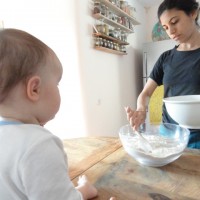
Sari has been coming over to my house a few days a week to help take care of my baby. A few weeks ago she brought a pita bread, one she’d made with her grandmother, in the old Yemenite way. “With one hand, two fingers!” her grandmother insisted. Enjoying a new health food store near my house, I picked up some high-quality, pre-sifted whole wheat flour, and some quick-rise yeast, and Sari taught me the old Yemeni ways.

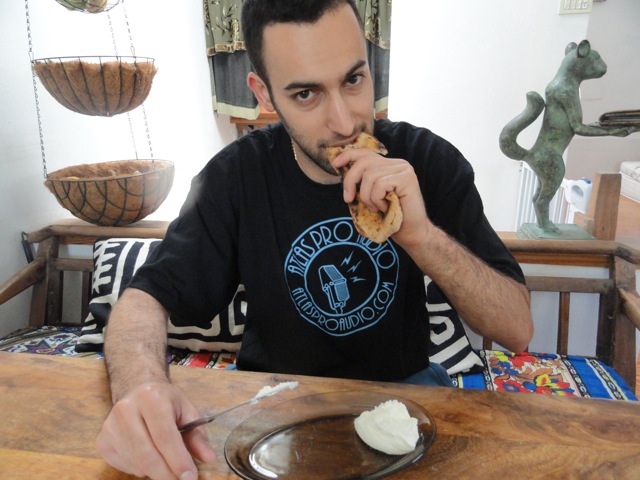
Our first round of pitas were a resounding success, and I gave a bag full to my husband’s band as they were heading for an event in Jerusalem. They are yummy eaten alone, drizzled with olive oil, or wrapped around some goat cheese. For breakfast, I commit an act of sacrilege by eating them with butter.

The method for making whole wheat pita

The trick is not just forming the pita with one hand, two fingers, it’s about maintaining a delicate balance with water. Add too much water and the pita will be hard to form, and too little, they will be hard. Another important piece of equipment is a pita pan. If you live in an Arab country, just ask a local store for a pita pan. See picture below. If you can’t find one, I’ve included a picture if it’s useful, then improvise. The trick is to have intense heat on both sides of the pita at the same time.
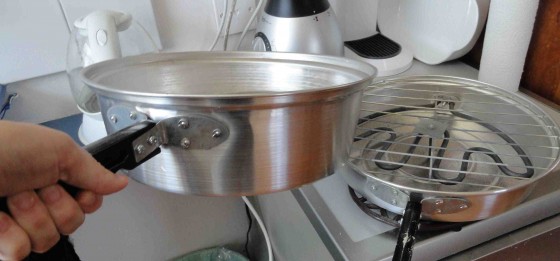
pita baking pan

Handmade, organic Yemenite pita

1 kg pre-sifted whole wheat organic flour (set aside half a cup for the end)
1 tsp salt (or more depending on taste)
1/2 teaspoon sugar
1 tbs olive oil (or more depending on taste)
1 1/2 tsp of yeast
2 cups water

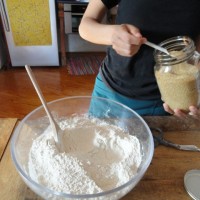
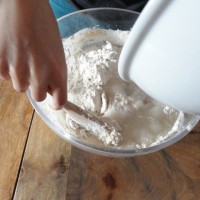
Pour flour into a large bowl. Add dry ingredients. Stir with a wooden spoon.

Add olive oil to 2 cups of water, luke warm, preferably filtered with a Brita or similar device.

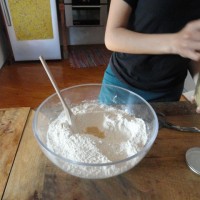
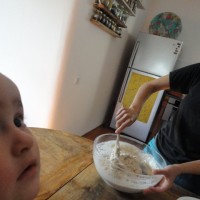
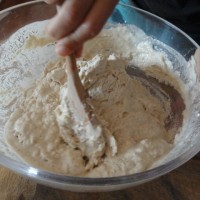
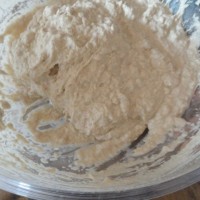
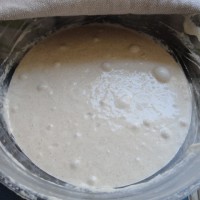
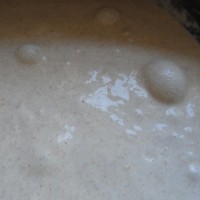
Take wooden spoon and stir while adding water. Dough should be considerably softer than when making regular bread. Firmer than cake dough, but softer than bread dough. About the consistency of cake icing or pizza dough. Later, as it’s rising you should be able to see bubbles on the surface.

Pita bread rising schedule:

Stir all the ingredients together, then set aside for 10 minutes covered with a clean towel. You can sprinkle the surface with a bit of water.

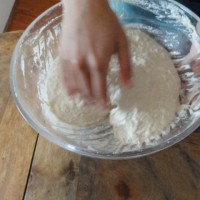
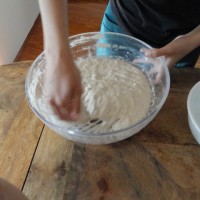
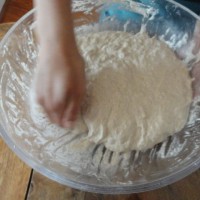
Take one hand, dip it in water, and plunge into the dough along the side of the bowl, and let the dough flop down trapping air. Repeat this for a few minutes, but only add water to prevent your hand from sticking to the dough.

After 10 minutes, repeat.

Let dough sit flat in the bowl and cover with cloth to let rise. After it rises, about 1 to 1.5 hours depending on temperature, fire up your pita pan. Put the stove on to medium high.

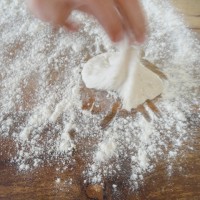
Wet fingers, and take a tangerine size ball of sticky dough and drop it onto a flour surface, preferably a tray to contain the mess. Pull wet dough from the side, and fold it up on top to form a round ball lined on the outer side with flour.

Form it in your hands, or pat the pita down on the surface covered with flour. Quickly drop it onto the pan, and immediately place the lid on top so the element in the lid heats the top side of the pita. Leave for about 1 minute or until you see a bit of smoke.

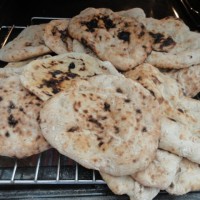
Remove with tongs and repeat. This recipe makes about 20 pita. Be careful about burning yourself though. I’m nursing a nasty burn as we speak.

Enjoy.

More recipes that go well with whole wheat pita:
Recipe for Baba Ghanoush
Recipe for Muhamarra
Tomato Confit Recipe

Fish Farming Isn’t So Evil After All

5

aquaculture, fish farm, UAE, EgyptA new report sheds light on when, where, and how aquaculture is terrible for the environment, and when it’s not so bad.

Aquaculture has a bad environmental rap. Possible negative impacts associated with fish farms include eutrophication or the loss of oxygen in water, greenhouse gas emissions, land occupation, excess energy demand, and biotic depletion stemming from feeding wild fish to farmed fish.

But Blue Frontiers, a recent report co-produced by the WorldFish Center and Conservation International, reveals that not all fish farms are equally destructive and that some farms can even have a positive environmental impact.

Israel’s “Green Queen” Royally Stamps Her Approval on Eco Design Products

2

"upcycled cloth necklace"Royally save resources with Green Queen’s eco friendly design products.

Green Prophet has encountered several green royals over the past few years, between Jordan’s Queen Rania helping organic farmers and lobbying for environmental education, and H.E. Sheikh Abdulaziz Al Nuaimi (aka The Green Sheikh) penning a monthly column for this very site.  But there’s a new eco-royal on the Middle Eastern scene in the form of the “Green Queen” – a new eco design studio in northern Israel started by Revital and Ruth, two former stage designers.  According to these ladies, every object in their studio (including the upcycled cloth necklace above) “has a story, and each item was examined by the Queen personally.  Only when we realize that the object meets our ecological and aesthetic standards does the queen grant her royal eco signal.”