Adults who are 21 or older can carry up to 30 grams. This amount applies to personal use within Pittsburgh’s limits. Carrying more could lead to confiscation or legal action. Staying under the limit avoids problems during any public stop.
In the study, the scientists didn’t just test one plant compound at a time. They tested two traditional Chinese medicine compounds together — luteolin (from flowers like honeysuckle and chrysanthemum) and astragaloside IV (from astragalus root, Huang Qi). These plants have been combined in Chinese herbal formulas for centuries to help the body recover from injury and inflammation.
A new collaboration between luxury brand Coach and textile reuse pioneer Bank & Vogue attempts to stitch those two worlds together: high fashion and the global textile waste stream.
Stepping up to democratize the moon is an EU-funded company, Deep Space Energy, which has just raised more than $1 million USD as a seed fund to help it create energy generators on the moon.
Adults who are 21 or older can carry up to 30 grams. This amount applies to personal use within Pittsburgh’s limits. Carrying more could lead to confiscation or legal action. Staying under the limit avoids problems during any public stop.
In the study, the scientists didn’t just test one plant compound at a time. They tested two traditional Chinese medicine compounds together — luteolin (from flowers like honeysuckle and chrysanthemum) and astragaloside IV (from astragalus root, Huang Qi). These plants have been combined in Chinese herbal formulas for centuries to help the body recover from injury and inflammation.
A new collaboration between luxury brand Coach and textile reuse pioneer Bank & Vogue attempts to stitch those two worlds together: high fashion and the global textile waste stream.
Stepping up to democratize the moon is an EU-funded company, Deep Space Energy, which has just raised more than $1 million USD as a seed fund to help it create energy generators on the moon.
Adults who are 21 or older can carry up to 30 grams. This amount applies to personal use within Pittsburgh’s limits. Carrying more could lead to confiscation or legal action. Staying under the limit avoids problems during any public stop.
In the study, the scientists didn’t just test one plant compound at a time. They tested two traditional Chinese medicine compounds together — luteolin (from flowers like honeysuckle and chrysanthemum) and astragaloside IV (from astragalus root, Huang Qi). These plants have been combined in Chinese herbal formulas for centuries to help the body recover from injury and inflammation.
A new collaboration between luxury brand Coach and textile reuse pioneer Bank & Vogue attempts to stitch those two worlds together: high fashion and the global textile waste stream.
Stepping up to democratize the moon is an EU-funded company, Deep Space Energy, which has just raised more than $1 million USD as a seed fund to help it create energy generators on the moon.
Adults who are 21 or older can carry up to 30 grams. This amount applies to personal use within Pittsburgh’s limits. Carrying more could lead to confiscation or legal action. Staying under the limit avoids problems during any public stop.
In the study, the scientists didn’t just test one plant compound at a time. They tested two traditional Chinese medicine compounds together — luteolin (from flowers like honeysuckle and chrysanthemum) and astragaloside IV (from astragalus root, Huang Qi). These plants have been combined in Chinese herbal formulas for centuries to help the body recover from injury and inflammation.
A new collaboration between luxury brand Coach and textile reuse pioneer Bank & Vogue attempts to stitch those two worlds together: high fashion and the global textile waste stream.
Stepping up to democratize the moon is an EU-funded company, Deep Space Energy, which has just raised more than $1 million USD as a seed fund to help it create energy generators on the moon.
Adults who are 21 or older can carry up to 30 grams. This amount applies to personal use within Pittsburgh’s limits. Carrying more could lead to confiscation or legal action. Staying under the limit avoids problems during any public stop.
In the study, the scientists didn’t just test one plant compound at a time. They tested two traditional Chinese medicine compounds together — luteolin (from flowers like honeysuckle and chrysanthemum) and astragaloside IV (from astragalus root, Huang Qi). These plants have been combined in Chinese herbal formulas for centuries to help the body recover from injury and inflammation.
A new collaboration between luxury brand Coach and textile reuse pioneer Bank & Vogue attempts to stitch those two worlds together: high fashion and the global textile waste stream.
Stepping up to democratize the moon is an EU-funded company, Deep Space Energy, which has just raised more than $1 million USD as a seed fund to help it create energy generators on the moon.
Adults who are 21 or older can carry up to 30 grams. This amount applies to personal use within Pittsburgh’s limits. Carrying more could lead to confiscation or legal action. Staying under the limit avoids problems during any public stop.
In the study, the scientists didn’t just test one plant compound at a time. They tested two traditional Chinese medicine compounds together — luteolin (from flowers like honeysuckle and chrysanthemum) and astragaloside IV (from astragalus root, Huang Qi). These plants have been combined in Chinese herbal formulas for centuries to help the body recover from injury and inflammation.
A new collaboration between luxury brand Coach and textile reuse pioneer Bank & Vogue attempts to stitch those two worlds together: high fashion and the global textile waste stream.
Stepping up to democratize the moon is an EU-funded company, Deep Space Energy, which has just raised more than $1 million USD as a seed fund to help it create energy generators on the moon.
Adults who are 21 or older can carry up to 30 grams. This amount applies to personal use within Pittsburgh’s limits. Carrying more could lead to confiscation or legal action. Staying under the limit avoids problems during any public stop.
In the study, the scientists didn’t just test one plant compound at a time. They tested two traditional Chinese medicine compounds together — luteolin (from flowers like honeysuckle and chrysanthemum) and astragaloside IV (from astragalus root, Huang Qi). These plants have been combined in Chinese herbal formulas for centuries to help the body recover from injury and inflammation.
A new collaboration between luxury brand Coach and textile reuse pioneer Bank & Vogue attempts to stitch those two worlds together: high fashion and the global textile waste stream.
Stepping up to democratize the moon is an EU-funded company, Deep Space Energy, which has just raised more than $1 million USD as a seed fund to help it create energy generators on the moon.
Adults who are 21 or older can carry up to 30 grams. This amount applies to personal use within Pittsburgh’s limits. Carrying more could lead to confiscation or legal action. Staying under the limit avoids problems during any public stop.
In the study, the scientists didn’t just test one plant compound at a time. They tested two traditional Chinese medicine compounds together — luteolin (from flowers like honeysuckle and chrysanthemum) and astragaloside IV (from astragalus root, Huang Qi). These plants have been combined in Chinese herbal formulas for centuries to help the body recover from injury and inflammation.
A new collaboration between luxury brand Coach and textile reuse pioneer Bank & Vogue attempts to stitch those two worlds together: high fashion and the global textile waste stream.
Stepping up to democratize the moon is an EU-funded company, Deep Space Energy, which has just raised more than $1 million USD as a seed fund to help it create energy generators on the moon.
Lewis Strauss, Chairman of the US Atomic Energy Commission said this to a group of science writers in 1954: “Our children will enjoy in their homes electrical energy too cheap to meter…” While this comment is often given as an example of overly-optimistic technological predictions, electricity is incredibly inexpensive. Just look at how much is wasted illuminating the night sky.
Would Strauss have ever imagined that people would be able to afford the energy required to make it snow in Dubai? Or that the hundreds of megawatt-hours used to remove salt from seawater would cost less than fresh water?
World Banks funds new irrigation project for Afghans.
The UN Food and Agriculture Organization is boosting its technical support for rehabilitation of Afghanistan‘s dilapidated traditional irrigation systems, in a bid to help farmers increase crop production. The initiative also aims to improve the knowledge and skills that farmers need to run and maintain irrigation systems.
The UN organization has signed a $27.7 million agreement with the Afghan Ministry of Energy and Water to provide technical assistance, including expertise and training for implementation of the Irrigation Restoration and Development Project (IRDP). This comes after decades of war in Afghanistan and migration away from rural areas have contributed to the degradation and neglect of the country’s irrigation system.
The lack of efficient irrigation facilities has left many farmers without sufficient water for agriculture, including the production of wheat, the country’s main staple food crop. But in recent years, the country’s Ministry of Energy and Water has placed a priority on water resources development within its National Development Strategy.
“The irrigation systems had suffered over the past three decades, not only because of a lack of investment, but also because people were moving away from the rural areas, leaving no one to maintain the systems or transfer indigenous skills to the younger generation. When there was a flood, for instance, there was no one to repair or clean up damaged canals or dams. So farmers in rural areas were not able to get enough water to cultivate their fields. As a result, they produced fewer crops,” said Pasquale Steduto, head of FAO’s Water Development and Management Unit.
The project is primarily funded by a grant from the World Bank with an additional contribution from the Government of Afghanistan. It builds on experience gained from FAO’s implementation of the Bank’s Emergency Irrigation Rehabilitation Project, which was completed in December 2011.
That emergency project strengthened the capacity of the Ministry’s Project Coordination Unit to plan and manage the rehabilitation of irrigation systems. The new six-year restoration and development project plans to follow up by designing and developing small storage dams, in addition to rehabilitating irrigation systems.
It will also complete development of hydro-meteorological networks and services to monitor weather conditions, water flow and water quality issues, and will include training in operation and maintenance of the networks.
Better irrigation, more crops
FAO will help the Ministry of Energy and Water by training personnel and assisting in the use of modern design and management methods. The initiative will also train farmers in improved water management practices, and operation and maintenance of irrigation systems.
The overall project objective is to increase agricultural productivity and production in the project areas, in line with the Afghanistan National Development Strategy.
The rehabilitation of irrigation schemes around the country are expected to cover a total irrigated area of about 300 000 ha, increase irrigated areas by about 15 percent, lead to an increase in the crop yield of around 20 percent, and benefit around 230 000 households.
“Wheat is the most important crop for Afghanistan because for 80-100 percent of the population, it is the number-one staple crop. And roughly 80 percent of the land which farmers cultivated is tilled for wheat. So any reduction in the production of wheat means a shortage of food. It directly affects the food security situation in Afghanistan,” said Steduto.
Cleverly titled “Outside the Box”, Buchler’s design consists of a modular furniture system made of recycled materials. The community center needed a waiting area for parents and kids in between activities, and Buchler designed an arrangement that is low-budget, functional, and stimulates everyone’s creative side.
From food shortages in Syria to green energy in Jordan, this news round-up will help keep you in the know
It’s been busy here at GreenProphet HQ and the stories that have got us talking this week include the wind-powered minesweeper, shocking seal killing revelations as well the upcoming first anniversary of the Fukushima disaster. These major stories may have stolen the limelight but I’ve scoured the internet for interesting tidbits on all the latest green news from the region. This includes a petition for Green energy in Jordan, food shortages in Syria and also the dangers of equating climate change to security- especially in the Middle East. So read on and tell us what stories have caught your eye this week.
You don’t have to have a million-dollar set up to save water. Follow the links to 100+ simple water-saving tips.
Sometimes we believe in short and sweet, and this is one of those times. Below you will find a link to a fantastic resource that provides a wonderful compilation of more than 100 water-saving tips, but that also lists dozens of conservation organizations and government agencies around the world that are trying like mad to cut down water waste.
There is unlimited goodness on wateruseitwisely.com. If you want to learn about recycling grey water, they’ve got you covered. How about tricks that will get you through a drought? They’ve thought of that too. Check out this incredible (but simple) platform if you’re concerned about water issues, and then share it among your friends. Join the campaign. Spread the knowledge.
Libyan sculptor Ali Al-Wakwak has transformed the charred remnants of war into inspiring creations
Around a week ago, Libyans celebrated the first anniversary of the uprising against Muammar Gaddafi. It’s certainly been a turbulent year for Libyans and although the future isn’t as certain as some would hope, thousands took to the streets to celebrate the new start they fought so hard for. Indeed, this chance for more open and democratic Libya is already leading to creative projects. Using bullets, tanks and burnt-out cars collected from abandoned military bases, Libyan sculptor Ali Al-Wakwak is recreating life from the weapons of death.
A host of eco-tourism initiatives in Egypt are moving away from the packaged tour to nature-based experiences
Nature has been developing solutions to its own challenges for the last 3.8 billion years, so two women in Egypt have set up an eco-tourism venture that tunes into that infinite wisdom. Biologists Sara el-Sayed and Betty Khoury decided to start their own business after last year’s revolution made their previous jobs obsolete.
Dayma offers guided journeys to many of Egypt’s less-explored locations and last up to 10 days. But here’s the most interesting aspect of their “everlasting, enduring, or sustainable” tours: instead of trooping with the throng to the same old historical destinations, Dayma focuses on biomimicry – “an alternative manner of development that harmonizes with natural processes.”
Once the region’s climate skeptic, Saudi Arabia is slowly shifting towards a more progressive stance ahead of the climate summit in Qatar
It’s not long now till the climate summit follow up to Durban, is held in Qatar later this year. And in response to the eyes that will be soon focusing on the Middle East, it appears that climate skeptics are being pushed away to the sidelines – if temporarily. In Saudi Arabia, the notoriously climate skeptic Mohammed Al-Sabban has been replaced by the well-respected Khalid Abuleif as the leading voice at the climate negotiations for the country. Kelly Rigg at HuffPost argues that this and a recent speech by the oil minister shows that Saudi may finally be prepared to play “a more progressive and less obstructionist role in the negotiations.”
South Africa, among the biggest emitters of greenhouse gases worldwide, plans to introduce its own price on carbon next year.
The Treasury said this week that South Africa, which is the continent’s biggest polluter, plans to introduce a carbon tax on annual emissions for all the industrial sectors responsible for greenhouse gas emissions, including electricity, petroleum, iron, steel and aluminium, to reduce greenhouse gases.
The Fukushima disaster forced 150,000 people to flee their homes – a year later, radioactive contamination is still keeping them away
In the lead up to the first anniversary of the Fukushima nuclear accident, Greenpeace have published a report looking back at the incident. As well as documenting the legacy of the nuclear disaster, they insist that now is the time to demand a renewable and nuclear-free future.
With various countries in the Middle East considering the nuclear option, I think its important that we look carefully at the impact and implications of the nuclear accident in Fukushima. Jordan, for example, has plans to build a 1,000 megawatt (MW) nuclear reactor by the end of the next decade and Israel insists it has mastered how to build a ‘safe nuclear reactor’ in the desert. In fact, Greenpeace campaigners in Jordan are planning a protest against their government’s nuclear plans to coincide with the Fukushima anniversary this March.
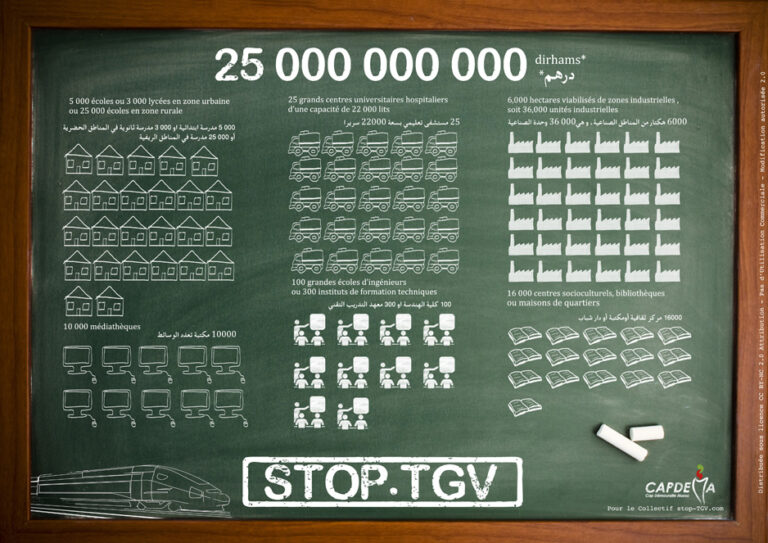
This graphic shows other ways to spend the $2.4 billion planned for what critics call Morocco’s luxury high speed rail project
A group of Moroccan Non-Government Organizations have launched the Stop TGV campaign in protest of Morocco’s $2.4 billion high speed rail project. The TGV line is expected to link up Casablanca with Tangiers by the end of 2015, reducing travel time from 5h45 to 2h10. Proponents of the project say that it will boost the economy, improve tourism traffic, and have a trickle down effect through improved infrastructure and job creation, but critics claim that high speed rail is a luxury that Morocco can ill-afford.
IKEA Israel’s Blue-Yellow buildings also have a green policy
IKEA’s blue and yellow store motifs have become familiar to households all over the world, including the Middle East with stores in Israel, Kuwait, Saudi Arabia and the UAE. IKEA’s Israel stores have been serving the public since 2001, and have introduced environmental policies into both the products it sells there, such as ceasing to sell incandescent light bulbs. These environmental friendly policies also hold true in regards to the bags used to carry purchased items home as IKEA stores in many countries, including Israel, now do not give plastic bags to customers in a policy to not only save money but be more green as well.
This lovely prefabricated LoftCube home is perched on a pretty piece of land just north of Beirut in Lebanon
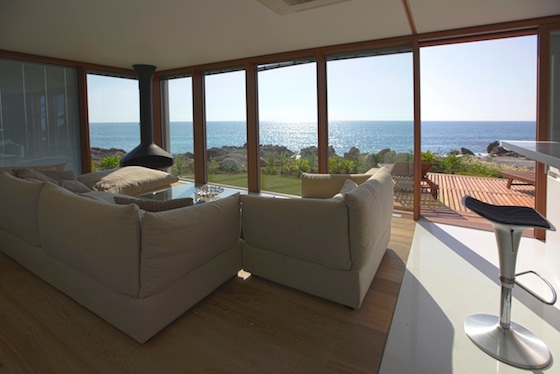
Nearly a decade ago Werner Aisslinger aspired to design a temporary, minimalist domicile that would suit the nomadic lifestyle while still retaining all of the aesthetics that contemporary society seeks. Voila! the 420 square foot LoftCube was born. Since 2004, the ultimate home for nomads has popped up in gardens and on rooftops all over the world: in Spain, Belgium, Canada, and now in Lebanon. Mark Doumet’s sleek home has 360 degree views of the Mediterranean Sea and is installed just a short ride north of Beirut. And as the country’s official LoftCube distributor, he encourages visitors.
Prefab construction has become increasingly popular in the last decade or so.
By manufacturing modular pieces in the factory and then transporting the intact structure to its destination site, designers significantly reduce waste materials and also cut down on carbon emissions associated with shipping.
The LoftCube can be transported in either two truck loads or in two shipping containers. It is wrapped in glazing that permit all kinds of light and ventilation and most of the interior is finished in Corian to create a breezy, comfortable home.
Heating and cooling systems can be customized in accordance with each buyer’s eco-ethos, and the facades and finishes are also flexible.
LoftCubes are exceptionally mobile; homeowners whose jobs require them to change their location – as often happens in the 21st century – can easily dismantle their home and move elsewhere. It goes up in 5 to 7 days and comes down in 1 to 2 days.
But they aren’t cheap. Unlike earth bag homes, which can be constructed for under $5,000, these can cost from 40,000 and 80,000 EURO, depending on the distance between the buyer and the factory. Now that AirBnBs are a thing, we bet they’d be a tad more resilient to Lebanese winters than a geodesic dome tent.
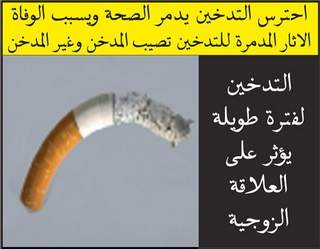
Translated from a poster in Jordan: “Smoking for a long period of time affects marital relations.”
I’m not “blowing smoke” when I rave about Amman. No need, because Amman generates enough smoke on its own. This city rivals onions in making eyes water. Blame diesel fuel. Trucks, cars, buses blast chewy plumes of black exhaust. Heavy equipment on uncontrolled worksites add to the smog. Now introduce the smokers of cigarettes, cigars and arghileh.
Smoking’s entrenched in Arab culture. (My doctor lit up during our consult.) Cabbies puff with abandon, businessmen chainsmoke through meetings. Tobacco’s cheap in Jordan, a virtual give-away. A pack of smokes costs under 3 bucks (compared to $8 in NYC, $12 in Dublin). Hookah – or hubbly-bubbly – is an essential part of Ammanian café culture; patrons flock to restaurants offering unique settings for enjoying the pipe. Arghileh is on most menus.
In 2005, Jordan and Egypt ratified the World Health Organization (WHO) Framework Convention on Tobacco Control, a treaty aimed at nipping tobacco use . Follow-on action has been at a slow drag. Jordan’s Public Health Law incorporated anti-smoking controls in 2008, but enforcement didn’t start until 2009. Smoking was banned in fast-food restaurants in 2010, but other businesses in the public realm were given a grace period to adapt. Smoking is now taboo in all public areas. Airport terminals in Cairo and Amman are no-smo-zones: but smoke rings their entry points (drivers, passengers, meeters and greeters cluster outside to light up).
Every year in Namibia, 86,000 Cape Fur Seal pups are butchered to death and only one man has the contract to turn their fur into so-called fashionable apparel. We had pictures of what’s going on but Google banned the page for it being too graphic.
The Turkish and Australian based company Hatem Yavuz named after the owner Hatem Yavuz controls roughly 60 percent of the world’s seal market and processes 130,000 seal pelts every year in his Istanbul factory. Yavuz also has a hand in the Canadian seal market and claims to be proud of what he does. In an interview that spurred a flurry of hate mail, Yavuz told 7 News in Australia that “it’s a job. If I don’t do it, someone else is going to do it.” He is called the King of Seal Killers.
Green Prophet recently caught up with Pat Dickens, founder of the Seals of Nam, a non-profit organization that has been campaigning to end Namibia’s annual seal cull on the Cape Cross Seal Reserve. A popular tourist attraction, every year between July and November the sands of the reserve are stained pink from the blood of seal pups as young as seven months old.
Men with clubs and picks enter the seal colony early in the morning. The traumatized animals squeal and run away, often regurgitating their mother’s milk in terror. Their skulls are crushed and their throats slit. Several reports show that blows to their head often only render the animals unconscious.
These remains are cleaned up before tourists show up in what is a heavily regulated area.
Dickens has gone through all of the appropriate channels to appeal to the Namibian government to cancel its contract with Yavuz, which is valid until 2019, as it stands in direct contravention to the Animal Protection Act of 1962 that makes it unlawful to “overload, overdrive, override, ill-treat, neglect, infuriate, torture or maim or cruelly beat, kick, goad or terrify any animal.”
He appealed to the Namibian ombudsman Adv. John Walters, which speech has since been followed up with a series of delay tactics. Several animal rights organizations have become involved and Jane Goodall and other celebrities have made public statements against this terrible practice.
Meanwhile, the Humane Society released a report which shows that the so-called seal-culling industry, which only employs 81 people in Namibia, benefits the Namibian economy 300 times less than live seals and eco-tourism would.
Since The Seals of Nam have not made progress “the nice way”, they have elevated the stakes of their campaign.
The activist organization recently sent a formal appeal to the world’s largest tourism fair taking place in early March, ITB Berlin, to bar Namibia’s attendance, and a series of other public protests will take place throughout the world in order to increase awareness of what has become the world’s largest seal harvest.
They have also called for a boycott of all major industries that contribute to Namibia’s Gross Domestic Product (GDP) including Namibia Breweries, De Beers, and Namibia Air.
Dickens, who quit a lucrative corporate career, sold his bike, and cashed in his pension to protect Namibia’s seals from the likes of Yavuz, told Green Prophet that the Wildlife Defense Society (WDS Namibia) recently announced their official support of the boycott, despite the enormous fiscal ramifications it could have for their own country.
Bloody Money from seals
But the odds are stacked against the seals since the King of Seal Killers makes a lucrative living from his business. One seal fur coat sells for Aus $30,000 – “enough to buy a car,” he boasted in an interview with 7 News.
Yavuz is from Turkey but Cape Fur Seals are listed as a UN-CITES Endangered Appendix II species and the United States, Mexico, the European Union, and Russia have subsequently banned all seal products in protest.