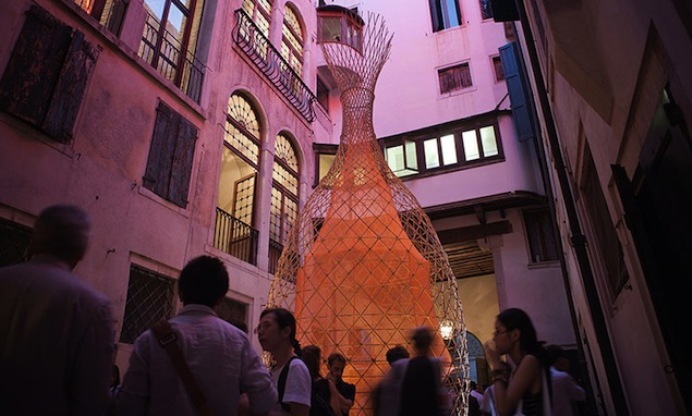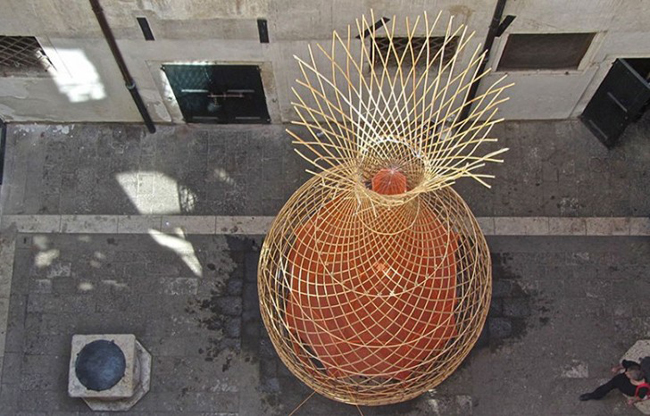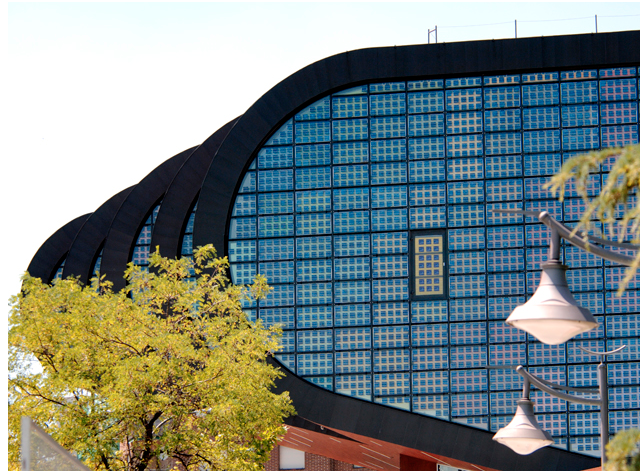
Nearly half a decade after his famous Habitat ’67, architect Moshe Safdie is still going strong. Born in Israel, Safdie strives to incorporate sustainability in his firm’s designs, but Project Jewel may be his most flamboyant effort yet. Hit the jump to learn more about this interesting airport development in Singapore.
Project Jewel: Moshe Safdie designs a massive indoor bio-dome for Singapore
Tentsile tents are suspended tree houses you can carry anywhere

Here is a kind of happiness comes in the form of a treehouse you can take anywhere!
Originally invented in 2010 by Alex Shirley-Smith, the first tentsile treehouse tent exploded on the internet to such an extent that Shirley-Smith hired a new designer to work on several prototypes in 2012. Kirk Kirchev came up with the current design, which can be suspended four feet above the ground as long as there are three points at which the tent can be anchored.

Like a regular multi-person tent that can be packed up in a small bag and carried around, the tentsile offers ultimate portability.
Related: Collapsible refugee tents powered by the sun
But it’s different in that it offers a vantage point that most people won’t find in a regular tent, one that lends itself to thoughtful reflection, but also spares those who might be concerned about insects and snakes and other wildlife encounters.

Of course, anyone with fear of heights might not love this design, and there’s always the question – how the heck do you get in the tent? See this video for a rough guide to pitching a suspended tent. Also, note the company warns people not to exceed the maximum load of 880 pounds.
The $599 two person “portable treehouse tent” comes in a variety of colors and with a removable fly sheet. In addition to providing shelter for two, it can connect with other Tentsile Connect tents to create a “super camp” of three or more tents – like a communal treehouse gathering.
Tents can be shipped around the world for $70, so unlike so many of these neat designs, it should be available to people living in the Middle East and North Africa as well
Update: if you want a discount on a Tentsile tent use the code GREENPROPHET for 5% off your entire purchase.
:: Tentsile
Sunscreen isn’t enough against skin cancer – new research

So you’ve made a batch of Green Prophet’s homemade organic sunscreen. And you’ve waxed your legs or chest hairs with our Arabian sugar wax. But home remedies are not enough to stave off bigger problems like skin cancer.
San Francisco’s plastic ban sends seismic wave around the world
Look West, Middle East – for a failsafe way to ween off one-use plastic bottles! Banning plastics is the best first step to eliminating this poisonous prodrome of modern civilization.
Last March, the San Francisco Board of Supervisors voted unanimously to pass a bottle-banning ordinance – quickly signed into law by Mayor Edwin M. Lee – prohibiting the sale of plastic water bottles on public property throughout this seismically-active city. The ban goes into effect in October 2014, the first of its kind in America: will it resonate around the world as a model in dealing with municipal waste?
“Where we have public spaces, in buildings, parks and other open space—these are places that we don’t want the sale or distribution of plastic water bottles,” said city official David Chiu who introduced the ordinance last year.
“San Francisco might have done it just a little bit to make every other American city look even worse,” wrote Eve Andrews in Grist.
Most US cities do pale against ‘Frisco. Did you know that television, Chinese fortune cookies and Irish Coffee were all invented in in the “City by the Bay”? Levi Strauss sewed the first pair of blue jeans there (1873). It’s the birthplace of the world’s first cable car (same year) – and the first public transit system run solely by electricity (1874). It’s where the United Nations was founded (1945), and its Human Rights Commission – formed in 1964 – has been at the forefront of the American civil rights movement. And San Francisco Bay is the largest estuary on America’s Pacific Coast.
That last fact in large part underpins the city’s environmental activism – and civic action. This bottle ban resulted from ten years of grassroots organizing. Residents will be encouraged to use reusable bottles, which will lower demand for waste collection and recycling, saving the city money and reducing strain on landfills. It also chokes the growing feed-stock of plastic pollution, and slowly re-educates the public on smarter ways to re-hydrate.
Twenty-five years ago, this topic was not even on the table. People drank from public water taps, flowing with free, safe, city water. While most major cities in America and Europe did offer public drinking fountains, maintenance of these systems has long been abandoned as people moved to purchased water. Moving back to that model reclaims the commons of water from corporate control – water is a resource that belongs to all of us.
It’s unlikely that the water-starved nations in the Middle East will invest in permanent public drinking fountains, but there are portable alternatives that serve the same purpose. The video below, created by Center for a New American Dream, explains the new law and shows one such water station in action.
[youtube]http://youtu.be/X2ZsAWspxng[/youtube]
Does your zip code lack the political resolve to ban plastic bottles outright? Individual action is simple and also effective. Use reusables. Because weening ourselves off one-off water bottles will afford the same ecological, fiscal and health benefits that San Francisco will be enjoying.
It’s a common sense approach that needs to be expanded to all plastic bottles, regardless of their contents.
NOMADD robots clean Saudi solar panels without using a drop of water
Saudi Arabia is a desert country with no freshwater resources. Every day the Saline Water Conversion Corporation (SWCC) produces more than three million cubic meters a day of potable water, which requires a great deal of precious energy, so every drop must be conserved. Cue NOMADD.
Dubai’s new air conditioned city to woo the wealthy elite
Sheikh Zayed Road in Dubai will soon play host to the world’s largest shopping mall – the gargantuan Mall of the World. Comprised of 48 million square feet of over-the-top retail, residential, and even medical services, the covered pedestrian city is expected to attract some 180 million visitors a year. I shudder at the thought.
“Smart herb garden” by Click & Grow will make you dumb
I get that a lot of people don’t have any experience growing food and that city people might not have garden space, but so called high tech gardening has gone one step too far with Click & Grow’s exorbitantly expensive “smart herb garden.”
Saving 3,000 year-old dates from Siwa Oasis in Egypt
The people of Siwa Oasis have been growing dates for 3,000 years. And while they cultivate many varieties, three that are native to the desert community are close to extinction. Don’t worry too much, though, because the Siwa Community Development Environmental Conservation (SCDEC) group is working to save them.
Hydroponic home box grows fresh food at home on water
The team behind Living Green just won $20,000 to further develop LivingBox, an off-grid, modular system of growing food in urban spaces – without soil!
The Israeli company entered their concept into the Pears Challenge, which targets entrepreneurs that are developing solutions that can be applied in developing countries.
The Challenge welcomes submissions that address health, education, agriculture, water, ICT, and clean energy.
In this case, Living Green develops food growing systems that are affordable, can be implemented at home or scaled up for commercial farmers, and perhaps best of all, once they are set up, they are completely self-sustaining. This means they require zero electricity, soil or water to maintain.
There are three different kinds of LivingBoxes — one that relies on aquaponics, a closed loop system that uses fish waste to provide the nitrogen necessary for plants to grow, hydroponics, growing food in water, and a biogas system that – quite simply – uses food waste to produce organic, healthy fertilizer.
Related: Bulldozers raze ancient urban farm in Turkey
As far as we can tell, Living Boxes can be scaled up and down using any combination of the three techniques. They are delivered in one box, which is comprised of an array of smaller boxes, and are incredibly easy to use.

“The Livingbox is the perfect system, because it lets anyone anywhere grow vegetables without the need for fertile soil, or running water and electricity, and with minimal farming skills,” said company co-founder Nitzan Solan.
“It could help feed people in the developing world, providing them with access to fresh, nutritious food, while helping them maintain a clean environment.”
Once users receive their boxes, they merely add water and seeds, and the relatively low-tech system essentially takes care of itself from there.
Noting that 70 percent of the global population are expected live in urban environments by 2050, Living Green proposes their system as an affordable means to grow nutritious food at home that will bolster people’s health and make them more resilient against disease.
The Pears Challenge is a collaborative competition hosted by the international Pears Foundation and Tel Aviv University.
My chickens and the Tyrant
“Out,” she said.
That was my cue to start chicken chasing.
Though I wasn’t cast as an extra for the show, currently filming its first season in Israel, I couldn’t help but feel like I was an extra in my own private movie as my friend Ofer and I tried to corral my five hens and one rooster toward their coop. On Sunday when they were preparing the house, the production crew chief had said, ‘Chickens, yes; dogs, no.’ But the director ruled otherwise.
So there we were, chasing chickens with no interest to return to their coop. Ofer had ulterior motives, as he was hoping to steer one under the legs of the Israeli beauty Moran Atias, who has also appeared in Crash and Mother of Tears.
The setting was supposed to look like the home and yard of an Arab sheikh, and in Jaffa, this made sense –– home to a 50/50 split of Arabs and Jews. Many of the homes here still look authentic, as does ours built in the Ottoman period about one hundred years ago.
As Ofer chased chickens in one direction, I was thinking about the male lead, Adam Rayner (playing the role of Barry Al Fayeed), and wouldn’t have minded if the rooster ran toward his legs, which at that point were relaxing in a plastic chair beside the director on my stoop.
The TV series portrays the life of an American family caught up in the Middle East conflict. That’s about all I got from Wikipedia and a trailer. When a film crew comes to your home, it’s pretty much on a need-to-know basis.
Dig, another American TV series about archeology, is also filming in Israel. Tyrant normally films at studios in Kfar Saba. On this last day in June around 3pm, the yard was full of people, mostly extras — about 75 men and women dressed in traditional Arab gear and speaking mainly Arabic. It looked like they had been hired from the mosque around the corner.
The executive staff was all American, it appeared, as English was the main language on the set.
We got a kick out of this one: There were also two extra “hairy” males in vested galabiyas holding machine guns inside our front gate. My husband, the perennial comedian, urged me to take a photo. Not because he cared about TV or getting close to fame but because he wanted these pictures for future use. On a day-to-day basis, our home houses a non-profit organization that gives a stage to world music. We normally see more musicians than machine guns. “No one has to know they were part of a set,” he joked.
About a third of the bodies moving between takes were Israelis, brought on through a local production company. Filming movies and TV in Israel clearly has a positive effect on the economy. And for a culture that normally doesn’t live by the clock, this crew ran like a Swiss train schedule. Each played a very specific part.
But they had no idea how to move chickens.
One had tried enticing them with seeds that we give them for breakfast. Another tried clucking. Mainly though, the crew and some actors were caught taking selfies with the chickens.
With a camera boom coming down in full swing toward me, preparing for the next shot, I gave up chicken chasing. But as I went inside, leaving Ofer behind for his magic moment with Moran, I managed to find a spot on the stairs to walk by Rayner, who lifted his leg for me to pass.
Blushing like a Beatles fan from the ’60s, I told my husband about how dashing this man looked.
“Go back out, catch one of those chickens, stand in front of him and ask him how he likes it cooked,” was his reply.
And I actually considered doing it.
As a former foreigner to this country, I still have a lot to learn about Israeli chutzpah. But you’ll see some of it on Tyrant, which was set to debut on the FX Network June 24.
And watch for my chickens!
Superadobe earthen dome homes for Palestinians
Working with NASA as part of an initiative to design homes fit for space, Iranian architect Nader Khalili conceived the dome home as an affordable, accessible, easy to build, and environmentally sensible housing solution. Now it’s being applied in the West Bank.
One of our close friends apprenticed with Nader Khalili in California. Fleeing Iran, he first presented his Superadobe construction method, which involves stuffing bags full of readily available dirt and then stacking them in a circular form. The bags are held together with barbed wire, and then covered with lime plaster. Any holes are filled in with grout.
The resulting homes are so well-insulated, no air-conditioning is necessary in summer, and in winter, the thick walls retain enough heat to keep the interior space comfortably warm. Much like strawbale homes, pioneered by Bill and Athena Steen in Canelo, Arizona. We visited them in the early 2000s. Read the story of Canelo here.
In 1991, Khalili founded the California Institute of Earth Art and Architecture (Cal-Earth), which continues to provide workshops and empower people around the world with these low impact structures. Superadobe technology, a kind of low-tech technology, was designed and developed by architect Nader Khalili and Cal-Earth Institute, and engineered by P.J. Vittore.
Related: Nader-Khalili resort in Oman wins big accolades
For SharmsArd, the young Palestinian firm that Ahmad Daoud commissioned to build his home in Jericho, building with Earth was an obvious choice that allows them to feel empowered in the context of the nation’s ongoing struggle against Israel’s increasingly aggressive behavior in the West Bank and Gaza.
One of the firm’s partners, Danna Massad, expresses their collective desire to operate independently of the foreign aid that so many Palestinians have to rely on to make any kind of respectable living in Palestine. I think the Palestinian society is oversaturated with international aid,” she tells NPR’s Emily Harris.
“Of course, we’re not the only example of a local business that refuses any kind of aid, but we can see how excited people get … to see how you can actually do something without being dependent.”
Despite some skepticism from his community, Daoud is chuffed with his new home.
“It’s an environmentally friendly house,” he told NPR. “I can tear it down and nothing will remain. In the summer, I don’t need air conditioning, and in the winter, I don’t need heat.”
Photos of the construction process taken from SharmsArd Facebook Page which has not been updated since 2020. As of October, 2023 their website page has not been working.
Turkey subsidizes solar donkeys for shepherds
Just when you think you’ve seen it all, a story pops up about donkeys in Turkey that carry solar panels so that shepherds, who are often out in the field alone for days at a time, have enough energy to power their laptops.
Vertical gardens in Lebanon based on traditional Arabia designs
Green walls and rooftop gardens are great, but keeping them healthy in the Middle East and North Africa can be challenging. Green Studios, whose work in Lebanon we’ve featured once before, has an answer with their patented technology that ensures plants can flourish despite the extraordinary heat in our region.
“We wanted to develop something that is applicable to super-hot [climates],” says Jamil Corbani, cofounder and CEO of Green Studios.” And in order to do this, they beefed up standard hydroponic growing techniques (that require no soil, and just a mineral nutrient solution to feed the greens) with smart technology that monitors plant health.
Their green walls are comprised of several layers of ‘skin’, the core of which comprises the irrigation network. Each skin has its own function, that – equipped with a series of sensors and nano-sensors – monitor and respond to the surrounding environment. Data collected by the sensors will be sent to an electrical board, and if the temperature and humidity skyrocket and the plants need some love, that board will signal pumps to go off.
The custom-built sensors monitor humidity, temperature, acidity, and electro conductivity of plants.
Founded by a small group, which consists of an architect, a landscape architect, landscape engineer and an economist, Green Studios now has 13 employees and have been commissioned to do no fewer than 30 patent-protected installations – in the Middle East and elsewhere.
According to Executive Magazine, the group is gearing up to install the largest green wall in the region – for Raouche 1090 – a massive residential development in Beirut.
So why do we care about green walls? For a lot of reasons. Decorative green walls can help improve air quality by absorbing carbon dioxide emissions and then expel oxygen that humans require to breathe. They also provide a heat sink, which is particularly important in the Middle East where ambient temperatures are really high.
But if Green Studios decides to start implementing food crops in their green walls, then we’re really talking business – since productive vertical gardens in urban environments could help to offset growing food insecurity.
The company is heading to the United States later this year in order to expand their horizons.
“We are going to look at other players, what are they doing, get a feel of the market, and exhibit as well, who we are, what do we do, what is our philosophy, what is our product, and our patent,” Corbani told the magazine.
Hopefully they won’t stray too far from the Middle East. We need them here!
Sunken trails create healing pilgrimage to bloody Gallipoli Campaign in Turkey
At least 124,000 people were killed in the bloody eight month Gallipoli Campaign. Also called the Dardanelles Campaign, it was considered to be the Ottomans’ final push against the Allied forces. ONZ Architects and friends commemorate this collective wound with a breathtaking series of sunken trails on the Gallipoli peninsula.