
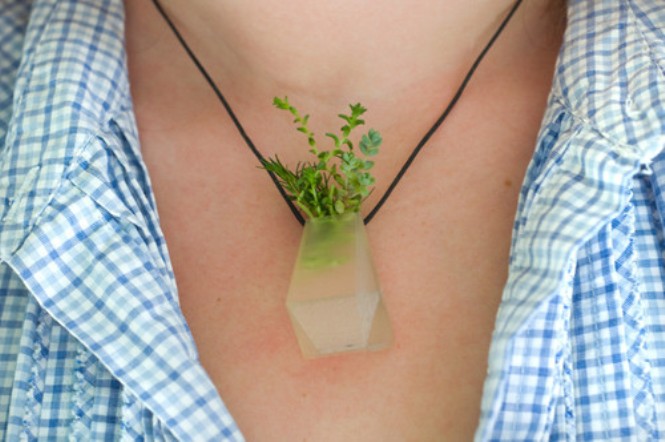
Wearable Planter is an art and design studio based in Atlanta, Georgia where owner Colleen Jordan creates tiny vases that blur the line between housewares and accessories. The geometric 3D-printed vessels (a/k/a “jewelry for green thumbs”) are water-resistant. Plant one with a bonsai-sized succulent or lilliputian flower arrangement and celebrate spring with a live plant in your pocket!
 Jordan explains on her website, “We believe that the world would be a happier place if people appreciated nature a little more, and were willing to carry a plant close to their heart from time to time.” You said it, sister.
The colorful containers prompt smiles. They are made from nylon fiber and dyed in Easter-egg colors, then sealed with acrylic varnish. The planters are available as pendants, rings, brooches and clip-on vases – perfect for tagging your bike handles or baby stroller.
Most feature a flat bottom so they can sit on a tabletop when not being worn. Prices hover around $30, but there are other items besides the 3D-printed vases – such as seed-bomb kits – that don’t break a ten-dollar bill. The business started in 2011 and has a continually evolving product line.
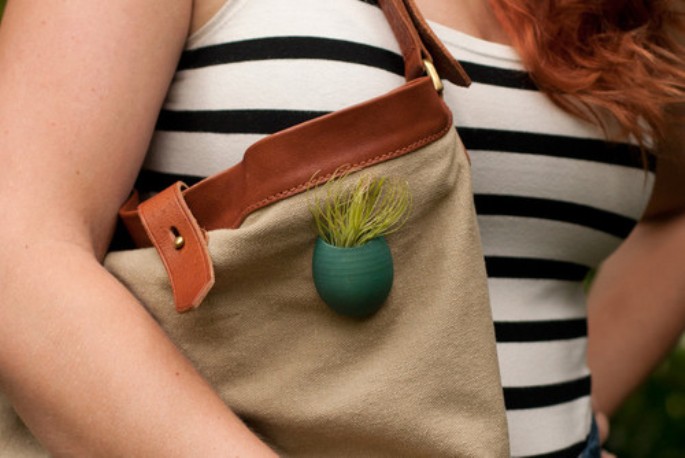 Three-dimensional printing allows Jordan to create more complex forms than older manufacturing techniques had allowed. The process minimizes waste, centralizes design and production, and reduces inventory as items are made on demand – all of which reduces the start-up’s environmental impact.
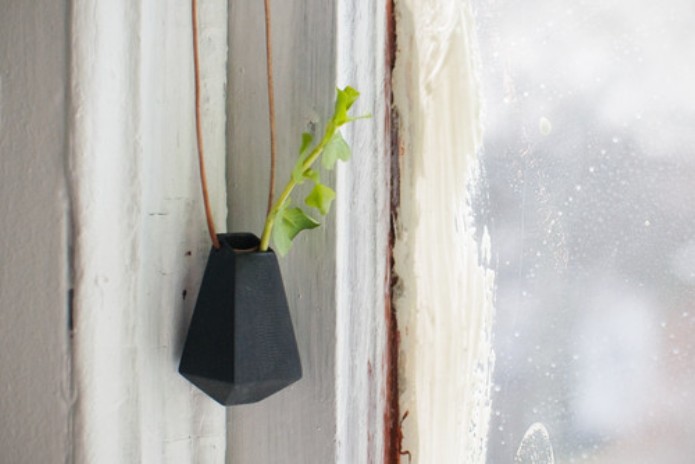
The vases can be sent anywhere, but postal regulations prohibit shipping plants through the mail. Customers who happen to be in Atlanta can stop by the studio and pick up a plant to pop in their planters. Everyone else can visit their website to learn how to plant their own – with clear directions for working with cut succulents, air plants, and cut flowers. There are also excellent how-to guides on making your own seed bombs, growing food on a windowsill, creating a terrarium in a light bulb – and general info on playing in dirt.

 The population at Jordan’s
 There’s a new toy on the shelf that’s been whipping up online comments that accuse its maker of radically







 Seven designers teamed up on a project to transform
 Vive la France! The country recently passed legislation that requires rooftops on all new commercial buildings to be at least partly




 Dubai has taken a giant step forward in greening up the city with its decision to move away from ordinary Portland cement (OPC) for all new buildings. As of April 1, OPC use is limited across the emirate; building permissions are reliant on developers specifying eco-friendly Supplementary Cementing Materials (SCMs). The new requirement aims to give residents a clean and pollution-free environment.








 Travel to the Middle East has never been a better deal than now – in terms of economics (deep-discounted hotels and holiday packages), weather (
 Finding greener ways to bury our dead is nothing new. In both Judaism and Islam, people are



 IKEA and UNHCR (the United Nations High Commission for Refugees) emerged from